
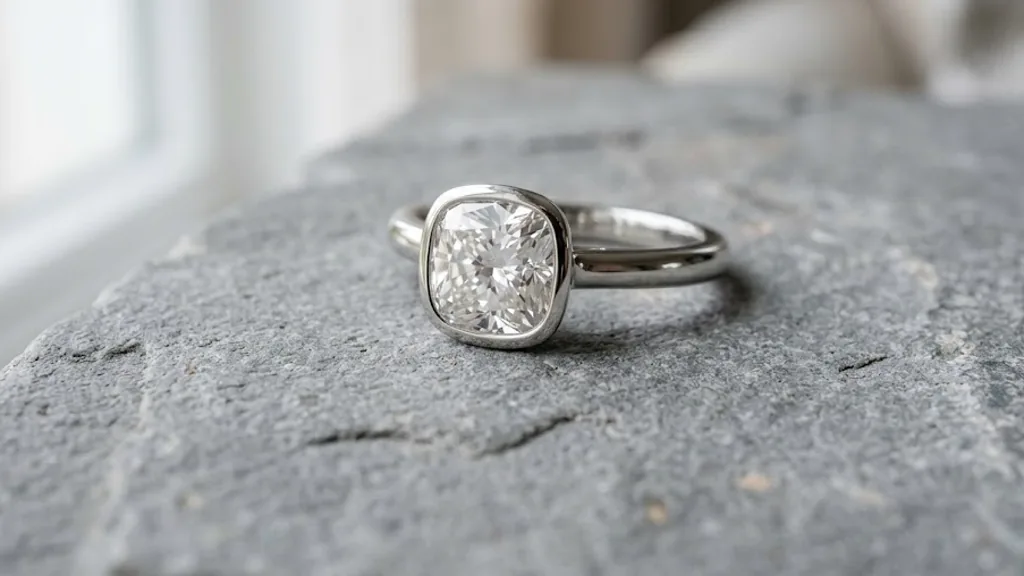
Do Elongated Cushion Cuts Look Bigger? And Where to Buy One
Elongated cushions do look larger on the finger. Here is why, what ratio to look for, the trade-offs, and how to buy one in the UK.
Yes — at the same carat weight, an elongated cushion usually looks bigger on the finger than a square one. Not because it is bigger, but because of how the eye reads a long shape against a finger. That is worth understanding properly before you pay for it, because the effect is real but it is not free.
Here is what “elongated” actually means, how much difference it makes, what it costs you, and where you can buy one in the UK.
What makes a cushion “elongated”
Every fancy-shaped diamond has a length-to-width ratio. Divide the length by the width and you get a single number that describes the outline.
| Length-to-width ratio | How it reads | Common name |
|---|---|---|
| 1.00 – 1.05 | Square, soft pillow corners | Square cushion / cushion square |
| 1.06 – 1.14 | Very slightly long — most people cannot see it | Slightly elongated |
| 1.15 – 1.25 | Clearly rectangular, still soft | Elongated cushion |
| 1.26 – 1.40 | Strongly rectangular, close to a soft radiant | Long elongated cushion |
Most buyers who say they want an elongated cushion are after something between 1.15 and 1.30. Below 1.10 the effect is so subtle that you are paying for a description rather than a look.
Why elongated shapes look larger
Two reasons, and both are honest.
First, surface area for the weight. A cushion carries a fair amount of its weight below the girdle, in the depth. Stretching the outline spreads more of that weight across the top of the stone, so a well-cut elongated cushion often has a larger face-up surface than a square cushion of the same carat weight. Not dramatically larger — but measurably.
Second, and more powerfully, the way a long shape sits on a finger. A finger is a narrow column. A stone that runs along it, rather than across it, covers more of the visible length and makes the finger itself look slimmer and longer. This is the same reason ovals, pears and marquises all “wear big”. It is a visual effect, not a measurement — but customers notice it immediately when they try both on.
You will see websites claiming elongated cushions look “up to 15 per cent bigger” or similar. We are not going to repeat a figure like that, because no one has published a measured study behind it. What we can tell you accurately is that the surface-area difference is modest and the finger-length effect is the part people actually respond to.
The trade-offs nobody mentions
Elongated cushions are not automatically better. Three genuine downsides:
- Bow-tie. Long brilliant-cut shapes can show a dark band across the middle where light is blocked by your own head as you look down. Cushions show it less than ovals or marquises, but it is present in some stones. It cannot be seen on a certificate — you have to look at the actual diamond.
- Availability and price. Elongated cushions are cut less often than square ones. Rarer shapes at good proportions command a small premium and are harder to source in a specific size and grade.
- The corners. Stretching the outline makes the two narrow ends slightly more exposed. A setting that protects the corners matters more here than on a square cushion.
Elongated cushion versus other long shapes
If the goal is “makes my finger look longer”, a cushion is not your only option, and it is worth being honest about that.
| Shape | Character | Typical ratio for a long look |
|---|---|---|
| Elongated cushion | Soft, romantic, crushed-ice or chunky sparkle | 1.15 – 1.30 |
| Oval | Smoother outline, very popular, prone to bow-tie | 1.35 – 1.50 |
| Radiant | Sharp cropped corners, very lively | 1.20 – 1.40 |
| Emerald | Step cut, glassy flashes, no crushed ice | 1.30 – 1.50 |
| Marquise | Most finger-lengthening of all, pointed ends | 1.85 – 2.00 |
A cushion gives you the elongation with softness. A radiant gives you the elongation with edge. An emerald gives you the elongation with calm. Try all three before you decide — they look far more different in person than in photographs.
Where to buy an elongated cushion cut diamond in the UK
Being straight with you: we hold three cushion designs at the moment, and we do not list them by length-to-width ratio, so we would not want to sell you a square cushion as an elongated one. If a specific ratio is what you want, the right route with us is a bespoke commission — and we charge no extra design fee for it. You tell us the ratio, carat weight and setting, we source the stone with its IGI certificate, and we hand-make the ring in solid gold or platinum.
Whether you buy from us or elsewhere, ask for these four things before you pay:
- The exact measurements in millimetres, not just the carat weight — you want the length and the width so you can calculate the ratio yourself.
- An independent certificate (IGI or GIA) for the centre stone. We include IGI free on every centre stone.
- A video of the actual stone, moving, under normal light — not a stock photo. This is how you spot a bow-tie.
- A clear returns period. Ours is 30 days, with free insured UK delivery both ways.
If you want to see and handle our current cushion pieces first, start with the Bezel Cushion Cut Engagement Ring in Platinum at £904 at the time of writing — the bezel is the setting we would recommend for any elongated cushion, because it wraps and protects the narrow ends. The Three Stone Cushion Cut Engagement Ring at £957 at the time of writing is another useful one to try on, because three stones in a row create a long line across the finger and give you a feel for the effect elongation produces.
The full cushion cut collection is here, and if you decide a different long shape suits you better, the radiant cut pieces are the closest relative.
Frequently asked questions
Do elongated cushion cuts look bigger than square cushions?
At the same carat weight, generally yes. They spread slightly more weight across the top of the stone, and a long outline covers more of the finger, which reads as larger. The effect is noticeable in person and modest on paper.
What length-to-width ratio should I look for?
Between 1.15 and 1.30 for a clearly elongated look that still keeps the soft cushion character. Under 1.10 and most people will not see the difference.
Are elongated cushions more expensive?
Usually a little, because they are cut less often and are harder to source at good proportions. The difference is driven by availability rather than by any inherent quality advantage. This is guidance, not a fixed rate, and it applies to both lab-grown and natural stones.
Do elongated cushions have a bow-tie?
Some do. It is less common and less severe than in ovals or marquises, but it exists. No certificate reports it, so you must look at the individual stone or a video of it.
Which setting suits an elongated cushion best?
A bezel, or claws that sit over the two narrow ends. Those ends are the thinnest points and the most likely to catch on something. A hidden halo also works well and adds visual width without changing the outline.
Can you make an elongated cushion ring to order?
Yes. Bespoke design carries no extra design cost with us. Tell us the ratio and carat weight you want and we will source a certified lab-grown stone to match and hand-make the ring around it in North Harrow.
If you are torn between an elongated cushion and an oval or radiant, message us with what you like about each and we will give you a straight comparison rather than a sales pitch.
Ready to find your perfect ring?
Explore our lab-grown diamond collection or book a virtual appointment with our team.











