Is 925 Sterling Silver Good for Wedding Rings?
Sterling silver is real precious metal but softer than gold and it tarnishes. When it is the right choice for a wedding ring, and when it isn't.
Sterling silver is the cheapest of the traditional precious metals by a wide margin, and it looks, at a glance, very much like white gold or platinum. So the question is a fair one: is it good enough for a ring you intend to wear for the rest of your life?
The honest answer is that it depends entirely on what you want the ring to do. Silver is a genuine precious metal, not a fake — but it behaves differently from gold and platinum in ways that matter for a ring worn every single day.
What “925 sterling silver” actually means
Pure silver is too soft to make jewellery from. Sterling silver is an alloy: 92.5% pure silver, with the remaining 7.5% usually copper. That is where the “925” comes from — it is the parts-per-thousand purity, and in the UK it is the number stamped into the hallmark.
The copper is what makes the metal workable. It is also the source of most of sterling silver’s downsides, because copper reacts with things.
The three real problems
1. It is softer than gold and much softer than platinum. On the Mohs scale, which measures scratch resistance, silver sits around 2.5 to 3. Gold alloys are a little harder, and platinum harder still. In practice a silver band picks up scratches faster and, more importantly, will go out of round more easily. A ring you knock against a desk edge daily for ten years will show it.
2. It tarnishes. Silver reacts with sulphur compounds in ordinary air and forms a dark film on the surface. This is not dirt and washing-up liquid will not remove it. It is easy to fix with a silver polishing cloth, but it comes back — it is a maintenance job, not a one-off.
3. Some people react to the copper. The green mark that silver sometimes leaves on a finger is copper reacting with sweat and skin acids. It is harmless and washes off, but it is more common in warm weather and on people who work with their hands. People with a copper or nickel sensitivity often find gold or platinum easier to live with.
The honest comparison
| Sterling silver (925) | 9ct/14ct gold | 18ct gold | Platinum | |
|---|---|---|---|---|
| Relative cost | Lowest | Moderate | High | Highest |
| Scratch resistance | Lowest | Good — the harder gold alloys | Moderate | Good, and scratches displace rather than remove metal |
| Tarnishes? | Yes, regularly | No | No | No |
| Holds its shape | Weakest — bends out of round more easily | Strong | Good | Excellent |
| Holds diamonds securely long-term | Adequate, needs more frequent checking | Good | Good | Best |
| Maintenance | Polishing cloth, regularly | Occasional clean | Occasional clean | Occasional clean and polish |
When sterling silver is a genuinely good choice
We stock silver pieces, so we are not going to pretend it has no place. It is the right answer in several real situations:
- A stacking ring rather than the main band. A slim silver ring worn alongside other rings does far less work than a solo everyday band, and the cost lets you build a stack gradually. Our stackable rose cut wedding band in sterling silver was £489 at the time of writing.
- A budget that is genuinely tight right now. A silver band you can pay for outright beats a gold band bought on expensive credit. Many couples upgrade the metal on a later anniversary and keep the original.
- A travel or work ring. Something you can wear on a building site, on holiday, or in a job where you would rather not risk the real thing.
- Trying a shape before you commit. Living with a design in silver for a few months tells you far more than ten minutes in a shop.
- You simply prefer the colour. Sterling silver is slightly warmer and less brilliantly white than rhodium-plated white gold. Some people prefer it, and that is a legitimate reason.
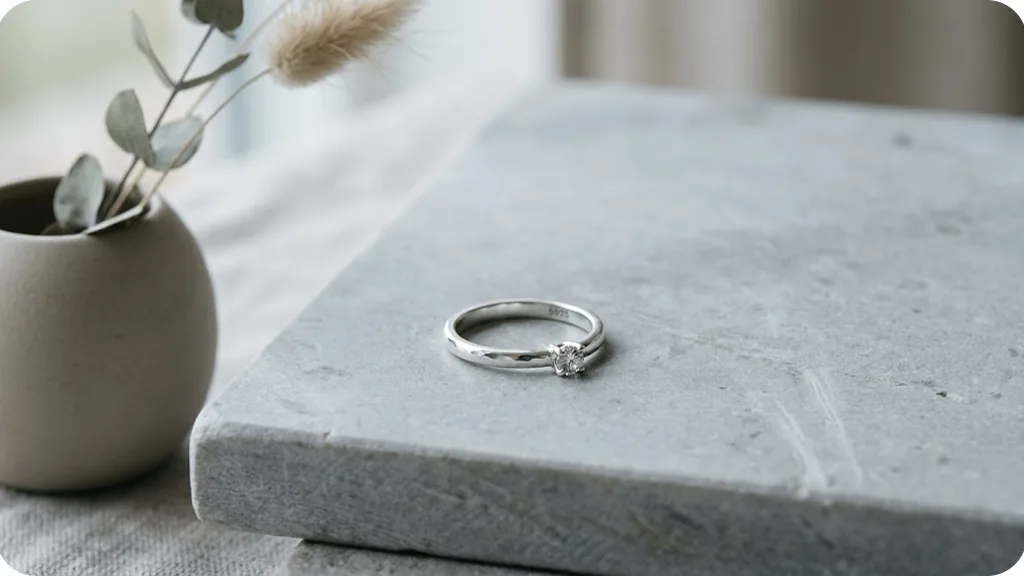
If you want silver but with more presence, a set piece like the solitaire cushion cut wedding band in sterling silver gives you a proper centre stone with a free IGI certificate at £904 at the time of writing.
When to choose something else
Go for gold or platinum if you want a ring you can put on and forget about for the next forty years, if you work with your hands every day, if you have reacted to costume jewellery before, or if the ring will carry a significant centre stone that you would rather not have to worry about.
Platinum in particular is the metal to pick if security of the setting matters most. It is dense, tough and does not tarnish, and claws made from it wear more slowly.
Looking after a silver ring properly
- Wear it. Silver worn regularly tarnishes more slowly than silver left in a box, because skin contact keeps the surface moving.
- Store it dry and sealed. A small zip bag with the air pushed out slows tarnish dramatically. Do not store it in a bathroom.
- Use a silver cloth, not toothpaste. An impregnated silver polishing cloth removes tarnish without removing metal. Toothpaste is abrasive and will dull the surface over time.
- Keep it away from chlorine, bleach and hot tubs. These attack silver faster than they attack gold, and gold does not enjoy them either.
- Take it off for hand cream and perfume. Both accelerate tarnish.
Frequently asked questions
Is 925 sterling silver good for wedding rings?
It is fine for a stacking ring, a starter band or a second everyday ring. For a single band worn constantly for decades, gold or platinum will hold its shape and its stones better and needs far less upkeep.
Will a sterling silver ring turn my finger green?
It can. The green comes from the copper in the alloy reacting with skin, and it is harmless and washes off. It is more likely in hot weather, at the gym, or if you have acidic skin.
Can sterling silver rings be resized?
Usually yes, and it is generally a straightforward job on a plain or partly set band. Full eternity bands with stones all the way round are difficult in any metal.
Is silver-plated the same as sterling silver?
No, and the difference is enormous. Sterling silver is solid silver throughout. Silver-plated means a thin silver coating over a base metal, and the coating wears through. Check for a 925 hallmark.
Can you set real diamonds in sterling silver?
Yes, and we do. The stones are exactly the same lab-grown diamonds we set in gold and platinum, with the same free IGI certificate on centre stones. The metal holding them is what differs, so have the settings checked a little more often.
Making the choice
If you are torn, ask yourself one question: will you take this ring off for anything, ever? If the answer is no — it goes on and stays on — buy the hardest metal you can afford. If the answer is yes, silver is a perfectly sensible option and will save you a great deal of money.
All of our rings, in every metal, are hand-made in North Harrow with lab-grown diamonds, free insured UK delivery and 30-day returns. Have a look through the wedding ring collection, and if you want the same design in a different metal, just ask — bespoke work carries no extra design charge.
Ready to find your perfect ring?
Explore our lab-grown diamond collection or book a virtual appointment with our team.