
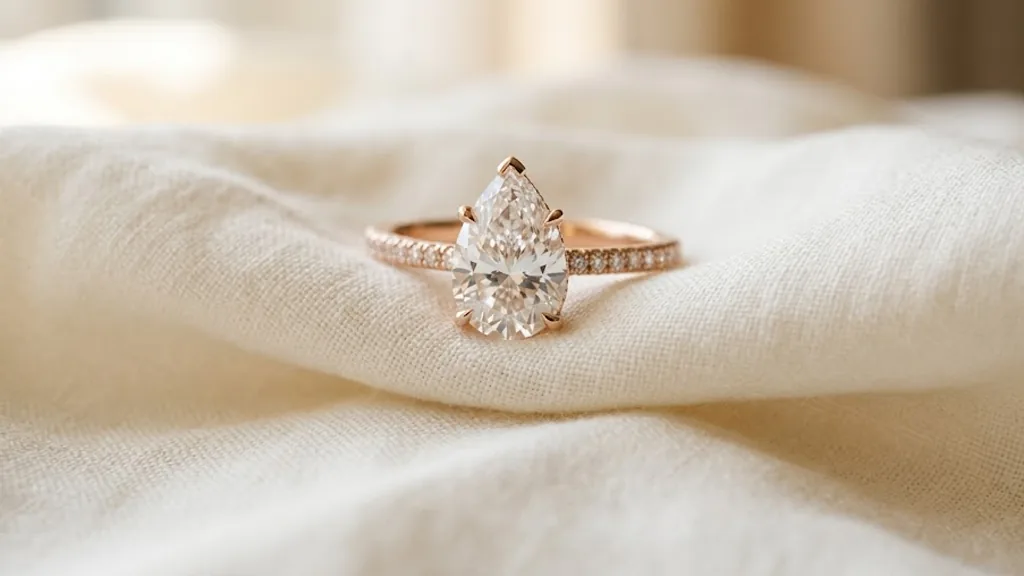
Which Way Should You Wear a Pear-Shaped Diamond?
Point up, point down or east-west? How to wear a pear-shaped diamond ring, why it spins, and how to stop it.
A pear-shaped diamond has a rounded end and a pointed end, which raises a question no other shape does: which way round should it face? Point towards your fingertips, or point towards your wrist? There is a conventional answer, a practical answer and a personal answer, and they are not always the same. Here is all three.
The short answer
By convention, a pear-shaped diamond is worn with the point facing towards your fingertips and the rounded end towards your wrist. That is how the vast majority of pear rings are made and how you will see them worn.
But there is no rule, no etiquette, and nothing that will mark you out as having got it wrong. Some people wear the point towards the wrist deliberately, and a growing number wear the stone east-west, laid sideways across the finger.
Why point-up is the standard
It makes the finger look longer
This is the real reason, and it works. The eye follows the taper of the stone away from the hand, which visually stretches the finger. The effect is most noticeable on shorter fingers and with a longer, more elongated pear.
It reads as intentional
Because it is the usual orientation, a point-up pear looks settled and deliberate. A point-down pear can occasionally read as though the ring has spun round on the finger, which is not the impression most people want.
It photographs better
Hands are almost always photographed with the fingers pointing towards the camera or lying flat. Point-up gives a cleaner line in both.
Reasons to wear the point downwards
There are real arguments the other way, and they are not just contrarian.
The point is better protected. The tip is the most fragile part of any pear-shaped stone. Worn towards the wrist, it sits in the quieter part of the hand and catches on fewer things than it does at the knuckle end.
It sits better with some wedding bands. If your wedding ring has a curved or chevron profile designed to nest against the pear, the fit can be neater in one orientation than the other. Try both before committing.
You may simply prefer it. Some people find the round end nearer the knuckle more balanced. It is your ring.
East-west: the third option
Setting a pear horizontally, so it lies across the finger, has become genuinely popular. It looks modern rather than traditional, it makes a modest carat weight look wider on the hand, and it tucks the point safely against the band. It also stacks unusually well with plain wedding bands.
If you like the idea, it is worth knowing that an east-west pear needs to be designed that way from the start — the setting head, the claws and the shank all differ. We build these as bespoke commissions at no extra design cost.
Comparing the three orientations
| Point up (towards fingertips) | Point down (towards wrist) | East-west | |
|---|---|---|---|
| Lengthens the finger | Yes, strongly | Slightly | No — widens instead |
| Protects the point | Least | Better | Best |
| Feels traditional | Yes | Neutral | No, modern |
| Availability off the shelf | Very wide | Wide (same rings, worn flipped) | Limited, usually bespoke |
| Sits with curved bands | Usually designed for this | Depends on the band | Needs a matched band |
How to stop a pear ring spinning
Almost everyone who worries about orientation is really dealing with one thing: the ring rotating on the finger. A pear ring that keeps turning will show its point in every direction over the course of a day.
The usual causes are a band that is very slightly too large, a heavy setting head that makes the top of the ring outweigh the bottom, or fingers that change size in heat and cold. The fixes are:
- Correct sizing. A ring should take a little effort to come over the knuckle. If it slides off easily, it is too big.
- Sizing beads or a bar. Two small metal beads added inside the base of the band grip the underside of the finger without changing the ring size much. This is the standard trade fix and it works well.
- A slightly heavier shank. Adding weight to the bottom of the band counterbalances the stone.
- Wearing it with a wedding band. A second ring below it acts as a brace and dramatically reduces spin.
Choosing a pear you will be happy with
Orientation matters far less than these three things.
Symmetry. Draw an imaginary line from the point through the middle of the round end. The two halves should mirror each other exactly. Look at the shoulders where the curve begins — if one shoulder is higher than the other, the stone will always look slightly off.
Bow tie. Every pear has a faint dark band across its widest part. A good cut keeps it subtle. A poor one shows a solid black bow tie that no setting will hide.
Length-to-width ratio. Around 1.45 to 1.75 suits most people. Below 1.45 the stone looks chunky and rounded; above 1.75 it looks long and slim, which is lovely on some hands and too narrow on others.
Point protection. The tip must be held in a V-shaped claw. This is not optional on a pear.
Pear rings we make
Pear is our second-largest shape after round, with eleven designs in the collection. The Stackable Pear Cut Engagement Ring is the most understated at £503 at the time of writing, and works beautifully as part of a stack.
For something with more presence, the Teardrop Pear Cut Bridal Set in Rose Gold pairs the engagement ring with a band shaped to nest against the stone, which solves both the spin problem and the fit problem in one go.
If you want two stones rather than one, the Toi et Moi Pear Cut Engagement Ring in White Gold sets a pair facing each other — a design where the orientation question becomes part of the point.
Frequently asked questions
Is there a right and wrong way to wear a pear ring?
No. Point-up is conventional and most flattering to the finger, but nothing about point-down is incorrect. Wear it the way you prefer to see it.
Can I turn my existing pear ring around?
Only if the setting allows it — most pear rings have a shaped head and a shank designed for one orientation, so simply rotating the ring on your finger will put the band’s detailing in the wrong place. A jeweller can reset the stone the other way round if you feel strongly about it.
Do pear diamonds look bigger than round?
For the same carat weight, yes. Elongated shapes spread more of their weight across the top of the stone, so a 1ct pear covers noticeably more finger than a 1ct round.
Are pear diamonds fragile?
The point is the vulnerable part; the rest of the stone is as tough as any diamond. With a V-claw protecting the tip and sensible care — take the ring off for the gym, gardening and DIY — a pear will last a lifetime.
Which wedding band goes with a pear engagement ring?
A curved or chevron band that follows the line of the stone gives the closest fit. Our Chevron Pear Cut Wedding Band in Rose Gold is made for this. A plain straight band also works if you are happy with a small gap under the point.
Where to go from here
Browse the full pear cut collection or the wider engagement ring range. Every centre stone is a lab-grown diamond with a free IGI certificate, hand-set in solid gold or platinum, with free insured UK delivery and 30 days to return it.
Ready to find your perfect ring?
Explore our lab-grown diamond collection or book a virtual appointment with our team.











