When Did Diamond Engagement Rings Become Popular?
Diamond engagement rings became the norm in the mid twentieth century. The geology, the cutting and the campaign behind it.
Diamond engagement rings became normal in Britain and America in the middle of the twentieth century. Not the middle ages, not the Victorian era. Within living memory for some families.
They existed long before that, but as rare objects belonging to royalty and the very wealthy. The moment they became the default thing an ordinary person buys when they propose is much more recent, and the reasons are a mixture of geology, economics and one exceptionally effective advertising campaign.
Before diamonds: rings as contracts
Betrothal rings are ancient. Roman custom included giving a ring at the point of agreement to marry, and these were commonly plain iron or gold. The ring signified a binding promise, closer to a legal token than a romantic gift.
Through the medieval and early modern periods, engagement and wedding rings in Europe were mostly gold bands, sometimes engraved inside with a short verse. These are known as posy rings, from the French poésie. Gimmel rings, made of two or three interlocking hoops that came together as one, were also popular in the sixteenth and seventeenth centuries.
Where gemstones appeared, they were as likely to be coloured. Rubies stood for passion, sapphires for fidelity. Diamonds appeared, but rarely, and the ones that did were nothing like modern brilliant cuts. Cutting technology could not yet release the light from the stone.
1477: the first recorded diamond engagement ring
The usual starting point is 1477, when Archduke Maximilian of Austria gave Mary of Burgundy a ring set with thin flat diamonds arranged in the shape of an M.
It is genuinely the earliest well-documented example, and it started a fashion among European nobility. But it is worth being clear about scale. This was a gift between two of the most powerful families in Europe. It did not filter down. For the next four hundred years a diamond engagement ring remained something almost nobody would ever see, let alone own.
The nineteenth century: supply changes everything
The real turning point was geological. Until the 1860s, diamonds came mainly from India and Brazil in very small quantities. Then large deposits were found in South Africa, and by the 1870s the mines around Kimberley were producing on a scale the world had never seen.
Suddenly diamonds were available in quantities that could support a mass market. The industry that grew up around those mines consolidated rapidly, and De Beers was founded in 1888 to control that supply.
Cutting improved at the same time. The modern round brilliant cut, with the proportions designed to maximise light returning to the eye, was refined in the early twentieth century. This matters more than it sounds. It is the cut, not the material, that makes a diamond sparkle the way people expect, and before it existed diamonds simply did not look the way they do now.
1938 to 1950s: the campaign that made it a rule
Diamond sales fell heavily during the Depression. In 1938 De Beers engaged the American advertising agency N. W. Ayer, and what followed is one of the most studied marketing campaigns in history.
The strategy was not to sell a product but to establish a custom. Diamonds were placed in films, worn by film stars, described in magazine features, and consistently associated with proposals rather than with jewellery in general. In 1947 the copywriter Frances Gerety wrote the line “A Diamond Is Forever”, which ran for decades and did the crucial work of making resale unthinkable, keeping used stones off the market.
The guideline that you should spend a certain number of months’ salary comes from this era of advertising as well. It has been repeated so often that it now sounds like tradition. It is not a measured norm and never was, and any jeweller who quotes it at you as a rule is repeating an advertisement.
| Period | What an engagement ring typically was |
|---|---|
| Roman era | Plain iron or gold band as a token of agreement |
| Medieval to 1600s | Gold bands, posy rings, gimmel rings, occasional coloured stones |
| 1477 onwards | Diamond rings appear among European nobility only |
| 1700s to mid 1800s | Coloured gemstones and pearls common; diamonds still rare |
| 1870s to 1930s | Diamonds become available in quantity; still not the default |
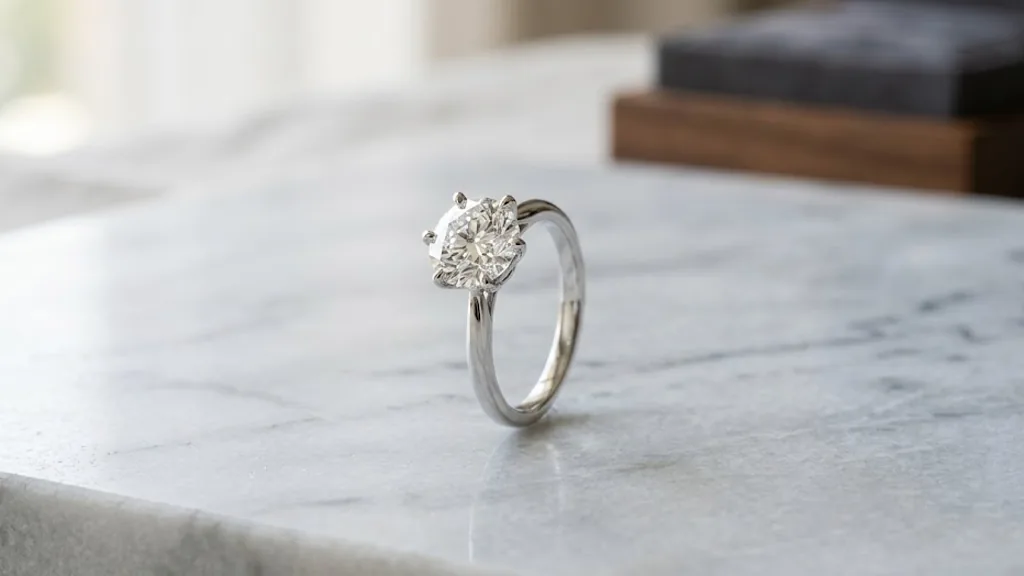
| 1940s to 1960s | The diamond solitaire becomes the expected engagement ring |
| 1980s onwards | Established as the norm; coloured stones return as a deliberate alternative |
Britain specifically
The custom took hold in Britain slightly later than in the United States, through the 1940s and 1950s, and by the 1960s a diamond solitaire was the expected thing.
The most visible British counter-example came in 1981, when Lady Diana Spencer’s engagement ring was a large oval sapphire surrounded by diamonds. It was not a bespoke royal commission but a ring chosen from a jeweller’s existing collection, which was itself considered unusual at the time. The same ring is worn today by the Princess of Wales.
That ring is a useful reminder that the “rule” is thinner than it looks. We look at the alternatives in our guide to whether an engagement ring has to be a diamond.
What has changed most recently
Two things, and both are meaningful.
The first is where diamonds come from. Diamond has been produced in laboratories since the mid-1950s, but only in recent decades has the process reached the quality and size needed for fine jewellery. Lab-grown diamond is the same material, graded on the same scales by the same laboratories, and it costs substantially less for equivalent size and quality. It is the first real change to the economics of the diamond ring since the Kimberley mines opened.
The second is that the single-stone solitaire is no longer the automatic answer. Three stone rings, toi et moi designs, unusual shapes and coloured stones are all chosen openly rather than apologetically. Our Toi et Moi Pear Cut Engagement Ring in White Gold, £685 at the time of writing, revives a design that predates the solitaire’s dominance entirely.
If you do want the classic, our Solitaire Round Cut Engagement Ring is £657 at the time of writing, and our Vintage Round Cut Engagement Ring in Yellow Gold at £1,051 leans towards the earlier, more decorative styles.
Frequently asked questions
Who invented the diamond engagement ring?
Nobody invented it in a single moment. The 1477 ring given to Mary of Burgundy is the earliest documented example, but the custom as most people know it was built by the advertising of the mid twentieth century.
Are diamond engagement rings a genuine tradition?
Engagement rings are an old tradition. Diamond engagement rings for ordinary people are a recent one. Both facts are true at once, and knowing which is which makes it easier to choose freely.
Did the two months’ salary rule ever mean anything?
It was an advertising guideline, not a measurement of what anyone actually spent. Treat it as a piece of history rather than as advice.
Why is the round brilliant the most common shape?
Because its proportions were specifically calculated to return the most light to the eye, and because it became established at exactly the moment diamond rings became mass market. Practicality and timing, rather than tradition.
Does choosing a lab-grown diamond break with tradition?
Not in any way that matters. The tradition is a diamond ring given at a proposal. Lab-grown diamond is diamond. What has changed is the cost and the supply chain, not the stone.
If you would like to see how the classic and the unconventional compare in person, browse our engagement ring collection. Every piece is hand-made in solid gold or platinum in North Harrow, London, with a free IGI certificate on the centre stone, free insured UK delivery and 30-day returns.
Ready to find your perfect ring?
Explore our lab-grown diamond collection or book a virtual appointment with our team.