What Makes a Ring a Wedding Ring?
There is no legal definition. A ring becomes a wedding ring by how it is given and worn. Here is what good ones have in common, and why.
Nothing about the ring itself makes it a wedding ring. There is no legal definition, no hallmark, no design requirement and no rule about the metal. A ring becomes a wedding ring because it was exchanged at a wedding and is worn as one.
That said, wedding rings do share a set of practical characteristics — and those characteristics exist for good reasons, because a wedding ring has to do a job that most jewellery does not. It has to be worn every day, for decades, through everything.
What actually defines a wedding ring
Two things, and neither is about the design:
- It was exchanged at the ceremony. That is the moment that gives the ring its meaning.
- It is worn continuously afterwards, traditionally on the fourth finger of the left hand in the UK.
Everything else — the shape, the metal, whether it has diamonds, whether it matches your partner’s — is preference. A plain steel band exchanged at a register office is as much a wedding ring as a platinum eternity band.
The features most wedding rings share
Practicality drives all of these.
| Feature | Why it is typical |
|---|---|
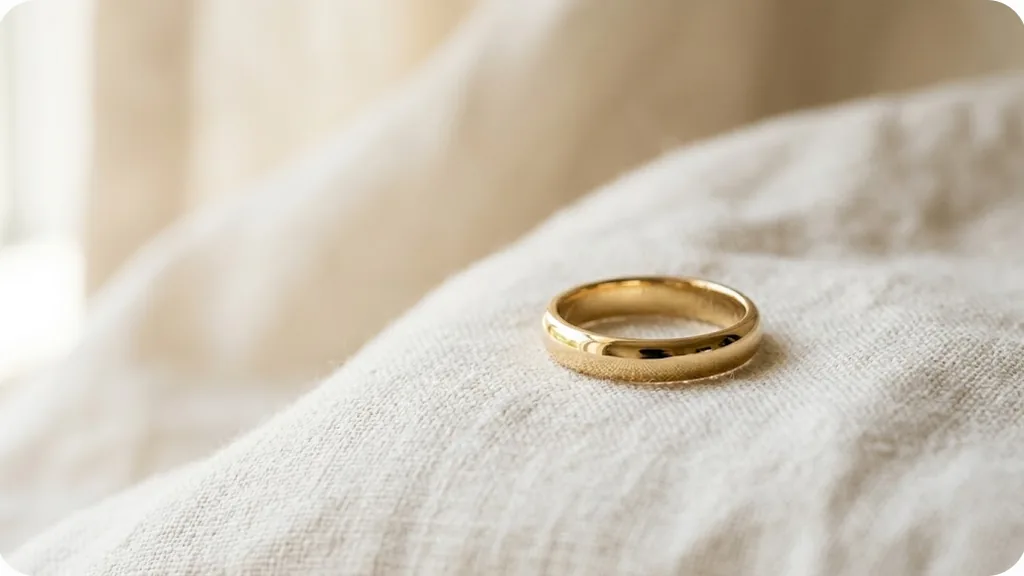
| Continuous circle, no ends | Comfortable to wear all day; the endless circle is also the traditional symbolism |
| Low profile | Sits close to the finger so it does not catch on clothing, pockets or gloves |
| Solid precious metal | Gold or platinum can be polished, repaired and resized; plated metals wear through |
| No large raised stone | A high setting knocks against things and loosens over years of daily wear |
| Stones set flush or in channels | Keeps the surface smooth and protects the stones from knocks |
| Smooth inner edge | Often called comfort fit; far more wearable over long periods |
A ring that has all of these will be easy to wear for fifty years. A ring that has none of them can still be a wedding ring — it will just need more care.
Wedding ring versus engagement ring
The difference is in the job, not the category.
| Wedding ring | Engagement ring | |
|---|---|---|
| Given | At the ceremony | At the proposal |
| Typical design | Band, flat or low profile | One prominent centre stone |
| Worn | Closest to the palm | Above the wedding band |
| Built for | Constant daily wear | Display; often removed for rough work |
You can absolutely use an engagement-ring style as a wedding ring, or a band as an engagement ring. Plenty of people do, particularly those who want one ring rather than two.
Does it have to be a specific metal?
No. Gold, platinum, palladium, silver, titanium, tungsten, steel and wood have all been used.
What matters is whether the metal will survive daily wear and whether it can be repaired.
- Gold and platinum can be resized, polished and repaired essentially indefinitely. This is why they dominate.
- Sterling silver is softer and tarnishes, but it can be worked on by any jeweller.
- Titanium and tungsten are extremely hard-wearing but generally cannot be resized. Tungsten in particular is brittle and can crack rather than bend.
- Plated bands should be avoided for a ring you intend to wear every day. The plating wears through at the contact points and cannot be properly restored.
In the UK, precious metal above a certain weight must carry a hallmark — a set of small stamped marks inside the band showing the metal and its fineness. That is a legal requirement about metal content, not about the ring being a wedding ring, but it is a useful thing to check when buying.
Does it have to be plain?
Not at all. Diamond-set wedding bands are now as common as plain ones, and the range of what people wear is very wide.
Common wedding ring styles:
- Plain band. The classic. Nothing to catch, nothing to lose, endlessly repairable. A minimalist round cut wedding band is about as simple as it gets.
- Half eternity. Diamonds across the top half, plain metal underneath. Sparkle where you see it, and still resizable.
- Full eternity. Diamonds all the way round. Beautiful, but cannot be resized because there is no plain metal to cut.
- Shaped or curved. Cut to nest against an engagement ring rather than leaving a gap.
- Textured or patterned. An ocean wave round cut wedding band in yellow gold has a moving surface without any raised setting to catch.
- Multi-stone. A 7 stone round cut wedding band in yellow gold gives a run of diamonds with the metal still doing most of the work.
Does it have to match your partner’s?
No. Matching pairs are a modern preference, and it is completely normal for two people to wear entirely different bands — different metals, different widths, one with diamonds and one without.
What matters more is that each band suits the hand and the life of the person wearing it. Someone who works with their hands needs a low, smooth, stoneless band. Someone who wants sparkle across the finger needs something else entirely.
What makes a good wedding ring
If the question behind “what makes a ring a wedding ring” is really “what should I look for”, here is the checklist.
- Solid precious metal, hallmarked. Not plated.
- A fit you can wear all day. Snug enough not to slide off, loose enough to spin freely.
- Resizable, unless you are certain of the size. Plain and half eternity bands can be adjusted; full eternity bands cannot.
- Stones set securely. Channel, bezel and flush settings survive daily wear better than high claws.
- A profile that suits your hands. Manual work means low and smooth; desk work gives you more freedom.
- Something you actually like. You will look at it every day for a very long time.
Frequently asked questions
Is there a legal definition of a wedding ring?
No. In the UK there is no legal requirement to exchange rings at all, and no legal definition of what a wedding ring must be. Hallmarking law governs precious metal content, not the ring’s purpose.
Can an engagement ring be used as a wedding ring?
Yes. Some people use one ring for both, either by wearing the engagement ring as the wedding ring or by having it re-presented at the ceremony. It is entirely valid.
Does a wedding ring have to have no stones?
No. Diamond-set bands are extremely common. The practical consideration is how the stones are set — flush or channel settings last better under daily wear than high claws.
Does the wedding ring have to be a plain circle?
No. Shaped, chevron and curved bands are all standard, and they often fit better against an engagement ring than a straight band does.
Can I inherit a wedding ring and use it as mine?
Yes, and many people do. A jeweller can resize a plain or half-set band and refinish it so it looks new while keeping the original metal.
Choosing one
A wedding ring is defined by how it is given and how it is worn, not by any rule about the design. So the only real question is what you will be happy wearing for the next several decades.
Our bands are hand-made in solid gold and platinum with lab-grown diamonds, with a free IGI certificate on centre stones, free insured UK delivery and 30-day returns. Browse the wedding ring collection, or ask about a bespoke band — we charge nothing extra for the design.
More guides on this topic
Ready to find your perfect ring?
Explore our lab-grown diamond collection or book a virtual appointment with our team.