
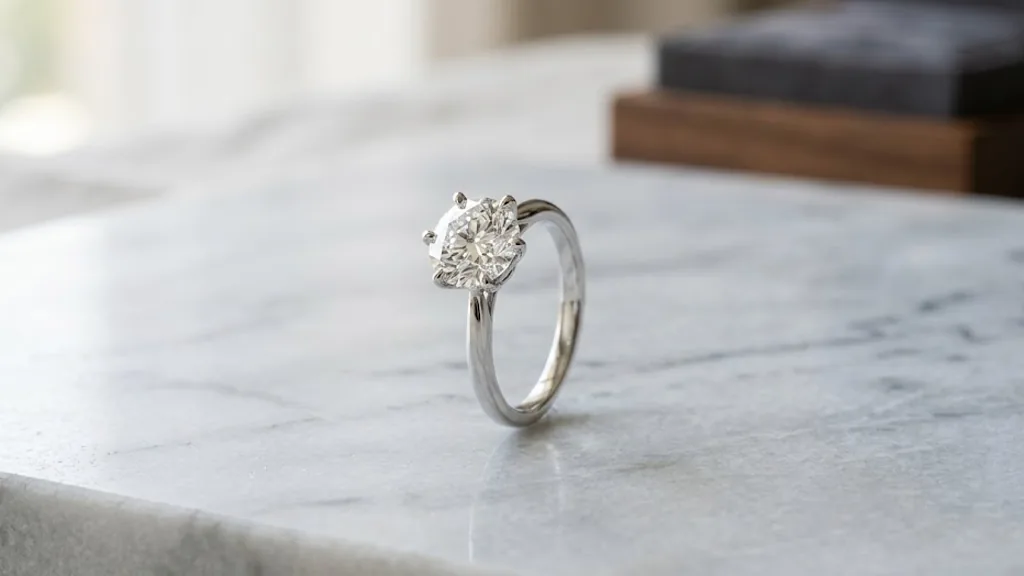
What Quality Diamond for an Engagement Ring? How to Pick the Right One
Which of the four Cs actually matter, the specification most people should buy, and a step-by-step way to choose the ring.
Two questions sit behind almost every engagement ring enquiry we get: what quality of diamond do I actually need, and how do I go about picking one out without getting it wrong? This guide answers both in order — first the quality decision, then the practical process of choosing the ring.
The four Cs, and which ones matter most
Every diamond is described by four measures. They are not equally important, and knowing the order saves both money and disappointment.
| What it measures | How much it affects how the ring looks | |
|---|---|---|
| Cut | How well the stone is proportioned and finished | Enormous — this is what makes a diamond sparkle |
| Colour | How colourless the stone is, graded D to Z | Moderate — visible above a certain point |
| Clarity | Internal marks, graded FL down to I3 | Small, if you stay above the eye-clean threshold |
| Carat | Weight, not size | Obvious, but the least informative on its own |
Cut first, always
Cut is not the shape. It is how accurately the facets have been angled and polished so light enters the stone, bounces around inside and comes back out at your eye. A badly cut diamond leaks light out of the bottom and looks dull and glassy no matter how good its other grades are.
Buy the best cut you can afford and take the savings from clarity. A well-cut stone one colour grade lower will look better than a poorly cut stone one grade higher, every single time.
Colour: match it to the metal
Colour runs from D (completely colourless) down through the alphabet as the stone gets progressively warmer, towards a faint yellow or brown.
| Grade range | What it looks like | Best with |
|---|---|---|
| D–F | Colourless. No visible tint at all. | Platinum and white gold |
| G–H | Near colourless. Looks white to the naked eye. | Any metal — the value sweet spot |
| I–J | Very faint warmth, usually only visible next to a whiter stone | Yellow and rose gold, where it disappears entirely |
| K and below | Noticeable warmth | Yellow gold, vintage-style settings, if you like the effect |
Paying for D when the ring will be set in yellow gold is money spent on something nobody will ever see. Deciding the metal first is one of the most useful things you can do.
Clarity: buy with your eyes
Clarity describes tiny natural features inside the stone. The only question that matters is whether you can see any of them without magnification, at normal viewing distance. If you cannot, a higher grade buys you nothing but a nicer certificate.
| Grade | Meaning | Visible without magnification? |
|---|---|---|
| FL / IF | Flawless / internally flawless | No |
| VVS1 / VVS2 | Very, very slightly included | No |
| VS1 / VS2 | Very slightly included | No |
| SI1 | Slightly included | Usually not |
| SI2 | Slightly included | Sometimes |
| I1–I3 | Included | Yes |
A practical note: larger stones and step cuts such as emerald and asscher show inclusions more readily, because there is more surface to look through and the long open facets act like windows. For those, aim a grade or two higher. Brilliant cuts hide inclusions far better.
Carat: the number people over-weight
Carat is weight, not width. Two 1ct diamonds can look noticeably different sizes depending on how deep they are cut. Read the millimetre measurements on the certificate, not just the carat figure.
Prices also step up sharply at the round numbers — 0.50ct, 1.00ct, 1.50ct, 2.00ct — because so many people ask for exactly those. Buying at 0.90ct instead of 1.00ct saves real money for a difference in width you cannot see.
A sensible specification for most people
If you want a short answer rather than a framework: an excellent cut, G or H colour, VS2 or SI1 clarity, in whatever carat weight your budget allows, is a specification that will look beautiful and waste nothing. Nudge colour up to F if you are set on platinum. Nudge clarity up to VS1 if you are buying an emerald cut or going above 2ct.
How to pick out a diamond engagement ring, step by step
1. Set a real budget first
Do this before you look at anything, because it is much harder afterwards. Ignore the “two months’ salary” figure entirely — that came from a mid-twentieth-century advertising campaign, not from etiquette or from any measured average. The right amount is the amount you can spend without it causing a problem.
2. Find out the ring size
The most common way to get this wrong is guessing. If it is a surprise, borrow a ring she already wears on that finger and have it measured, or ask a friend who can ask casually. Rings can be resized afterwards, but plain bands resize more easily than eternity bands or heavily set shanks.
3. Work out the style before the stone
Look at what she already wears. Is her jewellery yellow, white or rose? Is it delicate or bold? Modern or antique? A stunning diamond in a setting that does not suit her is a worse outcome than a modest diamond in exactly the right ring.
4. Choose the shape
Shape has more impact on the character of a ring than any other single decision. Round is the most brilliant and the safest. Oval, pear and marquise look larger for their weight and elongate the finger. Emerald and asscher are calm and architectural. Cushion is soft and vintage. Our Hidden Halo Oval Cut Engagement Ring and Three Stone Emerald Cut Engagement Ring are useful examples of two very different directions, at £1,021 and £1,017 at the time of writing.
5. Then choose the stone within your budget
With shape and metal fixed, the quality decision becomes simple: spend on cut, take colour to match the metal, and take clarity down to the point where the stone is still clean to your eye.
6. Insist on a certificate
A certificate from an independent laboratory is your evidence that the grades are real rather than the seller’s opinion. Every centre stone we sell comes with a free IGI certificate. Keep it with your insurance documents.
7. Check what happens afterwards
Ask about resizing, returns, and whether the seller will inspect the setting in a year’s time. We offer 30-day returns and free insured UK delivery, and we are a workshop rather than a shopfront, so repairs and resets are done in-house.
Frequently asked questions
What is the minimum quality I should accept?
Avoid anything below SI2 clarity unless you have looked at the specific stone and are happy with it, and avoid poor or fair cut grades entirely. Below those points you are buying a diamond that looks like one only on paper.
Does lab-grown mean lower quality?
No. A lab-grown diamond is the same material with the same hardness and the same optical behaviour as a mined one, and it is graded on exactly the same four Cs by the same laboratories. What changes is the price, which is why the same budget buys a considerably better specification.
Should I prioritise size or quality?
Prioritise cut, then decide. A well-cut smaller stone looks livelier than a large dull one, and liveliness is what people notice from across a room. Beyond that, it is personal — some people genuinely want presence, and that is a legitimate choice.
How do I compare two rings fairly?
Line up cut grade, colour grade, clarity grade, millimetre measurements and metal. If any of those is missing from a listing, ask. A seller who cannot tell you the measurements of the stone is not a seller to buy from.
Can I have something made rather than buying from stock?
Yes. We design and make bespoke rings at no extra design cost, which means you pay for the metal, the stone and the making, not for the drawing. If you have a picture in your head or a photograph of something you like, send it over.
Where to go from here
Start with the engagement ring collection and use the shape filters to narrow things down — or begin with the classic Solitaire Round Cut Engagement Ring at £657 at the time of writing and work outwards from there.
Ready to find your perfect ring?
Explore our lab-grown diamond collection or book a virtual appointment with our team.











