
Are Diamond Engagement Rings Still Popular?
Diamonds are still the UK default, but six things around them have changed. An honest look at what has shifted and what has not.
Yes. Diamond engagement rings remain overwhelmingly the norm in Britain, and there is no sign of that changing. But almost everything around the diamond has changed in the past ten years — where the stone comes from, what shape it is, what it is set in, and how much people are willing to spend. Here is an honest look at what has shifted and what has not.
What has not changed
The diamond is still the default. If you ask someone to picture an engagement ring, they picture a diamond, and the overwhelming majority of proposals in the UK still involve one. That is not marketing on our part; it is simply what the market looks like.
The reasons are practical as well as cultural. Diamond is the hardest material there is, which means it survives daily wear on a hand better than any alternative. A sapphire or emerald engagement ring is a lovely thing, but it will show wear on the stone’s edges over decades in a way a diamond will not.
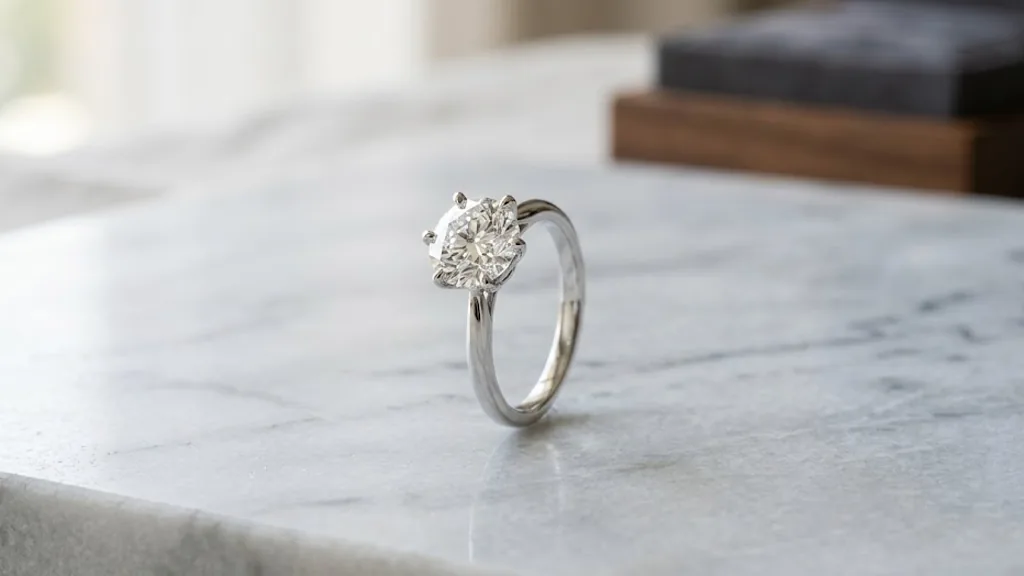
The round brilliant is still the most requested shape. The solitaire is still the most requested setting. The fourth finger of the left hand is still where the ring goes in Britain.
What has genuinely changed
1. Lab-grown diamonds have gone mainstream
This is the biggest shift by a wide margin. A decade ago, lab-grown diamonds were a curiosity. They are now a normal, unremarkable choice, sold by mainstream retailers and certified by the same laboratories that grade mined stones.
The effect on buyers is straightforward: the same budget buys a considerably better ring. People who would have bought a 0.50ct mined stone are buying 1ct lab-grown stones, or spending the difference on cut quality and on the setting.
We would add one honest caveat, because it is often glossed over. Lab-grown diamond prices have moved a great deal as production has scaled, and nobody should buy one as an investment. Buy it because you want to wear it.
2. Shapes have opened up
Round still leads, but ovals, emeralds, pears and marquises are all far more visible than they were. Genuinely unusual shapes — hexagons, lozenges, rose cuts — have moved from bespoke-only to something people actively seek out. Our Solitaire Hexagon Cut Engagement Ring at £1,078 at the time of writing is a shape that barely existed as an option ten years ago.
3. Two-stone and multi-stone designs
The toi et moi — two stones sitting side by side, representing two people — has come back strongly, along with three-stone rings and cluster designs. The Toi et Moi Pear Cut Engagement Ring in White Gold at £685 is the clearest example of that thinking.
4. People choose the ring together
The complete surprise proposal is far less universal than it once was. Many couples now choose the ring jointly, or the person proposing buys a placeholder and the real ring is chosen afterwards. This is a good development. It produces rings people actually want to wear.
5. Provenance matters to buyers
People ask where the stone came from now, and they expect an answer. That question is a large part of why lab-grown diamonds have grown so quickly.
6. Yellow and rose gold are back
White metal dominated for a long stretch. Yellow gold has returned properly, and rose gold has established itself as a permanent option rather than a passing trend.
| Ten to fifteen years ago | Now | |
|---|---|---|
| Stone | Mined diamond assumed | Lab-grown a normal, mainstream choice |
| Shape | Round or princess | Round still first, oval and emerald strong, unusual shapes accepted |
| Metal | White gold or platinum | Yellow and rose gold back in force |
| Setting | Solitaire or classic halo | Hidden halos, bezels, east-west, toi et moi |
| Buying | High street, surprise proposal | Online and workshops; often chosen together |
| Spending guide | “Two months’ salary” | Widely disregarded as advertising |
What about the alternatives?
They are more accepted than they were, and worth understanding honestly.
Sapphires and other coloured stones have a long history in engagement rings and are a genuinely good choice, particularly sapphire, which is hard enough for daily wear. Emeralds are softer and more brittle, so they need a protective setting and more care.
Moissanite is a different mineral, not a diamond. It is bright, hard-wearing and much cheaper. Some people love it. It has a different, more rainbow-heavy sparkle that others dislike. It is a perfectly legitimate choice as long as you know it is not a diamond.
Plain bands and no ring at all are choices some couples make deliberately, and nobody should feel odd about it.
We work in diamonds because that is our craft, and we do not stock coloured gemstone rings. If you want a sapphire centre with diamond shoulders, we will make it as a bespoke commission at no extra design cost rather than send you away.
So should you buy a diamond?
Buy one if you want one. The useful question is not whether diamonds are still popular but whether this particular ring is right for the person wearing it.
If it helps to have a starting point, the classic remains the classic for good reasons: a well-cut round brilliant in a simple solitaire setting looks as correct today as it did in 1960 and will look correct in 2060. Our Solitaire Round Cut Engagement Ring in White Gold is £563 at the time of writing, which is a useful illustration of how much the lab-grown shift has changed what that classic costs.
Frequently asked questions
Are diamond engagement rings going out of fashion?
No. Diamonds remain the dominant choice by a very wide margin in the UK. What has changed is the type of diamond people buy and the designs they choose, not whether they buy diamonds at all.
Are lab-grown diamonds taking over?
They have grown from a niche to a mainstream option remarkably quickly, and the share of engagement rings using them has risen sharply. Reported figures vary a great deal between sources, so treat any specific percentage you see with caution — but the direction is not in doubt.
Will a lab-grown ring look dated in twenty years?
The stone will not. A lab-grown diamond is the same material as a mined one and will look exactly the same in 2046 as it does today. Whether the setting dates depends entirely on the design you choose, which is an argument for a simple one.
Is it acceptable not to have a diamond?
Completely. Sapphire engagement rings have centuries of history behind them, and plenty of couples choose a plain band or no ring. There is no rule to break.
Do people still follow the two months’ salary guideline?
Far less than they used to, and rightly. It came from a mid-twentieth-century diamond advertising campaign, not from etiquette or from any measured figure. Spend what you can spend comfortably.
Where to go from here
Browse the full engagement ring collection, or look at the hexagon cut rings if you want to see where the more adventurous end of the market has gone. Every ring is hand-made in solid gold or platinum in North Harrow, with a lab-grown centre stone, a free IGI certificate, free insured UK delivery and 30-day returns.
More guides on this topic
Ready to find your perfect ring?
Explore our lab-grown diamond collection or book a virtual appointment with our team.











