What Does It Mean When Your Wedding Ring Breaks?
A broken wedding ring means the metal wore through, not that something is wrong with your marriage. Why rings break and what to do next.
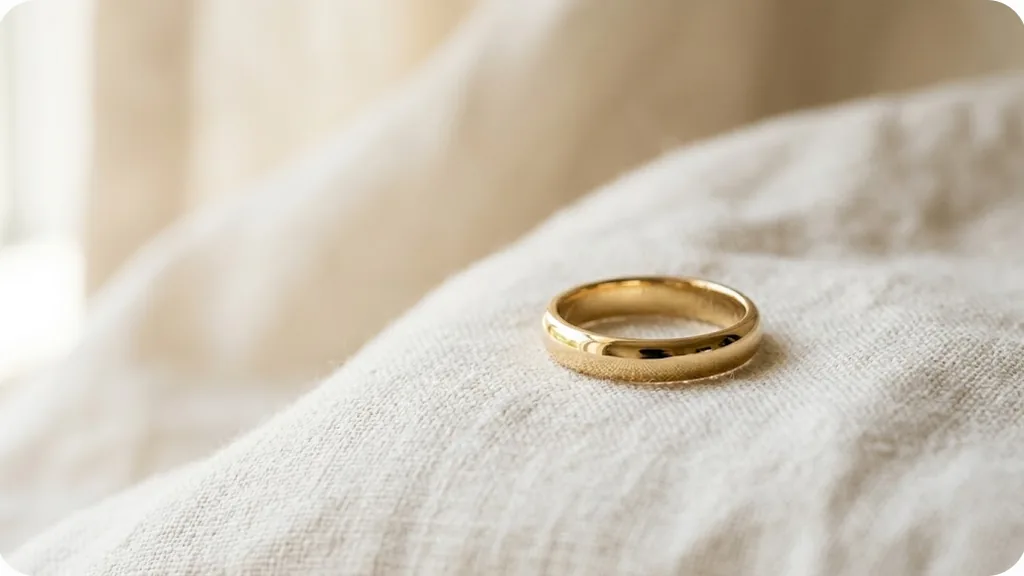
If your wedding ring has cracked or split, the first thing worth saying plainly is this: it is a metal problem, not a message. Rings break because metal fatigues. That is all it means.
The superstition is old and widespread, and it upsets people at exactly the moment they least need it. So let us deal with the actual causes, and then with what to do about it.
Why wedding rings actually break
A ring is a thin circle of soft metal that gets squeezed, knocked and rubbed thousands of times a day for years. It is remarkable that they last as long as they do.
The shank wears thin. This is the most common cause by a long way. The bottom of the ring, against your palm, rubs constantly. Over ten to thirty years the metal there thins until it can no longer take the pressure, and it cracks. You can often see it coming – hold the ring up to the light and compare the thickness at the bottom with the sides.
Two rings rubbing. Where a wedding band and engagement ring sit together, they wear each other away at the contact point. The softer metal always loses.
A single hard knock. Catching a ring in a car door, on gym equipment or under a weight bends it out of round, and metal that has been bent and straightened is weaker at that point.
Repeated squeezing. Gripping tools, handlebars and weights compresses a ring slightly every time. Enough repetitions and the metal fatigues, in the same way a paperclip snaps after being bent back and forth.
An old repair. A previous resize or repair creates a join. If it was not done well, that join is the weak point.
Which rings break most easily
| Feature | Effect on durability |
|---|---|
| Very thin or narrow shank | Least metal to wear away – breaks soonest |
| Hollow construction | Looks substantial, dents and splits readily |
| Full eternity band | Stones all the way round leave less solid metal in the shank |
| Solid plain band | Most durable design there is |
| Platinum | Very tough; wears by displacing metal rather than losing it |
| 9ct gold | Harder than 18ct, so it resists scratching, but it is less malleable |
| Sterling silver | Soft; bends out of round and wears faster than gold or platinum |
Can it be repaired?
Almost always, yes. A broken shank is one of the most routine jobs a goldsmith does.
Where the metal has simply worn thin, the usual repair is reshanking – the worn section is cut out and a new piece of matching metal is fitted and shaped in. Done properly the join is invisible and the ring is stronger than it was before it broke.
Where a ring has cracked at a single point without much wear, a simple solder repair may be enough. A good jeweller will tell you which your ring needs, and should be honest if reshanking is the better long-term answer even though it costs more.
What cannot easily be repaired: hollow bands, plated rings where the repair would show through the plating, and hard materials such as tungsten and ceramic, which cannot be soldered at all.
Stop wearing it straight away
This matters. A cracked ring has a sharp edge, and it will catch on things and cut you. More importantly, a ring that has cracked in one place is likely to keep opening, and if it has stones they can fall out through the gap.
Take it off, put it somewhere safe – not wrapped in tissue, which is how rings get thrown away – and get it looked at. Do not try to press it back into shape yourself, because working the metal further weakens it.
The superstition, dealt with honestly
There is a long-standing belief in Britain and elsewhere that a broken wedding ring is a bad omen for a marriage. There is no evidence for it and no mechanism behind it. Rings break for the reasons listed above, and they break just as often in long, happy marriages as in unhappy ones – arguably more often, because they have been worn longer.
If it helps to reframe it: a worn-through shank is proof the ring has been worn every day for decades. That is the opposite of a bad sign.
Some people find it meaningful to have the ring repaired rather than replaced, precisely because the repair becomes part of its history. Others prefer a fresh start with a new ring. Both are perfectly reasonable.
Repair or replace?
Repair if the ring has sentimental value, if it is a good solid design, or if it is an heirloom. Reshanking is usually well worth doing.
Replace if the ring is plated or hollow, if it has already been repaired more than once, or if the design was never robust enough for daily wear in the first place.
If you are replacing, choose for durability this time. A solid band such as the Minimalist Round Cut Wedding Band has the most metal where it matters. If you want stones, a half or three-quarter eternity like the Stackable Round Cut Three Quarter Eternity Band leaves solid metal at the back where the wear happens, which is genuinely more durable than a full eternity band.
Bezel-set designs, where metal wraps the edge of each stone, also survive knocks far better than raised claws – the Bezel Rose Cut Eternity Band shows the principle clearly.
How to stop it happening again
- Take it off for weights, DIY and gardening. These three account for most damage we see.
- Have set rings checked every couple of years. A jeweller can spot a thinning shank long before it cracks and build it up cheaply.
- Do not ignore a ring that has gone oval. Out-of-round is the warning sign that comes before a crack.
- Match metals if you stack rings, so one does not wear the other away.
- Get the fit right. A ring that is too loose spins and takes more knocks; a ring that is too tight is under constant stress.
Warning signs before a ring breaks
A ring almost never breaks without notice. It gives you months or years of warning, and most people simply do not know what to look for.
- The ring has gone oval. A ring that no longer looks circular has been squeezed and is under stress. This is the clearest warning of all.
- The bottom looks thinner than the sides. Hold it up to the light and compare. A visibly thin shank is weeks or months from cracking.
- A stone has become loose. Run a fingernail over the settings. Movement means claws have worn, and worn claws often accompany a worn shank.
- The ring is suddenly easier to get on and off. Sometimes this is your finger. Sometimes it is the ring stretching as the metal thins.
- A sharp edge you can feel. This usually means a crack has already started on the inside where you cannot see it.
Any of these is a reason to have the ring looked at now rather than later. Building up a thinning shank before it fails is a small, inexpensive job. Repairing a ring that has cracked and lost stones is neither.
Looking after a repaired ring
A properly reshanked ring is as strong as a new one, sometimes stronger, because the new metal has none of the accumulated wear. It does not need special treatment.
What it does need is the same sensible habits that would have prevented the break. Take it off for weight training, DIY and gardening. Have it checked every couple of years. Clean it fortnightly in warm water with a drop of washing-up liquid and a soft toothbrush.
One thing to ask when you collect it: whether the repair changed the ring size. Reshanking can shift it slightly, and it is far easier to correct at the workshop than to discover a month later.
Frequently asked questions
Is a broken wedding ring bad luck?
No. It is metal fatigue. Rings that have been worn daily for twenty or thirty years wear through, and that is the whole explanation.
How much does it cost to repair a broken ring?
It depends on the metal, the design and whether a full reshank is needed. Bring it in or send us photographs and we will tell you honestly before doing anything.
Will the repair show?
A well-executed reshank in matching metal is invisible once polished. A poor one shows as a colour difference, which is why it matters who does it.
Can a ring with stones all the way round be repaired?
Usually, but it is a bigger job because stones near the break must be removed and reset. It is worth doing on a good ring.
My ring has gone oval rather than broken. Is that a problem?
Yes, it is the stage before breaking. Have it rounded and checked – it is a small job now and a large one later.
Everything we make is hand-made in solid gold or platinum in North Harrow, and our wedding ring collection is built for daily wear. Free insured UK delivery, 30-day returns, and bespoke design at no extra design cost if you would like a replacement made to match the original.
More guides on this topic
Ready to find your perfect ring?
Explore our lab-grown diamond collection or book a virtual appointment with our team.