
Are Promise Rings Still a Thing? Who Gives Them Now, and Why
Promise rings are still bought, but by different people than twenty years ago. What has changed, what they look like now, and how to decide.
Yes. People still give promise rings, and they are asked for often enough that most jewellers can tell you what tends to sell as one. What has changed is not whether they exist but who gives them and why.
You will find articles claiming that promise rings peaked years ago, and others claiming they are booming. Neither cites anything you can check. We are not going to invent a figure to settle it. What we can give you is an honest picture of how these rings are actually bought now, what the modern version looks like, and how to decide whether one makes sense for you.
What has changed since the early 2000s
The promise ring of twenty years ago had a fairly narrow use: young couples, often teenagers, marking a serious relationship. That version still exists, but it is now the smaller part of the picture. Three shifts explain why.
People marry later. Couples now spend years living together, buying things together and building a life together before anyone mentions a wedding. That leaves a long stretch of genuine commitment with nothing to mark it, and a ring fills the gap.
Engagement has got heavier. An engagement now carries a public announcement, a photograph, a party and a set of expectations about timing. Plenty of couples want to say “we are serious” without setting all that in motion.
Buying jewellery for yourself became normal. A meaningful chunk of what would once have been called promise rings are now bought by the wearer, for the wearer, to mark something personal. Nobody blinks at that any more.
Who gives promise rings now
| Situation | What the ring is saying |
|---|---|
| Living together, no wedding planned yet | This is permanent, whatever the paperwork says |
| Apart for study, work or military service | Something to wear while we are not in the same place |
| A couple who do not intend to marry at all | The commitment stands on its own terms |
| A milestone anniversary before engagement | Marking years, not promising a date |
| Bought by the wearer, for themselves | A promise made to oneself, or simply a ring worth owning |
Notice that only one of those is the old teenage stereotype. The category grew up along with the people buying it.
Do people still give them at the start of a relationship?
Some do, and it is worth being honest about the risk. A ring given very early can put weight on a relationship it is not yet ready to carry, and it can be received as pressure rather than as a gift. If you are unsure, a simpler and less loaded piece of jewellery says the same warm thing without the vocabulary of commitment attached.
Where a promise ring works best is when it names something that is already true. If the commitment exists and everyone knows it, the ring is a nice way to mark it. If the commitment is what you are hoping the ring will create, it will not do that job.
What the modern promise ring looks like
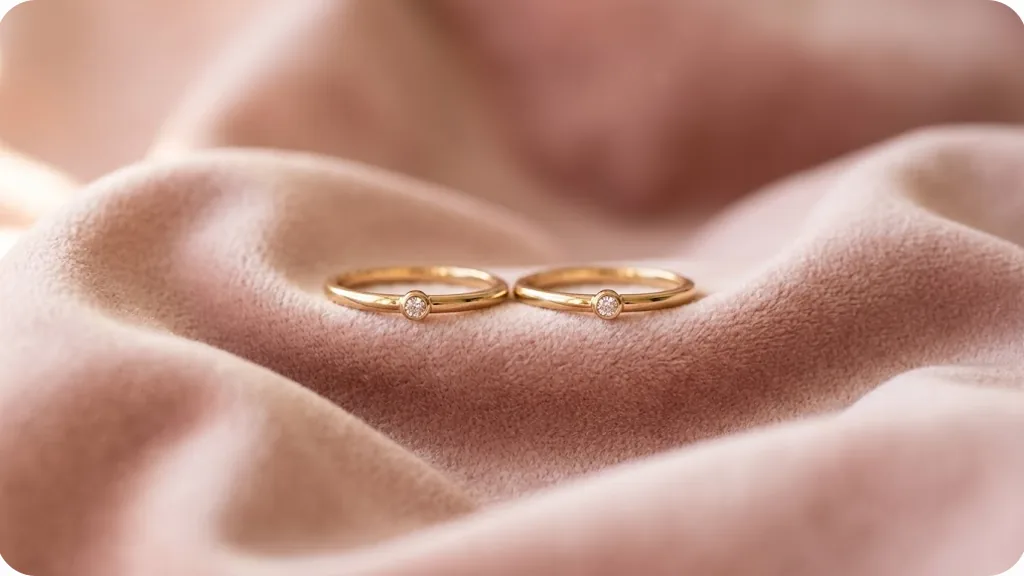
The design has moved with the buyers. The current version is more grown-up than the old one: less heart-shaped, less obviously teenage, more like a real piece of fine jewellery that happens to be smaller than an engagement ring.
Three patterns cover most of what people actually choose.
The stacking band. Slim, set with small stones along part of the top, designed to be worn with other rings. It is the most flexible choice because it still works if an engagement ring joins it later. A stackable pear cut ring at £503 (correct at the time of writing) is a straightforward example.
The small solitaire. One modest stone in a clean setting, for someone who likes classic jewellery. A minimalist round cut solitaire at £587 keeps the shape without the scale that would read as an engagement ring.
The plain or textured band. No stone at all, all the money in the metal. Unisex, indestructible and impossible to date. A minimalist round cut wedding band at £687 sits in this group.
What lab-grown diamonds changed
One practical development matters more than any trend. Lab-grown diamonds are chemically and optically identical to mined ones, graded on the same scale by the same laboratories, and cost significantly less for the same size and quality. That has moved the promise ring out of the territory of plated metal and imitation stones.
Ten years ago, a modest budget bought something that looked like fine jewellery. Today the same budget buys actual fine jewellery: a certified diamond in solid gold or platinum. Our centre stones come with a free IGI certificate, so the grades are independently documented.
Is a promise ring still taken seriously?
By the two people involved, yes, and that is the only audience that counts. Outside the couple, reactions vary — some people treat it as a lovely tradition and others find the whole idea slightly puzzling. If you are worried about how it will be received by family, the answer is usually to describe it in plain words rather than by category. “We wanted to mark five years together” lands better than “it is a promise ring” with anyone who has not come across the term.
How to give one now without it feeling dated
The part of the old promise ring tradition that has aged worst is the presentation, not the ring. Anything that borrows the staging of a proposal — the restaurant, the box produced at the end of the meal, the kneeling — creates a moment of confusion that is difficult to recover from.
What works better is smaller and more private. Give it at home, on an ordinary evening, or on a date that already means something to the two of you. Say what it is in your own words before it is opened rather than after. The whole point of a promise ring is that it is not a performance, and the giving should match that.
If other people will see it and ask, agree in advance what you will both say. Couples who have not had that conversation end up giving different answers to the same relative, which is where the awkwardness usually starts.
Engraving: the detail that has not gone out of fashion
Of everything in this category, engraving is the element that has survived every change in taste. A date, a place, a few words, or a pair of initials inside the band costs very little and is the part the wearer notices for years afterwards.
Keep it short. A slim band has limited room, and a long message shrinks the lettering to the point where it wears away faster. Somewhere between two and six words, or a date, is the practical range on most rings. Ask before you buy whether engraving affects the return period, because on many rings a personalised piece cannot be sent back.
How to decide
- Is there something specific this ring is marking? If you cannot name it, wait.
- Does the other person like wearing rings at all? Some people genuinely do not.
- Will it be understood as a proposal? If that would be a problem, avoid a large single stone on the left ring finger.
- Can you afford it comfortably? A promise ring should not come with a debt attached to it.
Frequently asked questions
Do people still give promise rings, or has it become an American thing?
They are still given in the UK. The vocabulary is more common in the United States, which is why some British buyers describe the same gift differently without using the term at all.
Is a promise ring taken as seriously as an engagement ring?
No, and it is not meant to be. An engagement ring signals an intended marriage. A promise ring signals commitment without that specific undertaking.
Is there an age at which a promise ring stops making sense?
No. Plenty are bought by couples in their thirties and forties who have no wedding planned.
Can a promise ring become the engagement ring later?
It can, if the design suits it. Many people prefer to keep them separate and stack the two, which is why slim stacking bands are so popular in this category.
What if we do not want to marry at all?
Then a promise ring is arguably the most appropriate ring there is. It marks the commitment without borrowing the language of a wedding.
If you want to see the designs people actually choose for this, browse our stone-set ring collection or the plainer band and eternity ring collection. Everything is hand-made in solid gold or platinum, with free insured UK delivery and 30 days to return it.
Ready to find your perfect ring?
Explore our lab-grown diamond collection or book a virtual appointment with our team.











