
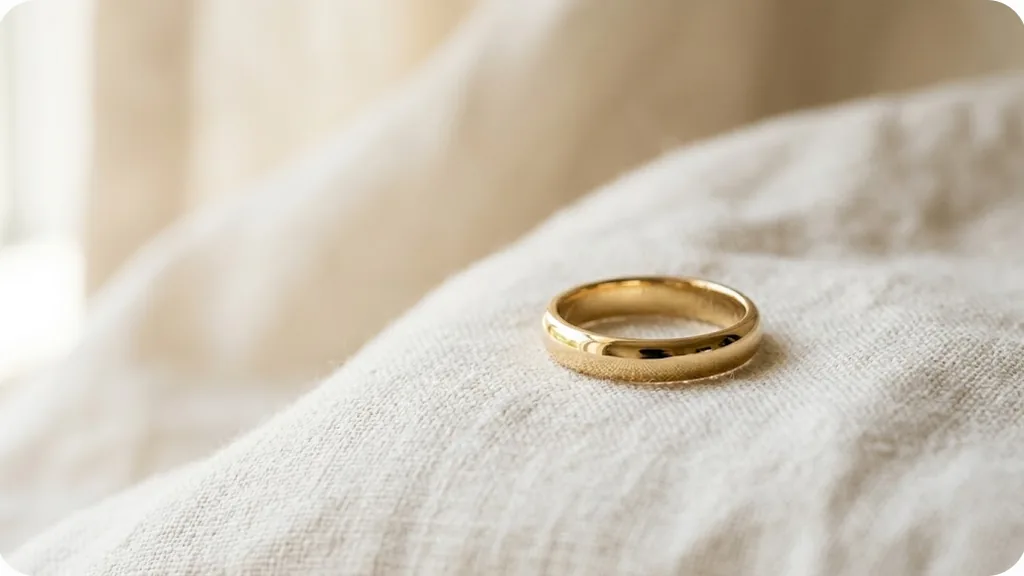
Can You Change Your Wedding Ring?
Yes, you can change your wedding ring. Resizing, reshanking, resetting stones, adding a band, and what to do with the original.
Yes, you can change your wedding ring. People do it all the time, and there is no rule, tradition or superstition that says the ring you were married in has to be the ring you wear at seventy. What there is, occasionally, is a partner who will mind — so this article covers both the practical options and the conversation.
Why people change theirs
The reasons are more ordinary than you might expect.
It no longer fits. Fingers change with age, weight, pregnancy, arthritis and simple time. A ring that spins or will not go past the knuckle stops being worn.
It has worn out. A thin band worn daily for twenty years genuinely wears through. Gold is soft, and a ring that has been catching on things since 2005 may now be a repair job rather than a ring.
The budget was tight then and is not now. Extremely common, and nothing to feel awkward about. Plenty of people married young with whatever they could afford.
Taste changed. You were twenty-four. You are now forty-one. It would be strange if nothing had shifted.
A milestone. A significant anniversary, a birth, or coming through something hard.
The metal is a problem. Some people develop a nickel sensitivity to certain white gold alloys years into wearing a ring.
The options, from smallest to largest change
| Option | What happens | Keeps the original? |
|---|---|---|
| Clean and re-polish | Jeweller removes scratches, restores shine | Yes, entirely |
| Re-plate (white gold) | Fresh rhodium plating restores the white finish | Yes, entirely |
| Resize | Band cut, metal added or removed, rejoined | Yes, mostly |
| Reshank | Worn lower half of the band replaced | Top half and stones |
| Reset the stones | Original stones moved into a new design | The stones only |
| Add a second ring | An eternity band joins the stack | Yes — nothing is altered |
| Buy a new ring | The original is kept, not worn | Yes, as an object |
Notice how many options keep the original ring intact. People assume changing means replacing, and it usually does not have to.
Adding rather than replacing
This is the solution most couples land on, and it is worth putting first. Instead of changing the wedding ring, add a band beside it.
It costs less than a full replacement, it changes the look of the hand completely, and it leaves the original ring exactly as it was on the day. A stackable round cut three-quarter eternity band next to a plain wedding ring transforms a modest stack. A stackable emerald cut half eternity band does the same with a calmer, step-cut sparkle.
It also sidesteps the emotional question entirely. Nobody can object to a ring being added.
Resizing: what is actually possible
Resizing means cutting the band, adding or removing metal, and soldering it closed. On a plain band this is routine and inexpensive.
On a stone-set band it depends on where the plain metal is. A half eternity ring has a plain section at the back and can generally be adjusted within limits. A full eternity ring usually cannot be resized at all, because there is nowhere to cut without going through a setting.
There are limits even on plain bands. Going up or down more than about two sizes starts to distort the ring’s proportions, and a very wide band is harder to size than a narrow one. A jeweller will tell you what is realistic for your specific ring.
Resetting the stones
If the sentiment lives in the diamonds rather than the metal, resetting is often the right answer. The original stones come out and go into a new design — the same diamonds, a ring you actually want to wear.
This works particularly well for inherited rings, where the stone matters and the setting is somebody else’s taste from 1962. It also works when a ring has worn thin: the metal is finished, but the stones are not.
Bring the ring in and have it assessed first. Older stones are sometimes chipped in ways that only show under magnification, and it is better to know before the design work starts.
The conversation
Here is the part that has nothing to do with jewellery.
Some people are entirely unbothered. Others attach real meaning to the specific object that was on the table at the ceremony, and discovering that your partner wants to replace it can land badly if it arrives as a fait accompli.
Say it early and say it plainly. “My ring doesn’t fit and I don’t really wear it any more — can we look at doing something?” is a very different conversation from arriving home with a new ring on.
Frame it around wearing, not upgrading. The honest argument is usually the strongest one: a ring that lives in a drawer is not doing its job, and one you put on every morning is.
What to do with the old one
Do not trade it in without thinking. Options that people are happier with, years later:
- Keep it as it is. The simplest and most common. It costs nothing to put a ring in a box.
- Wear it elsewhere — on the right hand, a different finger, or on a chain.
- Pass it on. A child or grandchild may want it precisely because it is the original.
- Reset the stones into the new ring so it is literally the same diamonds.
- Melt the metal into the new band. A jeweller can incorporate old gold, which puts the original material into the new ring.
That last one is worth knowing about. It is not always practical — alloys and purity have to be checked — but where it works, it gives you a new ring that is partly made of the old one.
What we can do
We are a workshop, not just a shop. We make everything in North Harrow in solid gold, platinum and sterling silver, set with lab-grown diamonds that carry a free IGI certificate on centre stones. Bespoke design costs nothing extra — you pay for metal and stones, not for the drawings.
If you want a new band designed to sit against a ring you already own, or an old stone reset into something you will wear, that is exactly the kind of work we do. Free insured UK delivery and 30 days to return on everything.
What it costs, roughly
Prices vary by jeweller, but the order of magnitude is consistent and worth knowing before you decide.
Cleaning and re-polishing is the cheapest job by far. Re-plating white gold is comparably modest and takes a few days. Resizing a plain band is straightforward work; resizing a stone-set band costs more because settings may need checking afterwards. Reshanking — replacing the worn lower half of a band — is a bigger job again. Resetting stones into an entirely new ring is effectively buying a new ring with the stones supplied.
Get a quote before agreeing to anything, and ask specifically whether the stones will need resetting afterwards, because that is where an unexpected cost usually appears.
Timing
Nothing here is quick. Resizing takes days to weeks depending on the jeweller’s workload. A reshank or a reset is weeks. A bespoke ring built around existing stones takes longer still.
If you are aiming at an anniversary, start at least two months ahead. And do not send a ring away over a period when you would mind being without it — plenty of people underestimate how odd a bare finger feels after twenty years.
Frequently asked questions
Is it bad luck to change your wedding ring?
No. There is no superstition attached to replacing or altering a wedding ring. The folklore concerns removing it, and even that is just folklore.
Can you upgrade a wedding ring?
Yes — by resizing, reshanking, resetting the stones, adding an eternity band, or buying a new one. Adding a band beside the original is the least drastic and often the most satisfying.
What do you do with the original wedding ring?
Most people keep it. Wearing it on the other hand or on a chain, passing it on, or melting the gold into the new ring are all common.
Can a wedding ring be resized after many years?
Usually yes, if it is plain or a half eternity. Very worn bands may need reshanking first. Full eternity rings generally cannot be resized at all.
Should we change both rings at once?
Only if you both want to. There is nothing odd about one person getting a new ring while the other keeps the original.
If you are considering adding rather than replacing, our wedding and eternity band collection is the place to look, and our guide to wearing stackable wedding rings shows how the stacks come together.
Ready to find your perfect ring?
Explore our lab-grown diamond collection or book a virtual appointment with our team.











