Is It Bad Luck to Buy Your Own Wedding Ring?
No, buying your own wedding ring is not bad luck. Nor is a second-hand ring or trying on someone else's. The real risks are sizing and fit.
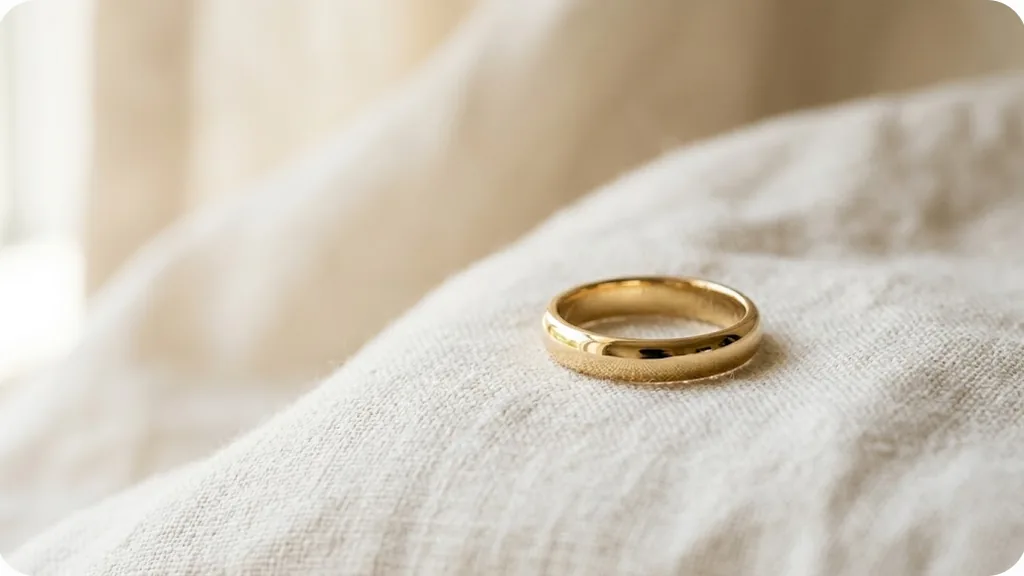
Buying your own wedding ring is not bad luck. No mainstream British wedding tradition forbids it, no religious ceremony requires the ring to be a gift, and UK marriage law does not mention rings at all. The only real risk is practical: a ring you choose alone still has to fit, suit your job and sit against your engagement ring.
Is it bad luck to buy your own wedding ring?
No. Buying your own wedding ring carries no recognised superstition in Britain, and jewellers see couples do it constantly. Plenty of people buy their own band because they know their own taste, their own finger size and their own budget better than anyone else does. Some partners buy each other’s rings, some buy their own and swap them for the ceremony, and some walk in together and pay separately. None of these is considered unlucky. If someone tells you otherwise, they are repeating a family habit, not a rule.
Where does the “don’t buy your own ring” idea come from?
The idea that you should not buy your own wedding ring is a modern echo of the engagement ring, not the wedding ring. Engagement rings were historically bought by one person as a surprise gift, and that gift-giving expectation has drifted sideways onto the wedding band. In reality the wedding band has almost always been chosen jointly, because both rings are exchanged at the same moment in the ceremony and are usually bought as a pair. There is no folklore tradition in the UK that punishes a person for buying their own band.
Is it bad luck to buy a used or second-hand wedding ring?
A used or second-hand wedding ring is not bad luck, and an inherited one is often treasured. The superstition people half-remember is about a ring from a marriage that ended badly, which is a matter of feeling rather than fortune. The practical questions matter far more. A second-hand ring may be worn thin on the underside, may have a stretched or previously resized shank, and may carry an engraving that has to be polished out. Ask to see the hallmark, ask whether the band has already been sized more than once, and have a jeweller check the wall thickness before you buy.
Is it bad luck to try on someone else’s wedding ring?
Trying on someone else’s wedding ring is not bad luck, and it is genuinely useful. Slipping on a friend’s or a relative’s band is one of the easiest ways to learn what width and profile you actually like before you order. The superstition that it “steals” their marriage has no basis and no place in a jeweller’s shop. Two sensible cautions apply: never force a ring past your knuckle, because a stuck ring on a warm hand is a real problem, and take it off before washing your hands so it cannot go down a drain.
Which wedding ring superstitions do UK couples still mention?
The table below lists the wedding ring beliefs customers raise most often at the counter, and what is actually true about each one.
| The belief | What is actually true |
|---|---|
| Buying your own wedding ring is unlucky | No tradition supports this. It is common and perfectly normal. |
| A second-hand ring carries the last marriage with it | Sentiment, not fortune. Check the wall thickness and hallmark instead. |
| Trying on another person’s ring is unlucky | No basis. It is one of the best ways to test width and profile. |
| Wearing the ring before the wedding is unlucky | A widely repeated belief with no origin anyone can trace. The practical risk of loss is the real reason to keep it boxed. |
| A ring that will not go on at the ceremony is a bad sign | It is a sign of warm hands and nerves. Fingers swell on the day. |
| The ring must never come off once worn | Not true. Removing it for the gym, gardening or heavy lifting protects it. |
If you would like the full account of the pre-wedding version of this question, we cover it in can you wear your wedding ring before the wedding.
What actually goes wrong when you buy your own wedding ring?
The problems with buying your own wedding ring are practical, and all of them are avoidable. The three we see most at the bench are: a band ordered in the wrong width so it fights the engagement ring; a size measured on a cold morning that is then too tight in July; and a heavily set band chosen by someone whose job involves gloves, tools or a keyboard all day. None of this is luck. It is measuring, timing and honest thinking about your hands. Order early enough that a resize before the wedding is still possible.
How to buy your own wedding ring well
Buying your own wedding ring works best when you treat it as a fitting exercise rather than a shopping trip. A short checklist:
- Measure your finger at the end of the day, at normal room temperature, never when cold or after exercise.
- Try the width before the design. Most people settle between 2 mm and 3 mm for a women’s band and 4 mm to 6 mm for a men’s.
- Hold the band against your engagement ring, not next to it on a tray. A curved or shaped band solves most gaps.
- Decide about engraving before you order, because it is easier to engrave a band before the stones go in.
- Allow four to six months where you can, so there is room for a resize.
Our own three-part test for how tight a wedding ring should fit takes about a minute and saves most of the resizes we are later asked to do.
What CarbonstoneUK makes, and what happens if you buy your own
CarbonstoneUK is a lab-grown diamond jeweller based in North Harrow, London, and every band is hand-made in solid gold or platinum. If you are choosing your own band, the simplest starting points are the Minimalist Round Cut Wedding Band at £687, the Ocean Wave Round Cut Wedding Band in Yellow Gold at £657, or the Stackable Round Cut Three Quarter Eternity Band at £762 if you want diamonds across the front. Prices are correct at the time of writing. Centre stones come with a free IGI certificate, delivery in the UK is free and insured, and returns run for 30 days, which matters when you have chosen alone. You can see the whole range in our wedding ring collection.
Frequently asked questions
Is it bad luck to buy your own wedding ring?
No. There is no British tradition or religious rule against buying your own wedding ring, and it is common practice. The ring is exchanged at the ceremony regardless of who paid for it. The only genuine risks are practical ones: sizing, width and whether the band sits flat against an engagement ring.
Is it bad luck to buy a used wedding ring?
No. A second-hand or inherited wedding ring carries no bad luck. What it can carry is wear: a thin underside, a shank that has already been cut and resized, or an old engraving. Ask a jeweller to check the wall thickness and confirm the hallmark before you commit to buying it.
Is it bad luck to try on someone else’s wedding ring?
No. Trying on another person’s wedding ring has no effect on either marriage and is a practical way to test widths and profiles. Only two cautions apply: do not force a ring over a knuckle, and take it off before washing your hands so it cannot be lost down a drain.
Can I buy my own wedding ring and still be surprised on the day?
Yes. Many couples buy their own bands and hand them to a witness or the person conducting the ceremony, so neither of you sees the other’s ring until the exchange. Some buy their own band, then have their partner choose the engraving inside it. Both approaches keep the surprise without risking the fit.
Do both wedding rings have to be bought by the same person?
No. There is no rule about who pays for wedding rings in the UK. Couples commonly split the cost, buy each other’s band as a gift, or each buy their own. Buying both from the same jeweller is worth considering for a different reason: matching metal colour and finish is far easier in one workshop.
Is it unlucky if my wedding ring does not fit on the wedding day?
No, it is physiology. Fingers swell in heat, with nerves, with alcohol and after a long day standing. If the band will not pass the knuckle at the ceremony, push it to the first joint and move it afterwards. Nobody watching will notice, and no tradition treats it as an omen.
Should I tell people I bought my own wedding ring?
That is entirely your choice, and it has no bearing on the marriage. Most jewellers would say the ring you wear every day for decades matters more than the story of who paid for it. If you chose it yourself, you are also far more likely to still like it in twenty years.
If you are choosing your own band, take your time over width and fit before design. Our wedding rings are hand-made to order in solid gold and platinum, and if nothing on the page is right we will design one with you at no extra design cost.
More guides on this topic
Ready to find your perfect ring?
Explore our lab-grown diamond collection or book a virtual appointment with our team.