Why Choose a Pear Cut Diamond? Meaning, Symbolism and Who It Suits
The pear is the shape with the strongest symbolism attached to it. Where that comes from, what the cut does well and badly, and how to choose one.
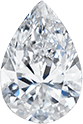
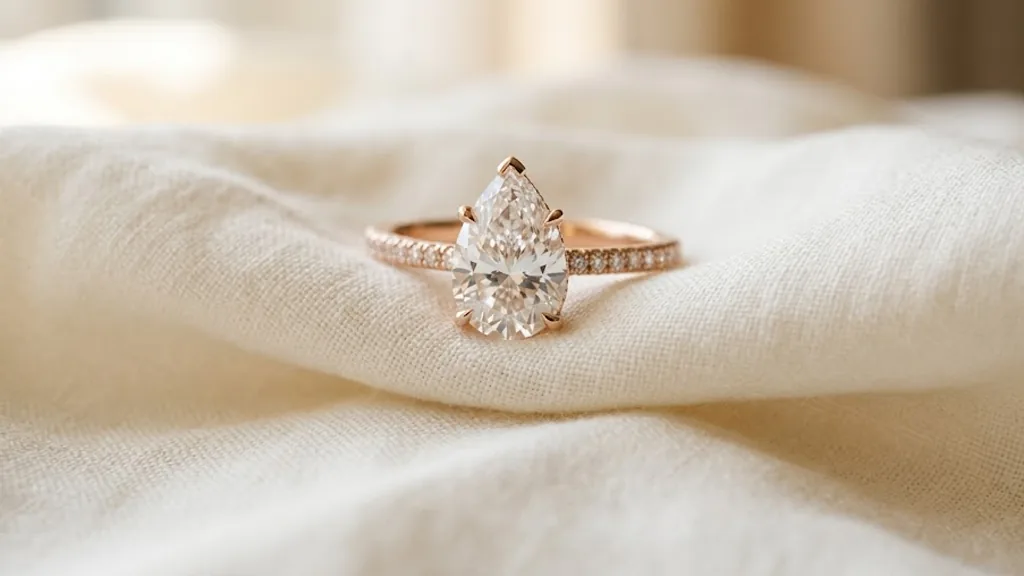
The pear cut is the shape people either fall for immediately or never consider at all. Round at one end, pointed at the other, it is usually described as a teardrop, and it is one of the few diamond shapes that carries a widely understood meaning of its own.
This guide covers what that meaning is and where it came from, what the shape does well and badly, who it suits, and how to choose one. If you want the size question specifically, we have written separately on how big a 1 carat pear shaped diamond is.
Where does the pear cut come from?
The pear, or pendeloque, is one of the older diamond shapes still in regular use. It is commonly credited to Lodewyk van Bercken, a Flemish cutter working in Bruges in the fifteenth century, who is also credited with early work on polishing wheels.
Treat that attribution with a little care. It is repeated everywhere, but the documentation from that period is thin and the story has been tidied by centuries of retelling. What is not in doubt is that the shape is genuinely old, which is one reason it does not read as a passing fashion.
What is a pear cut diamond said to symbolise?
The usual reading is tears — and, depending on who is telling it, either tears of joy or the tears of a long separation. A gentler version reads the shape as a drop of water, and therefore as renewal or new beginnings. Some people read the two ends as two people, one rounded and one pointed, joined into a single form.
None of this is fixed, and none of it is documented in any way that would satisfy a historian. Diamond symbolism is folklore rather than fact, and the honest position is that a pear means what you decide it means. What is true is that the shape has a stronger sense of meaning attached to it than most, which is exactly why so many people choose it for a ring that is marking something.
What are the practical advantages of a pear cut?
| Advantage | Why |
|---|---|
| Looks larger than its weight | The elongated outline puts more surface area facing upwards than a round of the same carat |
| Elongates the finger | Worn with the point towards the fingernail, it visually lengthens the hand |
| Costs less than a round | Less of the rough crystal is wasted in cutting; see our note on whether pear shaped diamonds are cheaper than round |
| Distinctive without being difficult | Far less common than round or oval, but still instantly readable as a classic shape |
What are the drawbacks of a pear cut diamond?
The point is vulnerable. The tip is the thinnest part of the stone and can chip if struck. A setting with a claw covering the point — sometimes called a V-claw — solves this, and we would not recommend a daily-wear pear without one.
The bow tie. Like all elongated shapes, a pear shows a shadow across the centre. A soft one is normal and adds depth. A hard black band is not, and no certificate will warn you about it, so the stone has to be looked at in movement.
Symmetry is visible. If the two shoulders of the pear are not level, or the point does not sit centrally, the eye notices. Look at the stone straight down before anything else.
It rotates. An asymmetric stone on a slim band will turn, leaving the point sitting sideways. Correct sizing fixes most of it. Our guide on which way to wear a pear shaped diamond covers the convention.
Who does a pear cut diamond suit?
Pear flatters most hands, and it is particularly good on shorter fingers because the length of the stone extends them. On very long fingers, a broader, shorter pear usually looks better proportioned than a long narrow one.
It suits someone who wants a ring with character but does not want to explain their choice. Unlike some of the more unusual shapes, a pear needs no justification — people recognise it immediately and read it as classical rather than eccentric.
It is less suitable for someone who never takes rings off and works hard with their hands, purely because of the point. If that describes the wearer, a bezel setting that wraps metal around the whole outline is the answer.
Which pear cut designs are worth knowing about?
Pear is our deepest shape after round, with eleven designs, so there is a genuine range to choose between. Four that show the span, prices correct at the time of writing:
The quietest. A stackable pear cut ring at £503 keeps the shape small and slim, and stacks against other rings.
The two-stone. A toi et moi pear cut ring in white gold at £685 sets two stones side by side. Toi et moi is French for “you and me”, which makes it the most literally symbolic ring we make.
The classic. A pear cut engagement ring in yellow gold at £938 is the straightforward version, with the warmth of yellow metal behind the stone.
The vintage. A cluster pear cut ring in sterling silver at £729 builds the shape from smaller stones, which gives an antique character at a lower price.
How does metal colour change a pear cut diamond?
The pear is more affected by its setting metal than a round is, because the broad end shows a large flat expanse of stone that picks up colour from whatever sits beneath it.
- White gold and platinum keep the stone looking as cold and white as possible. This is the choice if you want the diamond to read as bright and modern, but it also means any warmth in the stone’s colour grade shows more clearly.
- Yellow gold warms the stone and is forgiving of a slightly warmer colour grade, which can save money without any visible loss. It also gives the shape a softer, more antique character.
- Rose gold is the most distinctive, and it suits the vintage-leaning pear designs particularly well.
This is a genuinely useful lever. If your budget is tight, a slightly warmer stone in yellow or rose gold will often look better than a whiter stone in platinum at the same price, because the metal and the stone agree with each other.
Do pear rings work as bridal sets?
Because the point of a pear interrupts the line of a straight wedding band, several of our pear designs are built as matched sets from the start, with the band shaped to fit around the stone. It is worth considering at the point of buying the engagement ring rather than two years later, when your options narrow to whatever happens to fit.
A curved pear cut bridal set at £999, correct at the time of writing, shows how a band designed alongside the ring sits flush against it. You can see the rest in our bridal set collection.
How do you choose a pear cut diamond?
- Look at the stone straight down first, checking symmetry and the position of the point.
- Tilt it and watch the centre. A shadow that moves and refills is fine; a fixed black band is not.
- Decide whether you want a broad, rounded pear or a long, narrow one. Both are correct.
- Insist on a protected point in the setting.
- Check the stone is certified. Ours come with a free IGI certificate on centre stones.
Frequently asked questions
Is a pear cut diamond unlucky because it represents tears?
No. That reading is folklore, and the equally common reading is tears of joy. There is no superstition of any weight attached to the shape.
Which way should the point face?
Traditionally towards the fingernail, which lengthens the finger. Wearing it the other way is a matter of preference, not a mistake.
Are pear cuts hard to pair with a wedding band?
A straight band works with many pear settings, but a curved or shaped band that follows the point often looks better. Several of our pear designs are sold as matched bridal sets for exactly this reason.
Do lab-grown pear diamonds differ from mined ones?
Only in origin. The crystal, hardness and grading scale are identical, and the cutting challenges are exactly the same.
Can you make a pear ring to a specific length-to-width ratio?
Yes. We source and set to order, and bespoke design carries no extra design cost.
All eleven designs are in our pear cut collection, and you can compare them with everything else in the engagement ring range. Hand-made in solid gold and platinum in North Harrow, London, with free insured UK delivery and 30-day returns.
Ready to find your perfect ring?
Explore our lab-grown diamond collection or book a virtual appointment with our team.