Is a J Colour Diamond Too Yellow?
A J colour diamond is not too yellow for most rings. Where J sits on the D-Z scale, which metals suit it, and when to go higher.
A J colour diamond is not too yellow for most engagement rings. J is the last grade in the near-colourless band of the D-to-Z scale, so it carries a faint warmth rather than a visible yellow. In yellow or rose gold a J looks white to the naked eye. The tint shows most in large stones, in step cuts such as emerald, and against platinum or white gold.
Where does J sit on the diamond colour scale?
J is the fourth and final grade in the near-colourless band, which runs G, H, I, J. Above it sits the colourless band of D, E and F; below it the faint band begins at K. Diamond colour is graded by comparing a stone against master stones, face-down, under controlled lighting — a position in which graders can see differences that nobody sees on a hand. J is the point on the scale where the trade generally stops calling a stone white and starts calling it warm.
This table shows where J falls and what each band actually looks like when the ring is on a finger.
| Grades | Band | What you see face-up | Relative price |
|---|---|---|---|
| D, E, F | Colourless | No tint in any metal | Highest |
| G, H | Near colourless | No tint visible to most people in any setting | High |
| I, J | Near colourless | Faint warmth; invisible in warm metals, occasionally noticeable in platinum | Moderate — the value zone |
| K, L, M | Faint | A gentle warm cast that most people can see | Lower |
| N to Z | Very light to light | Clearly tinted in any setting | Lowest |
Does a J colour diamond look yellow to the naked eye?
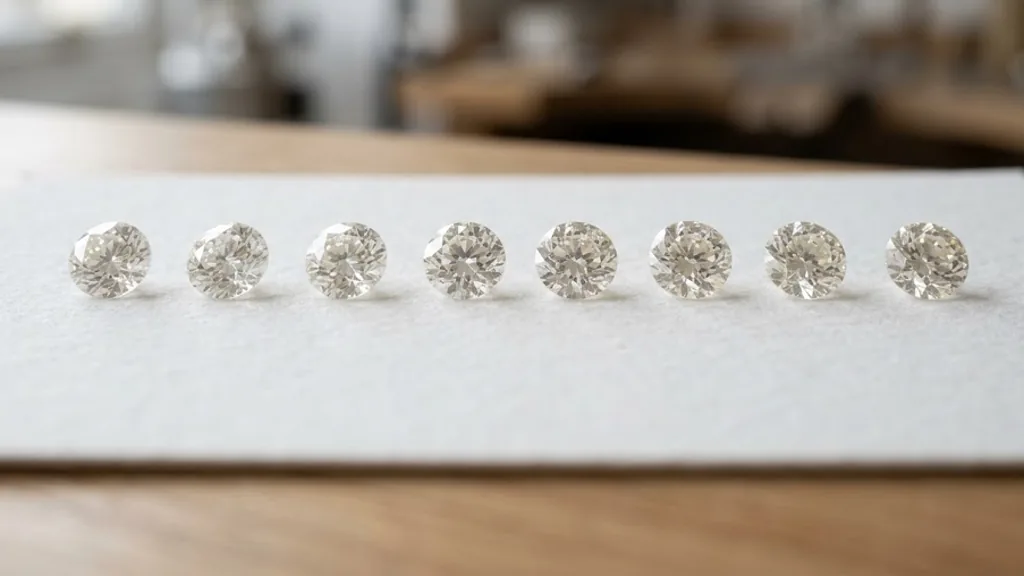
A J colour diamond does not look yellow to most people in normal conditions. The warmth in a J is subtle enough that it is hard to see at all unless the stone is placed directly beside a higher-graded diamond of the same shape and size. Graders spot it because they view stones face-down against a white tray, which removes the sparkle that masks colour when you look at a ring from above. Wearing a J on your hand, you see reflection and fire long before you see body colour.
Which metals suit a J colour diamond?
Yellow gold and rose gold suit a J colour diamond perfectly, and they are the reason so many buyers choose one deliberately. Your eye judges colour by comparison, so a faintly warm stone set against warm metal simply reads as white. Set the same J in platinum or rhodium-plated white gold and the bright, cool metal sits right beside the stone and gives your eye a reference point, which is when the warmth becomes noticeable. If you have your heart set on white metal and on a J, a yellow gold basket under the stone is a common workaround.
Does diamond shape change how yellow a J colour looks?
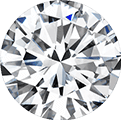
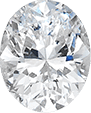
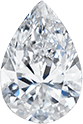
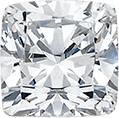
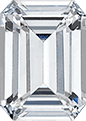
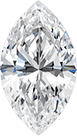
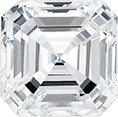
Shape changes it considerably. Round brilliants and other brilliant cuts hide colour best, because dozens of angled facets break light into flashes that distract the eye from body tint. Step cuts — emerald, asscher and baguette — have long, open, parallel facets that behave like clear windows, and they show colour far more honestly. Elongated brilliants such as oval, pear and marquise sit in between, and can concentrate colour at the tips. As a rule of thumb in the trade, not a measured figure, buyers who want a step cut go one or two colour grades higher than they would for a round.
Does the size of the diamond change how much J colour shows?
Size matters because light travels further through a bigger stone, and the further it travels through diamond, the more of the body colour it picks up. A J colour half-carat round looks white to almost everybody. The same grade at three carats has considerably more depth for the light to pass through, and the warmth becomes easier to see. A sensible guideline is that J is comfortable up to around one and a half carats in a brilliant cut, and worth reconsidering above two carats unless you are setting it in warm metal.
Is J colour good value in a lab-grown diamond?
J colour is good value, though the argument is weaker for lab-grown diamonds than it is for mined ones. In natural diamonds the price gap between a G and a J is large, so dropping to J frees real money for carat weight or cut. In laboratory-grown diamonds the whole colour range costs less and the steps between grades are gentler, so for many buyers the extra spend to reach G or H is affordable and worth taking. Where J still earns its place in lab-grown is in yellow and rose gold settings, where the higher grade buys you nothing you can see.
When should you avoid a J colour diamond?
Avoid J colour in three specific situations. First, in a step cut such as emerald or asscher set in platinum, where the open facets and the cool metal both work against you. Second, in a large centre stone above roughly two carats, where the extra depth shows the tint. Third, where the centre stone sits against a halo or pavé of higher-graded small diamonds — mismatched colour between the centre and the surround is far more obvious than the centre’s own grade would ever be on its own.
What is the difference between a J colour and a K colour diamond?
J is the bottom of the near-colourless band and K is the top of the faint band, so K is the first grade at which most people can see warmth without a comparison stone. The visual difference between one adjacent grade and the next is small, but the boundary is meaningful because it is where the trade’s language changes and where prices step down. In warm metal both can look excellent; in platinum, J is the safer of the two.
Frequently asked questions
Is a J colour diamond good for an engagement ring?
Yes, for most engagement rings. A J colour diamond in a brilliant cut, set in yellow or rose gold, looks white to the naked eye and costs less than a G or H of the same size and clarity. Put the saving into cut grade, which affects how much the ring actually sparkles far more than two colour grades ever will.
Can you see the difference between an I and a J colour diamond?
Almost nobody can, outside of laboratory conditions. I and J are adjacent grades in the same near-colourless band, and the difference is established by comparing a stone face-down against master stones under standardised lighting. Held face-up on a hand, in a setting, in ordinary light, the two are effectively indistinguishable. Comparing a J against an E or F is a different matter.
Will a J colour diamond still sparkle?
Yes. Sparkle is produced by cut, not by colour. A J colour diamond with an Ideal or Excellent cut grade will out-sparkle a D colour stone that has been cut too deep or too shallow, every time. Colour affects the tone of the stone; cut affects how much light comes back out of it. Cut is the C worth paying for.
Is a J colour diamond a fancy yellow diamond?
No. The D-to-Z scale grades how far a nominally white diamond departs from colourless, and J is only a faint step along it. Fancy colour diamonds are graded on an entirely separate system, starting beyond Z, using terms such as Fancy Light Yellow and Fancy Vivid Yellow. A J is a white diamond with a hint of warmth, not a coloured diamond.
Does J colour affect resale value?
Colour grade affects what a stone sells for, but the far larger factor is that all diamonds — laboratory-grown and mined — sell second-hand for a fraction of their retail price. Buying at J rather than G reduces what you paid in the first place, which usually leaves you no worse off proportionally. Buy the ring for wearing, not as an investment.
Should side stones match a J colour centre stone?
They should be close, and this matters more than people expect. Small accent diamonds are usually supplied in graded parcels rather than certified individually, and a halo of bright G-H melee around a J centre draws the eye straight to the difference. Ask what colour range the melee is, and choose a setting where the small stones sit slightly apart from the centre if the ranges do not line up.
What clarity should I pair with a J colour diamond?
VS2 or SI1 in a brilliant cut is the sensible pairing, and it is what most of our customers end up choosing. There is no benefit in spending on VVS clarity for a stone at J colour — the money is better placed in cut. In a step cut, go up to VS1 or better, because those long open facets show inclusions as clearly as they show colour.
See how metal changes what you see
CarbonstoneUK is a lab-grown diamond jeweller based in North Harrow, London. Every centre stone we set comes with a free IGI certificate, so the colour grade is stated in writing by an independent laboratory and you can check it yourself. Warm metals are where a J colour stone genuinely shines: our Vintage Round Cut Engagement Ring in Yellow Gold at £1,051 and the Solitaire Round Cut Engagement Ring in Rose Gold at £1,007 both surround the stone with warmth. For side stones set in yellow gold, the 5 Stone Pear Cut Engagement Ring in Yellow Gold at £528 is our most affordable way into the look. Prices correct at the time of writing. Browse all lab-grown diamond engagement rings or filter to round brilliants, where colour is easiest to hide. Hand-made in solid gold and platinum, free insured UK delivery, 30-day returns, and bespoke design at no extra design cost.
Ready to find your perfect ring?
Explore our lab-grown diamond collection or book a virtual appointment with our team.