What Is a Promise Ring? The Complete Guide
A promise ring marks a serious commitment that is not an engagement. Meaning, which finger, cost, metals and styles explained.
A promise ring is a ring given to mark a serious commitment between two people that is not yet an engagement. It carries no legal or formal status, and there is no single agreed meaning for it — the couple decide what it stands for. Most promise rings are simple bands or small stone-set rings worn on the ring finger of the right hand.
What does a promise ring actually mean?
A promise ring means whatever the two people exchanging it agree it means, and that is the honest answer rather than a dodge. In practice, jewellers see three common uses: a commitment to marry eventually but not yet, a marker of exclusivity in a relationship, and a personal promise such as sobriety, friendship or faith. Because there is no governing body and no tradition-setting authority behind promise rings, no definition is more "correct" than another. If it matters to you, say out loud what the ring stands for when you give it. Our full guide to whether a promise ring means anything goes into what customers actually tell us they intend by it.
How is a promise ring different from an engagement ring?
A promise ring differs from an engagement ring in intent, not in materials. An engagement ring announces a decision to marry and usually leads to a wedding date; a promise ring signals commitment without that decision being made. Engagement rings in the UK are typically built around a certificated centre diamond and worn on the left ring finger; promise rings are usually smaller, cheaper and worn on the right hand to avoid confusion. Nothing physically stops a promise ring from later becoming an engagement ring — some couples do exactly that. The detailed comparison is in promise ring vs engagement ring.
Which hand and finger does a promise ring go on?
A promise ring is most often worn on the ring finger of the right hand in the UK, which keeps the left ring finger free for an engagement ring later. There is no rule. Some people wear a promise ring on the left ring finger and simply move it when they get engaged; others wear it on the middle finger or on a chain around the neck. If you are buying as a surprise, the right-hand ring finger is usually about half a size larger than the left on the same person, because most people are right-handed. Which hand and finger a promise ring goes on covers the sizing detail.
When should you give a promise ring?
There is no correct point in a relationship to give a promise ring, and any "after X months" figure you read online is invented rather than measured. What matters is that both people understand the same thing by it. The moments customers most often choose are an anniversary, a long-distance separation starting, a birthday, or simply a quiet evening at home with no occasion attached. Avoid giving one at Christmas or on Valentine’s Day if you are worried it will be mistaken for a proposal — the expectation in the room is higher on those dates. See when to give a promise ring for how to handle the conversation.
Who buys the promise ring, and who pays for it?
Either person can buy a promise ring, and there is no convention about who pays. Unlike the engagement ring, which still carries an expectation in many families that one partner buys it, promise rings are frequently bought jointly, bought by the person receiving one for their partner, or exchanged as a matching pair with the cost split. Buying one for yourself is also entirely normal — a self-promise ring marking a personal goal is one of the fastest-growing reasons people ask us for a simple band. Read who buys the promise ring and buying a promise ring for yourself.
What does a promise ring look like?
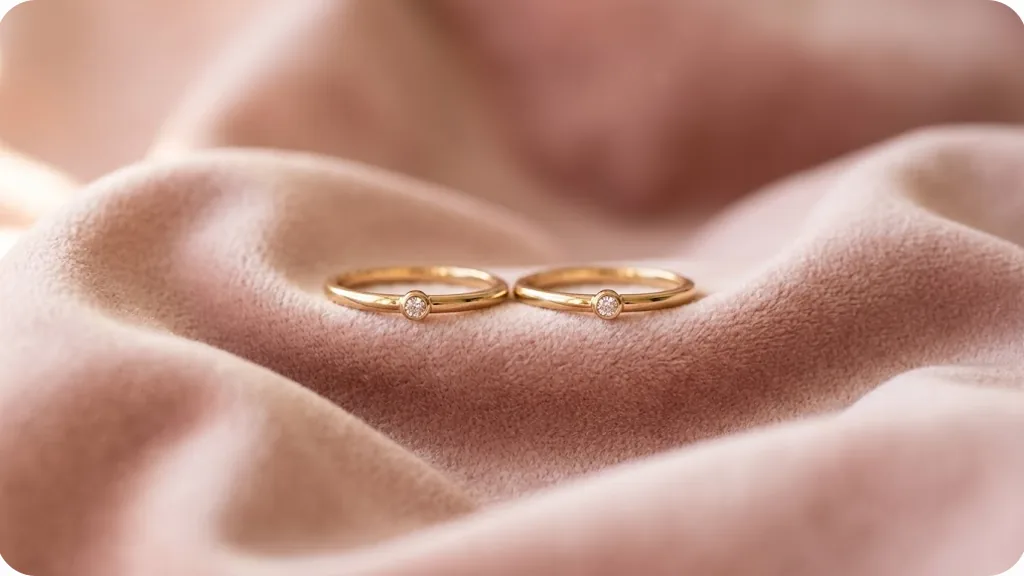
A promise ring usually looks understated: a plain or textured band, a thin pavé band, a small solitaire, or a design with a symbolic motif such as a heart, an infinity twist or two stones set side by side. The visual signal jewellers aim for is "meaningful but not a proposal", which normally means a smaller centre stone than an engagement ring and a lower profile that sits flat under gloves. There is no shape, metal or setting that is officially a promise ring. Our guide to what a promise ring looks like shows the styles people actually choose.
Do promise rings have diamonds in them?
Promise rings can have diamonds, and many do, but a diamond is not required. Where a diamond is used it is usually small — a single accent stone, a scattering of pavé, or a modest solitaire well under a carat — precisely so the ring does not read as an engagement ring. Lab-grown diamonds suit promise rings particularly well because they let a real, certificated diamond sit inside a promise-ring budget. Every centre stone we sell comes with a free IGI certificate. See do promise rings have diamonds for how to size the stone sensibly.
What are promise rings made of?
Promise rings are made from the same metals as any other ring: 9ct, 14ct or 18ct gold in yellow, white or rose, platinum, sterling silver, and harder industrial metals such as titanium and zirconium. The practical trade-off is that sterling silver is the cheapest but tarnishes and wears fastest, gold and platinum hold up to daily wear for decades, and titanium is tough but cannot be resized. If the ring is meant to be worn every day for years, solid gold is the sensible floor. What promise rings are made of compares the metals honestly.
How much does a promise ring cost in the UK?
Promise rings cost less than engagement rings because the stones are smaller, and most people spend well below what they would on a proposal. There is no reliable published UK average, and any figure quoted as one should be treated with suspicion. As a working guide, a plain sterling silver band sits at the low end, a solid gold band with accent diamonds in the middle, and a small lab-grown solitaire at the upper end. Our own lowest-priced rings start around £489 (correct at the time of writing). How much a promise ring costs sets out the real price bands.
This table compares the three ring types couples most often confuse, on the points that actually differ.
| Promise ring | Engagement ring | Wedding ring | |
|---|---|---|---|
| What it signals | Commitment, defined by the couple | An agreement to marry | Marriage |
| Usual finger | Right ring finger | Left ring finger | Left ring finger, below the engagement ring |
| Typical centre stone | None, or well under 1 carat | Often 0.5–2 carats | None, or small set stones |
| Who buys it | Either partner, or both | Usually one partner | Usually bought as a pair |
| Given as a pair | Often | Rarely | Almost always |
| Formal status | None | None in law, strong social meaning | Worn from the ceremony onward |
Do men wear promise rings?
Men wear promise rings, and matching pairs bought by two partners together are one of the most common promise-ring purchases jewellers see. Men’s promise rings tend to be wider, flatter bands in a harder-wearing metal, often with no stones or with stones flush-set so nothing catches. Width is the main practical decision: a 4mm to 6mm band suits most men’s hands, and anything wider will feel tight to size because a wide band needs a slightly larger size than a narrow one. Do guys wear promise rings covers men’s styles, and where to get a promise ring for your boyfriend covers buying one as a gift.
Should promise rings match?
Promise rings do not have to match, and plenty of couples deliberately choose different designs. Matching pairs work well when both people want the ring to read as a shared commitment at a glance. Mismatched pairs work better when one person wears a lot of jewellery and the other wears none, or when hand sizes are very different and the same band width would look wrong on both. A common middle path is the same metal and finish in two different widths, which reads as a set without forcing an identical design. Should promise rings match works through the options.
Where did promise rings come from, and are they bad luck?
Promise rings are not bad luck, and the superstitions attached to them are modern folklore rather than tradition. Rings exchanged as a pledge before marriage have a long documented history in Europe, including posy rings carved with a motto and gimmel rings that separated into two halves, but there is no unbroken line from those to the modern promise ring — the current version is largely a late twentieth-century revival. Anyone who tells you a promise ring "stops" a proposal is repeating a myth. Read where promise rings came from and are promise rings bad luck.
Are promise rings still popular, and can you make your own?
Promise rings are still bought regularly in the UK, and the reasons have widened rather than narrowed — self-promise rings, friendship rings and rings marking sobriety now sit alongside the traditional pre-engagement use. Making your own is possible for a simple band if you have access to a bench, but soldering, sizing and stone-setting are skilled jobs, and a home-made ring in a soft metal will not survive daily wear. A bespoke commission is usually the better route, and we charge no extra design fee for it. See are promise rings still a thing and how to make a promise ring.
Which promise ring guide should you read next?
This table maps every question people ask about promise rings to the guide that answers it in full.
| Your question | Guide |
|---|---|
| What does it actually mean? | Does a promise ring mean anything? |
| How is it different from an engagement ring? | Promise ring vs engagement ring |
| Which finger does it go on? | Which hand and finger? |
| When should I give it? | When to give a promise ring |
| Who buys it? | Who buys the promise ring? |
| Can I buy one for myself? | Buying a promise ring for yourself |
| What should it look like? | What does a promise ring look like? |
| Does it need a diamond? | Do promise rings have diamonds? |
| Which metal? | What are promise rings made of? |
| What will it cost? | How much does a promise ring cost? |
| Do men wear them? | Do guys wear promise rings? |
| Buying one for my boyfriend? | A promise ring for your boyfriend |
| Should ours match? | Should promise rings match? |
| Where did the tradition start? | Where did promise rings come from? |
| Are they unlucky? | Are promise rings bad luck? |
| Are they still a thing? | Are promise rings still a thing? |
| Can I make one myself? | How to make a promise ring |
What does CarbonstoneUK stock that works as a promise ring?
CarbonstoneUK does not sell a range labelled "promise rings", and we would rather say that plainly than invent a category. We are a lab-grown diamond jeweller in North Harrow, London, and we make rings only — no necklaces, earrings or bracelets. What works as a promise ring from our range is the quieter end of it: the Minimalist Round Cut Ring at £587, the Stackable Rose Cut Band in Sterling Silver at £489, and the Stackable Pear Cut Ring at £503 (all prices correct at the time of writing). You can browse the full range in engagement rings and wedding rings, and if nothing fits, we design bespoke at no extra design cost.
Frequently asked questions about promise rings
Is a promise ring the same as an engagement ring?
No. A promise ring signals commitment without a decision to marry; an engagement ring signals that the decision has been made and a wedding is intended. The rings can look similar, and the difference is entirely in what the couple say it means. Promise rings are usually worn on the right hand for that reason.
Can a promise ring be used later as an engagement ring?
Yes. Nothing stops a promise ring being re-purposed as an engagement ring — move it to the left ring finger and it functions as one. Some couples do this deliberately to keep the same ring throughout. If you want it to feel like a new ring, a jeweller can reset the stone into a different mount rather than starting again.
Do you wear a promise ring and an engagement ring at the same time?
Many people do. The usual arrangement is the engagement ring on the left ring finger and the promise ring moved to the right hand or to another finger. There is no etiquette rule forcing you to remove a promise ring once engaged, and keeping it on is common where it carries its own separate meaning.
How much should you spend on a promise ring?
Spend what is comfortable, because there is no trade convention for promise rings and no reliable published UK average. The one-to-three-months-salary idea attached to engagement rings was a marketing line, not a measured figure, and it has never applied to promise rings at all. Most customers spend noticeably less than they would on an engagement ring.
Which finger do you wear a promise ring on if you are single?
Any finger you like — a self-promise ring has no convention attached. The right ring finger and the right middle finger are the most common choices because both read as decorative rather than as a relationship signal. If the ring marks a personal goal, choose the hand you will notice it on most.
Are lab-grown diamonds suitable for a promise ring?
Yes, and they suit promise rings especially well. A lab-grown diamond is chemically and optically the same material as a mined diamond, so it looks identical, and the lower price means a certificated stone fits a promise-ring budget. Every centre stone we supply comes with a free IGI certificate confirming its grades.
Can a promise ring be resized?
Usually yes, if it is gold, platinum or silver and the band is not fully set with stones all the way round. Full eternity-style bands and rings in titanium or zirconium generally cannot be resized and must be remade. Get the finger measured properly before buying rather than relying on a guess, especially for a surprise.
If you are choosing a promise ring and want a second opinion on size, metal or stone, we are happy to talk it through before you buy. Every order includes free insured UK delivery and 30-day returns, and our bespoke service carries no extra design fee.
Ready to find your perfect ring?
Explore our lab-grown diamond collection or book a virtual appointment with our team.