How to Clean a Diamond Engagement Ring (and How Often)
The five-minute soak that restores sparkle, a realistic cleaning schedule, white gold and rhodium advice, and what never to use.
Your engagement ring will look duller three months after you get it than it did on the day. Nothing is wrong with it. Diamonds attract grease, and an engagement ring — unlike a plain band — has a raised stone, claws, and gaps underneath where hand cream, soap and skin oils collect.
The good news is that five minutes with washing-up liquid and a soft toothbrush restores almost all of it. Here is exactly how, how often, and the specific things that will damage your ring if you get them wrong.
Why an engagement ring dulls so quickly
A diamond sparkles because light enters the top, bounces around inside, and comes back out at you. That journey depends on clean, clear surfaces.
Diamond is oleophilic — it actively attracts oil. A thin, invisible film of grease on the underside of the stone scatters the light before it can bounce back, and the whole diamond goes flat and grey. The film is almost always underneath, where you cannot see it and where a quick wipe with a cloth never reaches.
That is why polishing the top of your ring does nothing. You have to get underneath the stone.
How to clean a diamond engagement ring at home
This method works on every metal and every setting we make.
- Block the plughole. Do this first, every time. It is the single most common way rings are lost.
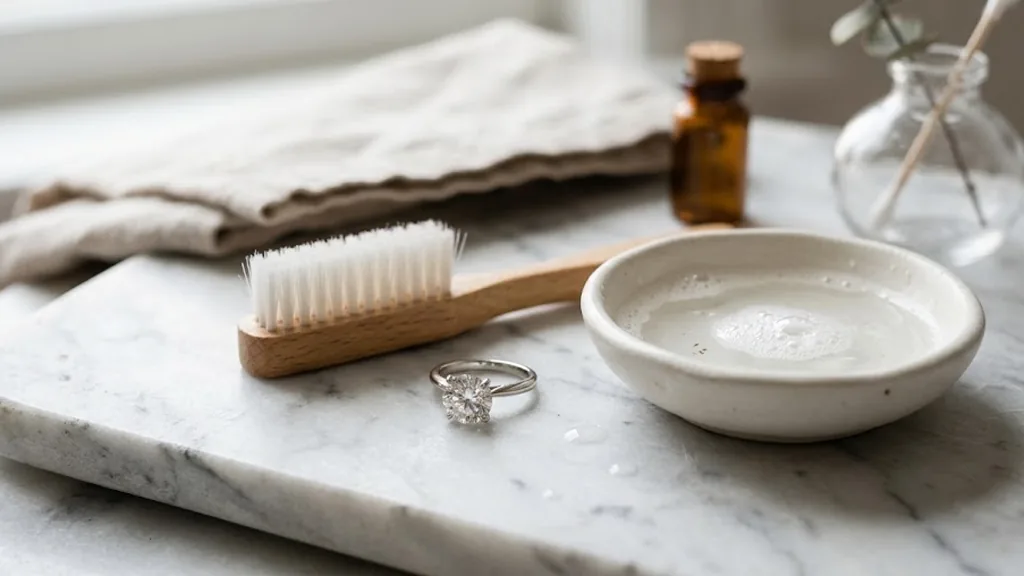
- Mix the bath. A small bowl of warm — not hot — water with a couple of drops of ordinary washing-up liquid. Nothing else is needed.
- Soak for 20 to 30 minutes. This does most of the work. The soak loosens the grease so you barely need to scrub.
- Brush gently. Use a soft baby toothbrush. Work on the underside of the stone and around the base of each claw, where the film lives. Light pressure only.
- Rinse in a bowl of clean warm water, not under a running tap.
- Dry properly. Pat with a lint-free cloth, then leave it on a towel for a few minutes. Water left sitting in a setting leaves marks on the metal.
That is the whole method. If the sparkle has not come back, the film is stubborn rather than the ring being damaged — repeat the soak, and lengthen it.
How often should you clean it?
Different jobs, different intervals. This is the schedule we give customers.
| How often | What to do | Why |
|---|---|---|
| Daily habit | Take the ring off before hand cream, sun cream, washing up and the gym | Prevention beats cleaning — most of the film never forms |
| Weekly | Quick warm soapy rinse and a soft brush, 2 minutes | Keeps it consistently bright with almost no effort |
| Monthly | The full 20-minute soak described above | Clears what the quick rinse leaves behind |
| Every 6 months | Check the claws — snag the ring gently on a piece of soft fabric | A claw that catches the fabric may be lifting |
| Yearly | Professional clean and setting check by a jeweller | Catches wear you cannot see, and re-polishes the metal |
If you wear the ring every day, weekly is the honest baseline. If you only wear it occasionally, a soak before each outing is plenty.
Cleaning a white gold engagement ring
White gold needs one extra piece of knowledge, because it is not naturally white.
Gold is yellow. White gold is gold mixed with white metals to lighten it, then plated with rhodium — a bright, hard, silvery-white metal from the platinum family. That plating is what gives a white gold ring its crisp, cool colour.
Rhodium plating is a surface layer, and it wears. Over time — how long depends entirely on how you use your hands — it thins on the underside of the band first, and a faint warm or yellowish tone shows through. This is normal wear, not a fault and not dirt. No amount of cleaning will fix it, and scrubbing harder only wears the plating faster.
The remedy is re-plating, which a jeweller does in minutes and which makes the ring look new again. Treat it like servicing, not repair.
So for white gold: same soapy soak, same soft brush, but be gentle and never use anything abrasive. Baking soda, toothpaste and polishing cloths designed for silver will all take rhodium off. A solitaire round cut engagement ring in white gold cleaned this way will keep its brightness for years between platings.
Other metals, briefly
- Platinum — naturally white all the way through, so it never needs re-plating. It develops a soft satin surface called a patina with wear; some people love it, and a jeweller can polish it back if you do not. Clean exactly as above.
- Yellow gold — very forgiving. Soapy water is all it ever needs.
- Rose gold — gold with copper for the warm colour. Same method, but dry it thoroughly, as the copper content dislikes sitting wet.
- Sterling silver — tarnishes, which cleaning solutions for silver will remove, but keep those solutions well away from any porous stone.
Settings that need more care
The more stones a ring has, the more places dirt hides.
Pavé and halo settings have many small diamonds held by tiny beads of metal. They collect grime beautifully and they need a slightly longer soak and a very light brush — heavy scrubbing can loosen a small stone. A vintage round cut engagement ring in yellow gold with detailed metalwork is worth soaking for the full half hour rather than rushing.
Hidden halo settings trap oils in the gap between the centre stone and the halo beneath it. Angle the brush sideways into that gap rather than pressing down from above.
Bezel settings, where a rim of metal wraps the stone, are the easiest of all to keep clean and the most protective for daily wear.
What never to use
- Bleach and chlorine — including swimming pools and hot tubs. Chlorine attacks the alloys in gold and can permanently weaken claws. Take the ring off before you swim.
- Toothpaste and baking soda — both abrasive. They scratch gold and strip rhodium.
- Boiling water — sudden temperature change is a risk to any stone.
- Ultrasonic cleaners at home — brilliant in a jeweller’s hands, risky in yours. The vibration can shake a slightly loose stone out of a setting that was otherwise fine.
- Household surface cleaners — not designed for precious metal, and often abrasive or acidic.
When to stop and see a jeweller
Take the ring in, rather than cleaning it, if you notice any of these:
- The stone moves or rattles at all when you tap the ring near your ear
- A claw looks flattened, bent, or catches on fabric
- The band has a visible thin patch or a groove worn into the underside
- The ring suddenly spins or feels loose on the finger
Cleaning a ring with a loose stone is how stones get lost.
Frequently asked questions
Can I use jewellery cleaning solution instead?
Yes for a diamond in gold or platinum, provided you follow the instructions and it is not a silver-dip product. Honestly though, washing-up liquid does the same job for nothing.
Why does my ring go dull again within days?
Hand cream, almost always. If you apply it with the ring on, a fresh film forms immediately. Take the ring off first and the problem largely disappears.
Do lab-grown diamonds need different cleaning?
No. A lab-grown diamond is the same material as a mined one, with identical hardness, so it is cleaned in exactly the same way.
Should I sleep in my engagement ring?
Better not to. Bedding tugs at claws over thousands of nights, and it is the most common cause of a claw slowly lifting. A ring dish by the bed solves it.
Is a professional clean worth paying for?
Once a year, yes — but mainly for the setting check that comes with it, not the cleaning. Spotting a lifting claw before the stone falls out is worth many times the fee.
My white gold ring has gone slightly yellow. Have I ruined it?
No. The rhodium plating has simply worn thin, which happens to every white gold ring eventually. Re-plating restores it completely.
Looking after it from the start
A well-made ring is easier to keep beautiful. Solid gold and platinum, properly finished claws and a sensible profile all mean less trouble later. Have a look at our engagement ring collection or the round cut rings, and if you already have one of ours and something does not feel right, bring it to us — we would far rather check it than replace a stone.
More guides on this topic
Ready to find your perfect ring?
Explore our lab-grown diamond collection or book a virtual appointment with our team.