
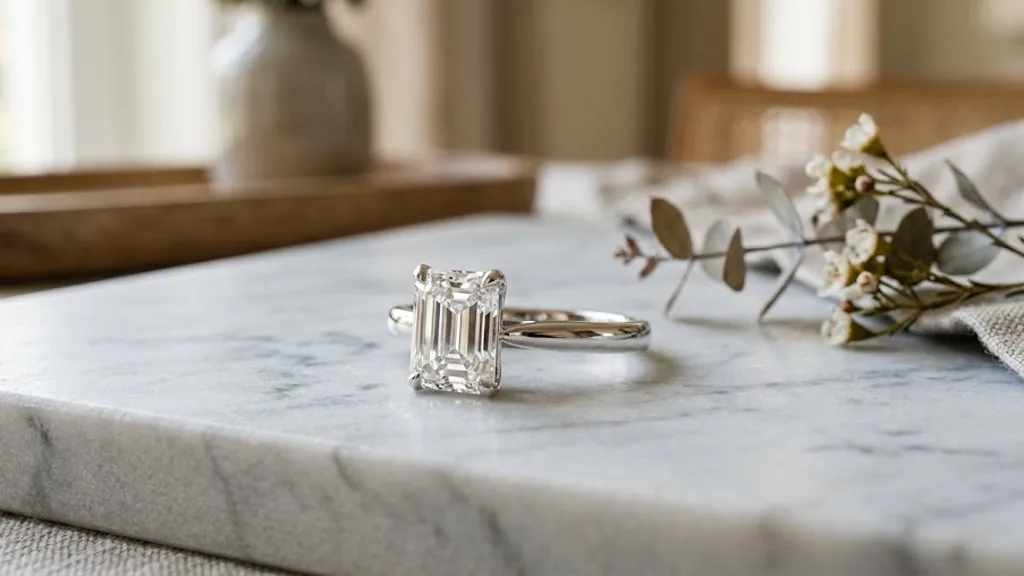
How Much Is a 3 Carat Emerald Cut Diamond?
A plain-English guide to 3 carat emerald cut diamond prices in the UK, lab-grown versus natural, and what really drives the cost.
A 3 carat emerald cut diamond is a big, confident stone. It is the kind of ring people notice from across a room. So the first question almost everyone asks is a fair one: what does it actually cost?
The honest answer is that the price swings enormously. Two stones that both weigh 3 carats and both say “emerald cut” on the paperwork can be thousands of pounds apart. Below I will explain exactly why, in plain English, and give you real guide prices so you know what a sensible budget looks like.
First, what does “3 carat” mean?
A carat is a unit of weight, not size. One carat is 0.2 grams. So a 3 carat diamond weighs 0.6 grams — about the same as a raisin.
Because it is a weight, two 3 carat diamonds can look different sizes on the hand. A stone cut deep hides some of its weight underneath the ring. A stone cut with a larger, flatter top looks bigger face-up. This matters more with emerald cuts than almost any other shape.
What is an emerald cut?
An emerald cut is a rectangular diamond with cut-off corners and long, straight facets running parallel to the edges. Facets are the flat polished surfaces on a diamond.
Most diamond shapes, like round and oval, are “brilliant cuts”. They have lots of small triangular facets designed to throw off fiery sparkle. An emerald cut is a “step cut” instead. Its facets are long and flat, like steps going down into the stone. Rather than sparkling, it flashes broad panels of light and dark. Jewellers call this the “hall of mirrors” effect.
Two practical consequences follow from that, and they both affect price:
- An emerald cut looks bigger than its weight suggests. The long open top spreads the weight across a wide surface, so a 3 carat emerald cut generally covers more finger than a 3 carat round.
- An emerald cut hides nothing. Those wide open facets act like clear glass. Small internal marks and faint yellow tints that would vanish in a sparkly round cut are visible in an emerald cut. So you have to buy a better grade of stone, which costs more.
Lab-grown or natural? This is the single biggest price factor
Before anything else, you need to know which type of diamond you are pricing. They are not slightly different in price. They are in completely different worlds.
A lab-grown diamond is a real diamond. Same carbon, same hardness, same sparkle, and it tests as a diamond because it is one. The only difference is where it formed: in a laboratory over a few weeks rather than underground over millions of years. A gemmologist cannot tell them apart by eye — it takes specialist equipment.
Here is roughly what a 3 carat emerald cut loose stone costs at the time of writing. These are guide figures for the stone alone, before the ring is made.
| Quality of stone | Lab-grown (guide) | Natural (guide) |
|---|---|---|
| Lower colour and clarity (visible tint or marks) | £600 – £1,100 | £9,000 – £15,000 |
| Good everyday quality (clean to the eye) | £1,100 – £2,000 | £16,000 – £28,000 |
| Top colour and clarity | £2,000 – £3,500 | £30,000 – £60,000+ |
Diamond prices move, and lab-grown prices in particular have fallen a long way over recent years, so treat these as a sense of scale rather than a quote. But the shape of the picture is stable: a 3 carat emerald cut in lab-grown is achievable on a normal budget, and in natural it is a major purchase.
What you actually pay for a finished ring
The stone is only part of it. You also pay for the metal, the setting work and the certificate.
A solid gold or platinum setting made by hand is not a small job, especially for a 3 carat stone, which needs a substantial mount to hold it safely. As a rough guide, expect the setting to add several hundred pounds for a simple solitaire in 14ct or 18ct gold, and more for platinum, which is denser and harder to work.
Add the two together and a finished 3 carat lab-grown emerald cut ring in a plain setting typically lands somewhere in the low thousands. The same ring with a natural stone starts well into five figures.
At CarbonstoneUK every ring is hand-made in solid gold or platinum, and every centre stone comes with a free IGI certificate. IGI is an independent laboratory that grades the diamond, so the quality is verified by someone other than the person selling it to you. If you want a 3 carat centre stone in a design you have seen, our bespoke service carries no extra design cost — you pay for the materials and the making, not for the drawing.
The four things that move the price of an emerald cut
Colour
Colour is graded from D (completely colourless) down through the alphabet as a faint yellow tint creeps in. Because an emerald cut is so transparent, tint shows early. For a 3 carat emerald cut I would not go below G if you want it to read as white, and D to F if it is going into white gold or platinum, which is unforgiving of warmth.
Clarity
Clarity describes tiny natural marks inside the stone, called inclusions. In a brilliant cut, sparkle disguises them. In an emerald cut you are looking straight through a window. VS1 or better is the safe zone at this size. VS2 can be fine, but only if you have seen where the marks sit.
Length-to-width ratio
This is simply how long the rectangle is compared with how wide. A ratio around 1.40 to 1.50 is the classic elegant emerald cut. Nearer 1.30 looks squarer and chunkier. Nearer 1.60 looks long and slim and covers more finger lengthways. None is wrong — but ratio changes how big the stone looks, so it changes what you are getting for your money.
Polish, symmetry and how flat the top is
Emerald cuts are not given the same overall cut grade as round diamonds, so you have to look at polish and symmetry instead. Poor symmetry in a step cut is obvious: the lines do not line up and the flashes look messy. Good symmetry costs a little more and is worth it.
How to get the biggest look for your budget
- Buy just under a round number. A 2.90 carat stone is priced noticeably below a 3.00 carat one, and nobody on earth can see the difference.
- Choose a longer ratio. A 1.50 ratio emerald cut looks larger on the finger than a stubby one of the same weight.
- Put it in a slim band. A narrow shank makes the centre stone look bigger by contrast.
- Consider a hidden halo. That is a small ring of tiny diamonds tucked underneath the centre stone, invisible from above but adding sparkle and lift from the side. Our Hidden Halo Emerald Cut Engagement Ring shows the effect nicely.
- Flank it. Two smaller stones either side add width without adding much cost. The Three Stone Emerald Cut Engagement Ring is the classic version of this.
What a 3 carat emerald cut looks like on the hand
A well-proportioned 3 carat emerald cut is roughly 10mm long and 7mm wide. On an average UK finger size (around L to N) it covers most of the width of the finger. It is a statement, and it suits people who like clean lines rather than fireworks.
If that sounds like a lot, it is worth trying a smaller emerald cut first to see whether you love the step-cut look before committing to the size. A simple Solitaire Emerald Cut Engagement Ring is the purest way to see how the shape behaves in daylight.
Frequently asked questions
Is a 3 carat emerald cut too big for everyday wear?
Not necessarily, but it needs a sensible setting. Emerald cuts have corners, and corners are the vulnerable part. A setting with claws covering all four corners, or a bezel that wraps metal around the edge, protects the stone. Ask for a lower profile if you work with your hands.
Will a lab-grown emerald cut look different from a natural one?
No. Cut the same way to the same grades, they look identical. The difference is on the certificate, not in the ring.
Do emerald cuts hold their value?
Treat any diamond, natural or lab-grown, as jewellery rather than an investment. Resale on all diamonds is well below retail. Buy the ring because you want to wear it.
What clarity should I insist on at 3 carats?
VS1 is a comfortable minimum for an emerald cut this large. Bigger stones give inclusions more room to show, and step cuts hide nothing. If you are considering VS2, ask to see the clarity plot on the IGI report, which maps where the marks are.
Can I have a 3 carat centre stone in one of your existing designs?
Yes. The designs on the site are shown in a standard specification, but they are hand-made to order, so the centre stone can be changed. Our bespoke work carries no extra design cost, so you only pay the difference in materials and making.
Where to start looking
If the emerald cut is the shape you keep coming back to, browse the full emerald cut collection to see how the shape sits in different settings, or look through all our engagement rings if you are still comparing shapes.
Every ring is hand-made in solid gold or platinum in North Harrow, London, with a free IGI certificate on the centre stone, free insured UK delivery and 30 days to return it. If you would like a price for a specific 3 carat emerald cut, just ask — we will quote the stone and the setting separately so you can see exactly where your money is going.
More guides on this topic
Ready to find your perfect ring?
Explore our lab-grown diamond collection or book a virtual appointment with our team.











