What Does a Right-Hand Ring Mean?
A right-hand ring is a diamond ring worn on the right hand, often self-bought. It has no fixed tradition and often marks a milestone such as a 40th birthday.
A right-hand ring is a diamond or gemstone ring worn on the right hand, usually bought by the wearer for themselves or given as a gift that is not about marriage. It carries no fixed tradition, so it means whatever the wearer decides: a 40th birthday, a promotion or simply a ring they love. The one caveat is culture, because some countries wear wedding rings on the right.
What does a right-hand ring usually mean?
A right-hand ring usually means independence and self-reward rather than a relationship. The left ring finger is reserved in the UK for engagement and wedding rings, so moving a diamond to the right hand signals that the ring is not bridal. Typical reasons are a 40th birthday, a new job or finishing a degree, and no formal rule lies behind any of them.
Which finger does a right-hand ring go on?
A right-hand ring most often goes on the ring finger or the middle finger, though any finger works. The middle finger suits a bolder ring because it is the longest and sits centrally. As a rule of thumb, a right-handed person’s right fingers are about half a UK size larger than the same fingers on your left, so measure the finger you will actually wear it on.
Finger customs are covered in which finger an eternity ring goes on.
Is a right-hand ring a promise ring?
A right-hand ring is not a promise ring, although the two can look alike. A promise ring is given by a partner as a sign of commitment before engagement, and it is often worn on the left hand. A right-hand ring is about the wearer, not a couple. A small 0.25 ct diamond could be either; the meaning comes from who bought it and why.
The differences are set out fully in promise rings compared with engagement rings.
Which ring styles work best on the right hand?
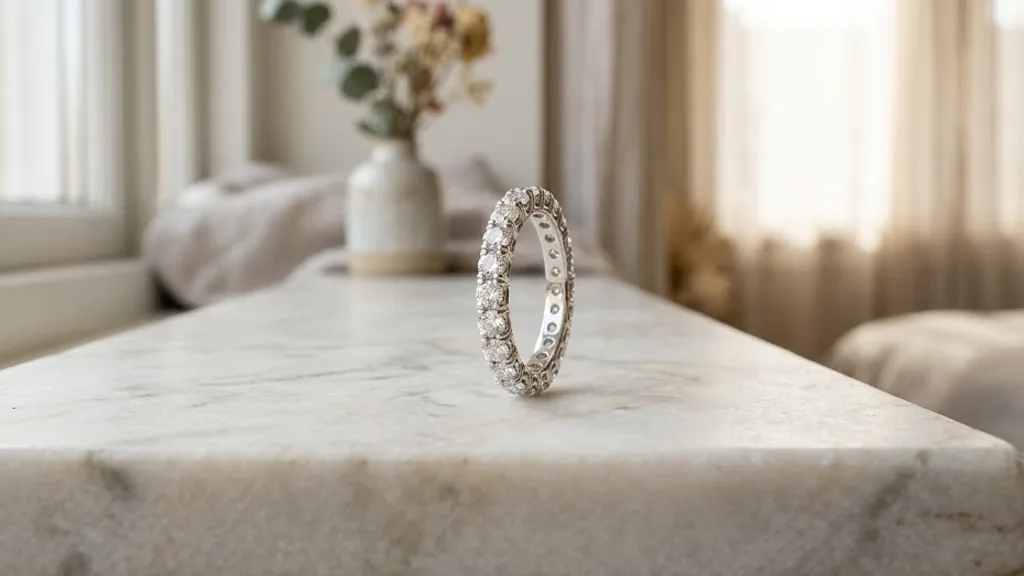
Ring styles that work best on the right hand are eternity bands, stacking bands, two-stone toi et moi rings and coloured or fancy-shaped stones. These styles look deliberate rather than bridal. A three-quarter eternity band, with diamonds across about 75% of the band, is comfortable for daily wear and leaves the palm side plain, which matters on a hand that does most of the work.
Two examples from our range at the time of writing: the Stackable Emerald Cut Three Quarter Eternity Band, 1.10 ct on a 2.0 mm band, from £1,074, and the Toi et Moi Pear Cut Engagement Ring, with 1.0 ct and 0.75 ct pear stones, from £685.
In short, the right hand suits rings that look chosen for pleasure rather than for a proposal.
| Style | Typical diamond weight | Everyday wear |
|---|---|---|
| Three-quarter eternity band | 0.50 to 1.50 ct | Very good, plain palm side |
| Toi et moi (two stones) | 1.00 to 2.00 ct total | Good, sits higher |
| Stack of slim bands | 0.20 to 0.50 ct each | Good, flexible look |
| Single fancy-shape stone | 0.50 to 2.00 ct | Good with a low setting |
Is it odd to buy a diamond ring for yourself?
Buying a diamond ring for yourself is not odd, and self-purchase is the main idea behind a right-hand ring. A 30th or 40th birthday is a typical moment for it. A lab-grown diamond makes this more affordable, because a lab-grown stone typically costs far less than a natural one of the same size and grades. Choose cut first, then size.
CarbonstoneUK, of North Harrow, London, makes rings only, with a free IGI certificate on every centre stone. For gifting rather than self-buying, see how to choose jewellery as a gift, or browse eternity and stacking bands in stock.
Frequently asked questions
Can a right-hand ring be an engagement ring?
Yes. In several countries, including Germany, Norway, Poland and Russia, engagement or wedding rings are traditionally worn on the right hand. In the UK the left hand is the norm, so a diamond on the right is usually read as a fashion or self-bought ring, but nothing stops a couple choosing the right hand.
Should a right-hand ring match my engagement ring?
No, it does not need to match. A right-hand ring is often chosen to contrast, for example yellow gold against a white engagement ring, or an emerald cut against a round. If you like a matched look, keep the metal the same, such as 18ct white gold on both hands.
Is it bad luck to buy your own diamond ring?
No. There is no recognised superstition against buying your own right-hand ring. The bad-luck idea people half-remember belongs to wedding rings, and even there it is folklore rather than a rule. Buying a 0.50 ct diamond for yourself carries the same meaning as any other gift: the one you give it.
How much should a right-hand ring cost?
No set amount applies, because a right-hand ring has no tradition behind it. Spend what feels comfortable. At the time of writing, our lab-grown eternity bands and two-stone rings start from about £685, and a natural diamond of the same 1 ct size would typically cost several times more.
Can I wear a right-hand ring every day?
Yes, if the setting is low and secure. The right hand does more work for most people, so choose a band of at least 1.8 to 2 mm and avoid tall settings. Take it off for the gym, gardening and cleaning, and have the claws checked once a year.
Which hand is a right-hand ring worn on if I am left-handed?
A right-hand ring is still worn on the right hand if you are left-handed, because its meaning comes from the UK custom of keeping the left ring finger for marriage. Left-handed wearers often find it easier, since the right hand takes fewer knocks. Size that finger, which may be half a size smaller.
More guides on this topic
For single-stone styles, read what a solitaire diamond ring is.
Ready to find your perfect ring?
Explore our lab-grown diamond collection or book a virtual appointment with our team.