
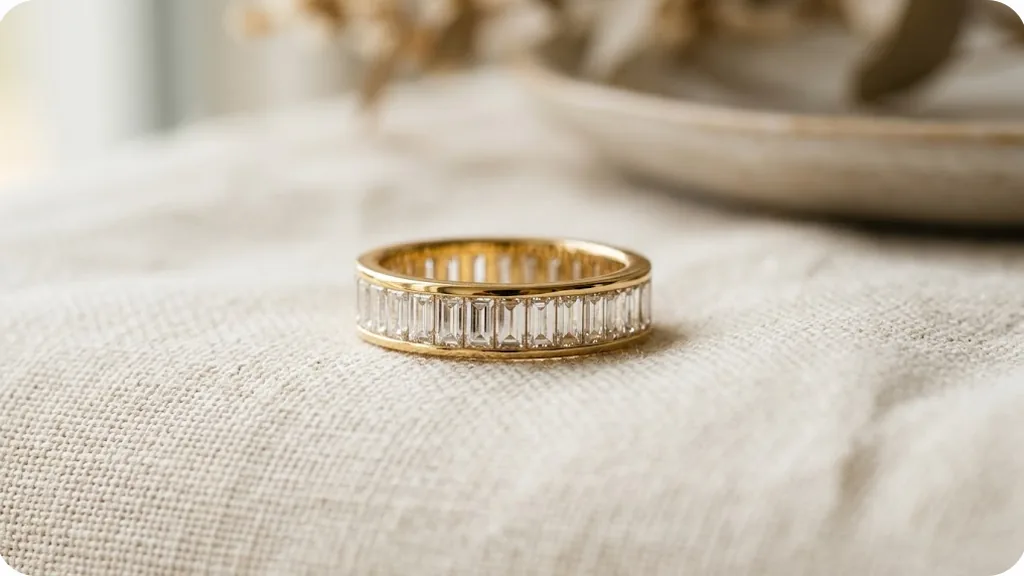
What Is a Baguette Cut Diamond? A Simple Guide
A baguette cut diamond is a slim rectangle with step-cut facets. Here is how it looks, where it works, and what to check before buying.
A baguette cut diamond is a long, narrow rectangle with straight sides and squared-off corners. It is named after the French loaf, because that is exactly what it looks like: a slim rectangular bar. Simple, clean, and completely different in character from the round diamonds most people picture.
If you have been looking at eternity bands or Art Deco style rings, you have almost certainly seen baguettes without knowing their name. Here is what they are, how they behave, and when they are the right choice.
What makes a baguette a baguette
Two things define it: the outline and the faceting.
The outline is a rectangle, usually somewhere between two and five times longer than it is wide. The corners are cut off at right angles rather than left as sharp points, which protects them from chipping.
The faceting is where it really differs. A baguette is a step cut. That means its facets — the flat polished surfaces — are long and parallel, running around the stone like the steps of a staircase. Most baguettes have only about 14 facets in total.
Compare that to a round brilliant, which has 57 or 58 small triangular and kite-shaped facets arranged to bounce light in every direction. That is why the two look so different in the hand.
How a baguette actually looks
A round brilliant twinkles. Lots of tiny facets throw out fast, fine flashes of white and rainbow light as your hand moves.
A baguette does something else entirely. Its few large facets produce broad, slow flashes — wide sheets of light that appear and disappear as the stone tilts. Jewellers often describe it as a hall-of-mirrors effect. It reads as glassy, architectural and calm rather than sparkly.
Neither is better. They are different visual effects. If you want fireworks, a baguette is the wrong stone. If you want clean lines and a quiet, expensive-looking gleam, it is exactly right.
Two kinds of baguette
| Type | Shape | Usually used for |
|---|---|---|
| Straight baguette | A true rectangle. Both long sides are parallel. | Straight bands, eternity rings, side stones flanking a centre stone, geometric patterns. |
| Tapered baguette | One end is narrower than the other, so the sides slope inwards. | Sitting either side of a centre stone, where the taper draws the eye inward. |
Tapered baguettes are the classic partners for a solitaire. Placed on each side of a larger stone, they narrow towards the shoulders of the ring and make the centre stone look bigger by comparison. It is a trick jewellers have used since the 1920s.
Where the baguette came from
Step cutting is old, but the baguette as we know it belongs to the Art Deco period of the 1920s and 30s. That era loved straight lines, symmetry and geometry, and the baguette suited it perfectly.
It fell out of favour for decades and has come back strongly in recent years, partly because minimal, architectural jewellery is popular again, and partly because baguettes suit stacking — wearing several slim bands together on one finger.
The honest downside: baguettes hide nothing
This is the single most important thing to know before you buy one, and plenty of shops will not tell you.
Those large, open, parallel facets act like windows straight into the stone. Everything inside is on display. A round brilliant’s churning sparkle disguises small imperfections; a baguette does the opposite and puts them under a spotlight.
Two consequences follow.
Clarity matters more. Clarity is a measure of the tiny natural features inside a diamond — specks, crystals, hair-thin fractures. In a round, a small one is invisible. In a baguette, the same feature can be plainly visible. So baguettes need a higher clarity grade to look clean.
Colour matters more. Colour grading measures how free a diamond is of faint yellow tint, on a scale from D at the top downwards. A baguette shows its body tint honestly, without sparkle to break it up. It needs to be a whiter stone.
There is a practical point too. Because baguettes usually appear in groups, they must be matched to each other. A row of baguettes where one stone is slightly warmer or slightly cloudier than its neighbours looks wrong immediately, in a way a row of rounds would not. Good baguette work is largely about matching.
Durability: mind the corners
Diamond is the hardest natural material there is, but hardness and toughness are not the same thing. Hardness means it resists scratching. Toughness means it resists chipping, and diamond is only moderately tough.
A baguette has straight edges and defined corners, and edges and corners are where a knock lands. That is why the corners are cut off square rather than left sharp, and why setting style matters more here than with a round.
The safest settings for baguettes are:
- Channel setting — the stones sit in a groove between two walls of metal, edge to edge, with nothing sticking out.
- Bezel setting — a rim of metal wraps right around each stone.
- Bar setting — slim bars of metal separate each stone and cover the vulnerable corners.
Simple claws gripping the corners of a baguette are the riskiest option for a ring worn every day.
What baguette rings look like in practice
The most common use is a band. The rectangular shape tiles neatly, so a row of baguettes forms an almost continuous line of light with very little metal showing between the stones. Nothing else does this as cleanly.
Our Stackable Baguette Cut Half Eternity Band at £672 is the straightforward version: baguettes across the front half of the ring, plain metal at the back. Half eternity is the sensible choice for a ring you will wear daily, because the plain section can be resized later and sits comfortably against the finger.
The Stackable Baguette Cut Three Quarter Eternity Band at £1,061 carries the stones further round the ring, so more of what you see from any angle is diamond. It costs more because it holds more stone, not because the design is fancier.
For something a little different, the Pave Baguette Cut Wedding Band at £690 combines baguettes with pavé — tiny round diamonds set close together in the surrounding metal. The rounds add the twinkle that baguettes on their own do not give you. It is a good compromise if you like the clean baguette line but want more sparkle.
Is a baguette right for you?
It probably is if you like clean geometry, Art Deco style, or stacking several slim bands together. It suits people who find heavily sparkly jewellery a bit much, and it works beautifully as a wedding band sitting flush against a solitaire engagement ring, because the flat top line meets the setting neatly.
It probably is not if maximum sparkle is what you are after, or if you want one large statement stone. Baguettes rarely work as a solo centre stone — the flat, open face needs company.
Frequently asked questions
Are baguette diamonds real diamonds?
Yes. Baguette describes the shape and faceting, nothing else. A baguette is as much a diamond as a round brilliant. Ours are lab-grown, which means they are chemically and physically identical to mined diamonds, grown in a controlled environment rather than dug out of the ground.
Do baguette diamonds sparkle?
They flash rather than twinkle. You get broad sheets of light instead of fine glitter. Set alongside pavé rounds you get both effects at once, which is why that combination is so popular.
What clarity and colour should I look for in a baguette?
Higher than you would accept in a round, because there is no sparkle to hide behind. Look for a stone that is clean to the naked eye at normal reading distance, and white enough that it does not look warm against the metal beside it. The IGI certificate we include free with every centre stone sets out those grades independently.
Are baguettes fragile?
They are more chip-prone at the corners than a round, so setting style matters. Channel, bezel and bar settings protect the edges and are what we use. Treated sensibly, a baguette band lasts a lifetime.
Can baguettes be mixed with other shapes?
Very much so. Tapered baguettes beside a round or emerald cut centre stone is one of the oldest and best-looking combinations in jewellery, and baguettes mixed with pavé rounds gives you geometry and sparkle together.
Have a look
The easiest way to understand a baguette is to see a row of them. Browse everything we make in this shape in our baguette collection, or see how they sit alongside other shapes in the full wedding ring collection.
Every ring is hand-made in solid gold or platinum in North Harrow, London, with free insured UK delivery and 30 days to return it. If you want baguettes in a specific width, metal or arrangement, we design bespoke pieces at no extra design cost.
More guides on this topic
Ready to find your perfect ring?
Explore our lab-grown diamond collection or book a virtual appointment with our team.











