Is an Oval Diamond Better Than a Round?
Oval or round? A straight comparison on size, price, sparkle and character, with the honest drawbacks of each shape.
Oval and round are the two shapes most people end up choosing between. Neither is better in an absolute sense. But one of them is almost certainly better for you, and the difference comes down to four practical things: size, price, sparkle and character.
Here is a straight comparison from a jeweller who has sold both for years, with no favouritism.
The short version
An oval gives you more visible diamond for your money. A round gives you more sparkle and a safer classic.
If your priority is a stone that looks as large as possible for the budget, choose oval. If your priority is maximum brightness and a shape nobody will ever question, choose round.
Size on the finger
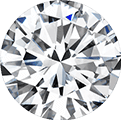
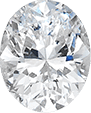
This is the oval’s strongest argument. An oval is a stretched version of a round brilliant, so its weight is spread over a longer top surface. You see more of it.
Approximate measurements for well cut stones at one carat:
| Shape | Approximate size at 1 carat | Effect |
|---|---|---|
| Round brilliant | About 6.5 mm across | Compact and even |
| Oval | About 7.7 mm by 5.7 mm | Longer, and it makes the finger look longer too |
An oval also flatters the hand. The length draws the eye down the finger and slims it. If you have shorter fingers, this is a genuine advantage rather than marketing talk.
Price
Ovals are normally cheaper than rounds of the same carat weight and the same colour and clarity grades.
There are two reasons. First, cutting a round wastes more of the raw crystal than cutting an oval does, and that wasted weight is priced into the finished stone. Second, round is what most people ask for by default, and high demand holds prices up.
As general guidance only, expect an oval to sit somewhere in the region of 10 to 25 percent below a round of matching weight and quality. That is a rule of thumb from years of comparing stones, not a fixed rate. Always compare two real certificates rather than trusting a percentage.
Combine the two points and the oval’s case is strong: it costs less and it looks bigger.
Sparkle
Here the round wins, and it is not close on paper.
The round brilliant was designed specifically to return as much light as possible to your eye. Its angles have been refined over a century for exactly that. Nothing sparkles more.
An oval uses the same style of faceting, so it is genuinely brilliant too — far livelier than a step cut such as an emerald cut. But stretching the shape means light behaves less evenly across the stone, which brings us to the one flaw you must check for.
The bow-tie. Every oval has a dark band across its middle where light does not return properly. It looks like a bow tie. In a good stone it is faint and you have to look for it. In a poorly cut stone it is a black stripe that kills the centre of the diamond. There is no discount that makes a bad bow-tie acceptable.
You cannot spot this from a certificate. You spot it by looking at the stone, or a video of it, moving in ordinary light.
The comparison in one table
| Oval | Round | |
|---|---|---|
| Looks larger for the weight | Yes, clearly | No |
| Price for the same carat | Lower | Higher |
| Sparkle | Very good | The best there is |
| Cut graded on the certificate | No — judge it by eye | Yes, Excellent to Poor |
| Main risk to check | Bow-tie shadow | Very little — the grade covers you |
| Hides slight warmth of colour | Less well — colour gathers at the ends | Better |
| Durability | Excellent, no sharp points | Excellent |
| Character | Elegant, a little different | The timeless classic |
Two honest points against the oval
Colour shows at the ends. In a long shape, any warmth in the diamond tends to gather at the two tips. If you want an icy white look, buy a slightly higher colour grade in an oval than you would in a round.
You have to do more homework. Because ovals are not given a cut grade, the certificate will not tell you whether the stone is beautiful. Two ovals with identical paperwork can look completely different. With a round, an Excellent cut grade does most of the thinking for you.
Which should you actually choose?
Choose an oval if you want the largest looking stone for your budget, you like a slightly softer and more individual shape, and you are willing to look at the stone properly before buying.
Choose a round if you want the brightest possible diamond, you prefer a shape that will never look dated, or you are buying without being able to inspect the stone closely.
There is no wrong answer. Both are excellent diamonds and both wear well for a lifetime.
One practical difference nobody mentions
Think about the wedding band that will sit next to the engagement ring for the rest of its life.
A round stone sits in a compact setting, so a plain straight band usually slides up against it without a gap. Simple.
An oval is long, and if it is set in a low setting the band may not sit flush. The usual solutions are a curved band shaped to follow the stone, or a slightly higher setting so a straight band can tuck underneath. Neither is a problem, but it is much easier to plan for at the start than to fix two years later.
If you are buying an oval, ask your jeweller how a wedding band will fit before the ring is made. We design the pair together as standard when customers tell us what they want, and it costs nothing extra to think about it early.
Oval and round rings we make
All of our rings are hand-made in solid gold or platinum in North Harrow, London, using lab-grown diamonds — real diamonds grown in a laboratory rather than mined — with a free IGI certificate on every centre stone.
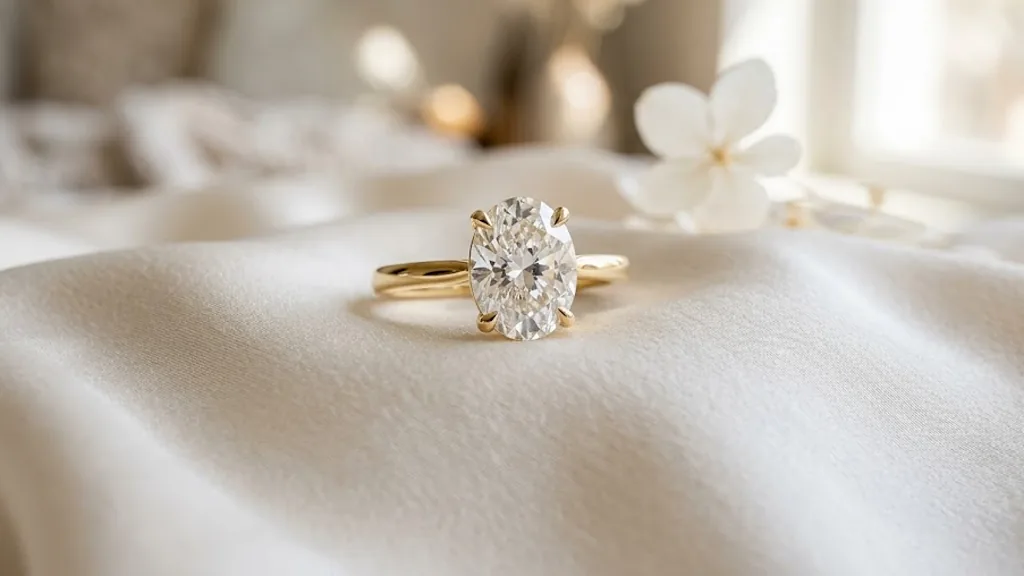
The Solitaire Oval Cut Engagement Ring at £557 is the purest way to enjoy the shape and one of the best value pieces we make. For more presence, the Hidden Halo Oval Cut Engagement Ring is £1,021 and hides a ring of small diamonds beneath the centre stone, so the outline stays clean from above.
On the round side, our Solitaire Round Cut Engagement Ring in White Gold is £563 — a useful direct comparison if you want to see the two shapes at a similar price.
Browse the oval diamond collection and the round diamond collection to see them side by side.
Common questions
Is an oval diamond better than a round?
Better value, yes — it looks larger and costs less for the same weight. Better light performance, no — the round brilliant sparkles more. Pick according to which of those matters more to you.
Are oval diamonds going out of fashion?
Ovals have been popular for decades and show no sign of fading. That said, round is the shape that never goes anywhere. If you worry about trends, round is the safer choice by definition.
Do oval diamonds look bigger than round?
Yes. At one carat an oval is roughly 7.7 mm long against a round’s 6.5 mm, and the length exaggerates the difference further on the hand.
Are oval diamonds harder to keep clean?
No. They have no sharp points and no awkward corners. Warm water, a drop of washing-up liquid and a soft toothbrush every couple of weeks is all any diamond ring needs.
Can you make an oval ring to my own design?
Yes, and there is no charge for the design work — you pay for metal and stones only. Send us a sketch or a photograph of what you have in mind. UK delivery is free and insured, and you have 30 days to return anything that is not right.
If you are still undecided, order both shapes in a similar setting and look at them on the actual hand in daylight. Photographs flatter every diamond equally. Real light does not.
Ready to find your perfect ring?
Explore our lab-grown diamond collection or book a virtual appointment with our team.