Do Oval Diamonds Sparkle as Much as Round?
How oval diamonds compare to round for sparkle, what the bow-tie is, and five ways to pick an oval that shines.
Almost no shape sparkles quite like a round brilliant. That is not opinion — the round was designed for exactly that job. So when someone asks whether an oval sparkles as much, the honest answer from a jeweller is: nearly, and a good oval is so lively that most people would never notice the difference on a hand.
The rest of this page explains where the small gap comes from, why some ovals sparkle beautifully and others look flat, and how to tell the two apart before you spend anything.
The short answer
A well cut oval sparkles almost as much as a round. A badly cut oval sparkles noticeably less.
The shape is not the problem. The individual stone is. Ovals vary far more than rounds do, so the quality of the particular diamond in front of you matters more here than in any other decision you will make.
Why the round is the sparkle champion
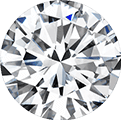
A round brilliant has 57 or 58 facets arranged in a pattern worked out over a century to bounce as much light as possible straight back up to your eye. The proportions are mathematically settled. Cutters know exactly what they are aiming for.
Because those targets are known, laboratories can grade a round for cut quality — from Excellent down to Poor — and put that grade on the certificate. Buy an Excellent cut round and you have a strong guarantee of sparkle before you have even seen it.
Why an oval is close behind
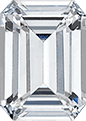
An oval uses the same style of faceting as a round. It is a brilliant cut, meaning it has lots of small triangular and kite-shaped facets designed to scatter light. That is completely different from a step cut such as an emerald cut, which has long flat facets and gives broad flashes rather than glitter.
So an oval is genuinely sparkly. It is in the same family as the round, just stretched.
The stretching is where the small loss happens. In a round, light travels the same distance whichever way it enters. In an oval it does not, because the stone is longer one way than the other. Light behaves less evenly, and one particular problem appears.
The bow-tie: the one thing to check
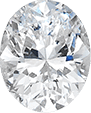
Every oval has a dark area across its middle, shaped like a bow tie. It happens because your own head blocks light from reaching that part of the stone at certain angles.
How bad it is varies enormously.
| Bow-tie | What you see | Verdict |
|---|---|---|
| Faint | A soft shadow you only notice when looking for it, that disappears as the hand moves | Normal and acceptable — every oval has this |
| Moderate | A visible grey band across the centre in ordinary light | Livable if the price reflects it, but keep looking |
| Severe | A black stripe across the middle that stays black as the stone moves | Reject it. No discount is worth this |
The bow-tie is not listed on any certificate. There is no grade for it. You judge it with your eyes, on video or in person, which is why we will always show you the actual stone before you commit.
Why two ovals with the same paperwork look different
This catches people out constantly. Laboratories such as IGI do not give fancy shapes — any shape that is not round — an overall cut grade. They record the measurements, the depth and the finish, but not a single verdict on beauty.
The result is that two ovals can share identical carat weight, colour and clarity grades and look nothing alike. One is bright edge to edge. The other has a dull middle and a heavy shadow.
Practical consequence: with a round, you can shop on paper. With an oval, you must look.
Crushed ice or big flashes?
Ovals come in two broad styles of sparkle, and neither is a fault. It is taste.
- Crushed ice. Lots of small, busy, glittery sparkles, like sunlight on broken ice. It looks lively and it hides small inclusions — the natural marks inside a diamond — very well.
- Distinct facets. Fewer, larger, bolder flashes of light with clear dark and bright contrast. Many people find this the more dramatic and expensive looking of the two.
Ask which style a stone has before you buy. It changes the look of the ring far more than a single clarity grade does.
Five ways to get maximum sparkle from an oval
- Watch it on video, moving, in ordinary daylight. Not under a jeweller’s spotlight, where every diamond looks superb.
- Look for a bright centre. The middle of the stone should light up as it turns, not stay grey.
- Choose a sensible ratio. Roughly 1.35 to 1.50 to one gives the best balance of good looks and even light. Very long ovals tend to have worse bow-ties.
- Go a touch higher on colour. Warmth gathers at the two ends of a long stone, so a slightly better colour grade pays off visually.
- Keep it clean. A film of hand cream flattens the sparkle of any diamond. Warm water, washing-up liquid and a soft toothbrush every fortnight.
Oval rings we make
Every ring is hand-made in solid gold or platinum at our London workshop in North Harrow. Our diamonds are lab-grown — real diamonds, grown in a laboratory rather than mined, with the same hardness and the same sparkle — and every centre stone comes with a free IGI certificate.
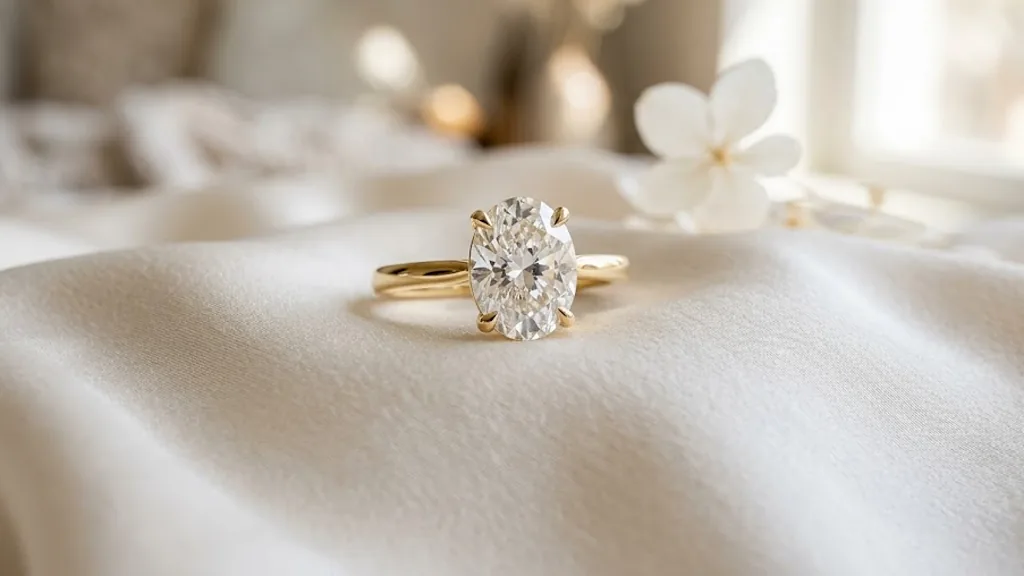
The Solitaire Oval Cut Engagement Ring at £557 keeps the metal out of the way so the stone can do all the work. Slim claws mean more light reaches the diamond from the sides.
The Three Stone Oval Cut Engagement Ring at £1,021 adds two flanking stones. Three sources of light instead of one makes the whole ring read as brighter, which is a useful trick if you want sparkle without buying a much bigger centre.
If you want to compare against the sparkle benchmark, our Halo Round Cut Engagement Ring is £707 and surrounds a round brilliant with a circle of small diamonds.
See the full oval diamond collection, or browse everything in the engagement ring collection.
Common questions
Do oval diamonds sparkle as much as round?
A well cut oval comes very close. A round brilliant still returns light slightly more evenly because it is symmetrical in every direction. On a moving hand, most people cannot tell the difference between a good oval and a round.
Does every oval diamond have a bow-tie?
Yes, to some degree. The question is not whether it has one but how strong it is. A faint shadow that vanishes as the stone moves is perfectly normal.
Does the setting affect sparkle?
It does. Slim claws let light in from the sides. A halo of small diamonds adds extra flashes around the centre. A heavy bezel rim protects the stone well but blocks some side light, which suits some designs and not others.
Do lab-grown ovals sparkle as much as mined ones?
Exactly as much. A lab-grown diamond has the same chemistry, hardness and optical behaviour as a mined one. Sparkle depends on how the stone was cut, never on where it was grown.
Can you make an oval ring to my own design?
Yes, with no design fee — you pay for metal and stones only. Send a sketch or a photograph and we will quote it. UK delivery is free and insured and you have 30 days to return.
The rule with ovals is simple. Never buy one on paper alone. See it move, check the centre stays bright, and you will get a diamond that holds its own against any round.
Ready to find your perfect ring?
Explore our lab-grown diamond collection or book a virtual appointment with our team.