
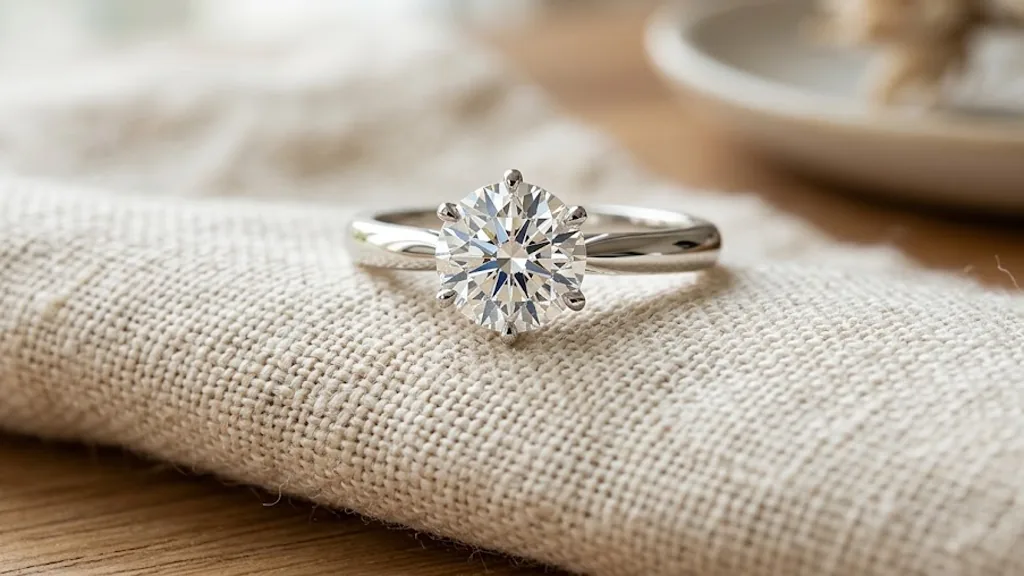
How Many Millimetres Is a 1 Carat Round Diamond?
A 1 carat round diamond measures about 6.5mm. Full size chart, why the figure varies, and what 6.5mm really looks like on a hand.
A one carat round brilliant diamond measures about 6.5mm across. That is the number to remember, and for a well-cut stone it is reliable to within a fraction of a millimetre.
But the reason people search for this is rarely academic. They want to know how big a one carat ring will actually look on a hand. So this guide covers the measurement, why it varies, and what 6.5mm looks like in real life.
Carat is weight, millimetres are size
This trips up almost every first-time buyer, so it is worth stating plainly.
Carat is a unit of weight. One carat equals 0.2 grams. It is written as 1.00ct.
Millimetres measure the physical dimensions of the stone. For a round diamond, the important one is the diameter across the top, because that is what you see once the ring is on.
The two are related but not fixed to each other. A diamond cut deep hides weight underneath the setting, where nobody sees it. A diamond cut shallow spreads its weight across the top. Both can weigh exactly one carat and look different sizes.
Round diamond size chart
These are typical diameters for well-proportioned round brilliants. Treat them as close approximations; the certificate for any individual stone is the authority.
| Carat weight | Approximate diameter |
|---|---|
| 0.25ct | 4.1mm |
| 0.50ct | 5.2mm |
| 0.75ct | 5.9mm |
| 1.00ct | 6.5mm |
| 1.25ct | 6.9mm |
| 1.50ct | 7.4mm |
| 2.00ct | 8.2mm |
Look at the jump from 1.00ct to 2.00ct. The weight doubles, but the diameter grows by only about 1.7mm, roughly a quarter wider. Diamond weight grows in three dimensions while width grows in one, which is why doubling the carat never doubles the look.
This is useful to know when budgeting. Moving from 1.00ct to 1.25ct costs meaningfully more but adds under half a millimetre of width. Many buyers get better value keeping the size and improving the cut quality.
Why a one carat round can measure more or less than 6.5mm
Cut depth
A deep stone can measure 6.2mm at a full carat. A shallow one might measure 6.7mm. The shallow one looks bigger, but if it is too shallow it leaks light through the bottom and looks glassy in the centre. There is a sweet spot, and an excellent cut grade is how you find it without becoming an expert.
Girdle thickness
The girdle is the narrow band around the widest part of the stone. A thick girdle adds weight without adding visible size. A very thin girdle is fragile. Medium is what you want.
Certificate rounding
A stone sold as “one carat” might weigh 0.96ct or 1.04ct. Ask for the exact figure and the exact measurements, which are printed on every IGI certificate. We include an IGI certificate free with every centre stone we sell.
What 6.5mm looks like on the hand
An average adult finger is roughly 15 to 17mm wide at the knuckle area where a ring sits. A 6.5mm stone therefore covers around a third to two-fifths of the finger width. It reads clearly as a diamond ring from across a room without looking oversized.
Some practical points:
- On a smaller finger size, say a J or K, a one carat round looks generous.
- On a larger finger size, say a Q or R, the same stone looks more modest. If you want the same visual impact, either go up in weight or choose an elongated shape such as oval or marquise, which spread further across the finger.
- A halo, which is a ring of small diamonds set around the centre stone, can add 1.5 to 2.5mm to the overall width. A halo on a 0.75ct centre can look as large as a plain 1.25ct solitaire.
Round rings we make, with real prices
Round is our largest collection, with twenty designs. Everything is lab-grown, hand-made in solid metal, and comes with a free IGI certificate on the centre stone. Prices correct at the time of writing.
| Ring | Style | Price |
|---|---|---|
| Solitaire Round Cut Engagement Ring in White Gold | Classic single stone | £563 |
| Halo Round Cut Engagement Ring | Halo frame makes the centre look larger | £707 |
| Solitaire Round Cut Engagement Ring in Platinum | Platinum, very hard wearing | £657 |
Browse the full round cut collection, or all engagement rings if you want to compare shapes.
Round versus elongated shapes at the same weight
If size on the finger is your priority, it is worth knowing that round is not the shape that looks biggest per carat. Approximate face-up dimensions at one carat:
| Shape | Approximate size at 1.00ct | Impression |
|---|---|---|
| Round | 6.5mm across | Maximum sparkle |
| Oval | 7.7mm x 5.7mm | Longer, elongates the finger |
| Marquise | 10.5mm x 5.2mm | Longest of all, very dramatic |
| Pear | 8.7mm x 5.7mm | Long with a point at one end |
| Emerald | 7.0mm x 5.0mm | Broad flashes rather than fine sparkle |
The stone is only half of how big a ring looks
Two rings holding identical 6.5mm stones can look quite different, because everything around the diamond affects the impression.
- Band width. A slim band makes the stone look larger by contrast. A wide band competes with it and makes the same stone look smaller.
- Setting height. A stone raised on tall claws catches more light and appears more prominent. A lower setting looks neater and is far more practical if you use your hands a lot.
- Metal colour. White gold and platinum blend with a colourless diamond, so the eye reads stone and setting as one larger shape. Yellow and rose gold outline the stone, which defines it clearly but can make it look slightly more contained.
- Claw style. Fine claws show more of the diamond’s edge. Chunky claws cover a little of it. The difference is small but real.
- Side stones and pavé. Small diamonds set along the band extend the sparkle outwards, so the whole ring reads bigger even though the centre stone has not changed.
If your budget is fixed and you want the most visible ring for it, adjusting these details is usually better value than chasing another tenth of a carat.
Frequently asked questions
How many millimetres is a 1 carat round diamond?
About 6.5mm in diameter for a well-proportioned stone. Individual stones commonly measure between roughly 6.3mm and 6.7mm depending on how deep or shallow they are cut.
Is a 6.5mm diamond always one carat?
Not exactly. A 6.5mm round is usually very close to one carat, but a deep-cut stone at that diameter could be a little heavier and a shallow one a little lighter. Check the certificate for the exact weight and measurements.
Does a lab-grown one carat measure the same as a natural one?
Yes. Size and weight follow the same physics regardless of where the diamond formed. A one carat lab-grown round measures about 6.5mm, exactly like a mined one, and has the same hardness and sparkle.
Should I buy just under one carat to save money?
It is a sensible trick. A 0.90ct round measures about 6.3mm, which is only a fifth of a millimetre smaller and effectively invisible to the eye, but prices step up sharply at the round carat milestones. You get almost the same look for less.
Can you make a ring around a specific millimetre size?
Yes. Tell us the diameter you want and we will source the stone and build the ring around it. Bespoke work carries no extra design cost with us; you pay for the stone and the metal.
Before you decide
Cut a 6.5mm circle out of paper and tape it to your finger for an hour. It is the cheapest and most honest size test there is, and it settles more arguments than any chart.
Every ring we make is hand-made in solid gold or platinum at our North Harrow workshop in London, with free insured UK delivery and 30-day returns, so you can judge the size in your own light before deciding.
More guides on this topic
Ready to find your perfect ring?
Explore our lab-grown diamond collection or book a virtual appointment with our team.











