
What to Clean a Wedding Ring With
Warm water, mild washing-up liquid and a soft brush: the safe home method, plus what to never use on gold, platinum or set stones.
Most wedding rings do not need a special product. They need warm water, a drop of washing-up liquid and a soft brush. That is genuinely it, and it is what a jeweller will use on your ring when you bring it in.
The reason people ask is that a ring worn every day gets dull, and it is not obvious why. So before the method, here is what is actually happening to your ring.
Why your ring goes dull
Nothing is wrong with the metal or the diamond. What builds up is a film underneath and around the stone: hand cream, soap residue, body oils, sun cream, fake tan, hairspray, washing-up water and everyday dust. It collects in the small gaps behind the stone where light is supposed to enter.
A diamond gets its sparkle from light going in through the top, bouncing around inside and coming back out. If the underside is coated in a greasy film, less light gets in, and the stone looks flat and grey. Clean the underside and the sparkle comes straight back. It is that simple, and it is why the underside matters far more than the top.
What to clean a wedding ring with: the method
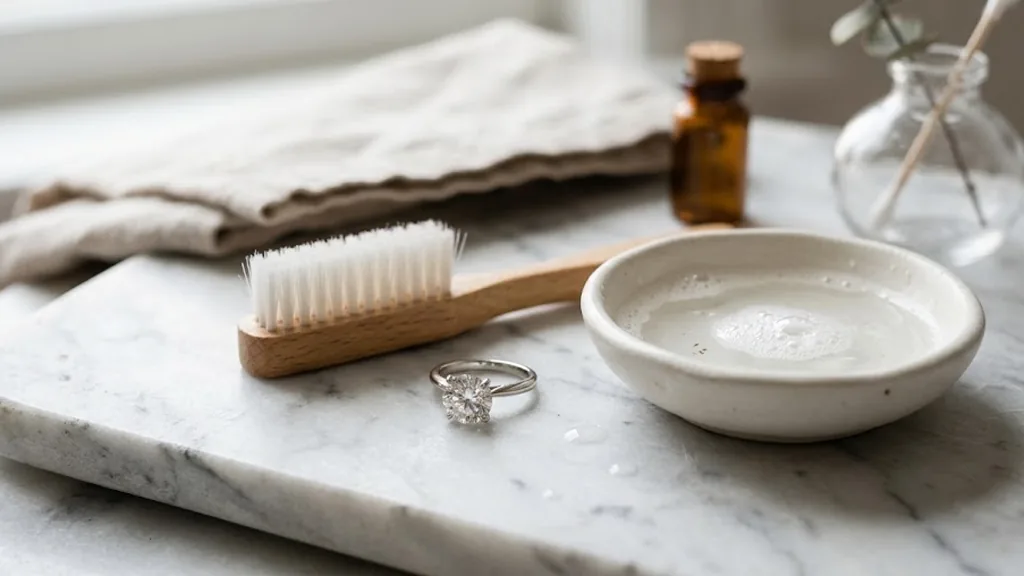
You need a bowl, warm water, mild washing-up liquid, a soft toothbrush and a lint-free cloth. A baby toothbrush is ideal because the bristles are very soft.
- Block the plughole first. Every jeweller has heard this story. Do it before anything else, or clean in a bowl away from the sink entirely.
- Mix warm water with a drop of mild washing-up liquid. Warm, not hot — hand-hot is right. Very hot water can shock some gemstones and can loosen the adhesive used in a few older settings.
- Soak the ring for 15 to 20 minutes. This softens the film so you barely have to scrub.
- Brush gently, especially underneath. Work the soft brush around the back of the setting, between the claws and along the sides of the band. Light pressure only — you are lifting a film, not scouring a pan.
- Rinse in clean warm water. Rinse thoroughly; leftover soap dries into its own dull film.
- Pat dry with a lint-free cloth and leave it to air-dry completely for a few minutes before putting it back on. Trapped damp under a ring is the usual cause of itchy skin beneath a band.
Once a week keeps most rings looking new. If you use a lot of hand cream, make it twice a week.
What to avoid
This list matters more than the method, because these are the things that cause real damage.
| Avoid | Why |
|---|---|
| Bleach and chlorine | Attacks the alloys mixed into gold. Over time it makes the metal brittle and can crack a claw. Never wear rings in a swimming pool or hot tub, and take them off before cleaning the bathroom. |
| Toothpaste | A very common tip and a bad one. It is mildly abrasive and puts fine scratches into gold and platinum, which dulls the surface permanently. |
| Bicarbonate of soda, salt, baking powder | Also abrasive. Same problem. |
| Ultrasonic cleaners at home | Fine for a plain gold band, risky for anything set. The vibration can shake a slightly loose stone right out, and it can damage treated or fracture-filled stones and softer gems such as emerald, opal and pearl. |
| Steam cleaners | Heat and pressure. Leave these to a jeweller who can see what your setting is made of. |
| Acetone and nail varnish remover | Harmless to a diamond, but it strips any rhodium plating on white gold and dulls the finish. |
| Silver dip on gold or platinum | Wrong chemistry, and it can leave a permanent stain on some settings. |
| Household descaler and oven cleaner | Strong acids and alkalis. They will damage metal on contact. |
One general rule: if a product carries a warning about skin contact, keep your rings away from it.
Different rings, different care
Plain gold or platinum bands are the easiest thing you own. Warm soapy water, a soft brush, dry. A band like our Minimalist Round Cut Wedding Band has almost nowhere for dirt to hide, so a quick weekly wash is plenty.
Eternity and pavé bands need more attention, not less. A ring like our Stackable Round Cut Full Eternity Band has dozens of tiny stones and dozens of tiny gaps, and each one collects residue. Soak longer, brush all the way round including the back of the band, and rinse very thoroughly.
Channel-set and baguette bands trap residue in the channel between the stones. Our Pavé Baguette Cut Wedding Band benefits from a longer soak so the film loosens before you brush, rather than trying to scrub it out.
White gold is yellow gold mixed with white metals and then plated with rhodium, a bright white metal, to give it that cool bright finish. That plating wears off over a few years and the ring starts to look faintly warm or yellowish. No amount of cleaning fixes it — it needs re-plating, which is a routine and inexpensive jeweller’s job. Platinum never has this problem because it is naturally white all the way through.
Silver tarnishes, which is different from getting dirty. Tarnish is a dark surface layer that forms in air. A silver polishing cloth removes it. Do not use a silver dip on a ring with set stones.
What about jewellery cleaning solutions you can buy?
Branded jewellery cleaners are fine, provided you check two things: that the bottle names your metal, and that it names your stone type. Most are simply a detergent solution and work no better than washing-up liquid. Where they help is convenience — a small pot with a basket and brush makes you more likely to actually do it.
Avoid anything sold as an “instant dip” for stone-set rings. Those are usually acid-based, intended for tarnished silver, and they can strip plating and leave a residue in the setting.
When to stop and see a jeweller
Home cleaning is safe. These are the moments when it is not the right answer:
- You can hear or feel a stone move. Hold the ring by the band next to your ear and tap it gently. Any tiny rattle means a loose stone. Stop cleaning and get it checked, because brushing a loose stone can dislodge it completely.
- The ring snags on fabric. That is usually a lifted claw.
- The band has thinned. Years of wear grind the underside down. A jeweller can build it back up before it cracks.
- It stays dull after cleaning. That is surface scratching or worn plating, not dirt, and it needs polishing or re-plating.
A yearly check-over is the single most valuable thing you can do for a ring you wear every day. It takes minutes and it prevents the one problem nobody can fix: a lost stone.
Everyday habits that keep a ring clean
Cleaning less often is easier than cleaning well. Take your rings off before hand cream, fake tan, hair products, washing up, cleaning the house, gardening, the gym and swimming. Put them in the same dish every time — most rings that go missing are not lost, they are put down somewhere new.
And if you wear both a wedding band and an engagement ring, clean them together and take them both off together. Which one goes on first is a separate question, and we answer it in our guide to which way round you wear wedding and engagement rings.
Frequently asked questions
Can I clean my wedding ring with vinegar?
We would not. Vinegar is a weak acid and, used repeatedly, it can dull some metals and irritate the settings. Warm soapy water does the same job with none of the risk.
Is an ultrasonic cleaner safe for a diamond ring?
Safe for a plain band, and generally safe for a well-made diamond ring in a jeweller’s hands. Not something we would recommend using unsupervised at home, because it will loosen an already-weak claw and it can damage treated or softer stones.
How often should I clean my wedding ring?
Once a week for a quick wash, and a longer soak once a month. If you use hand cream daily, clean it more often — cream is the main cause of a dull ring.
Why does my white gold ring look yellow?
The rhodium plating has worn through to the gold underneath. It is normal after a few years of daily wear and is fixed by re-plating, not by cleaning. Our guide on how many carats of gold to choose for a wedding ring explains how the metals differ.
Can I clean the ring while wearing it?
Not properly. The dirt that dulls a ring sits underneath the stone, against your finger, which is exactly the part you cannot reach. Take it off.
One last thought
Every CarbonstoneUK ring is hand-made in solid gold or platinum and set with lab-grown diamonds, which are chemically the same as mined diamonds and clean in exactly the same way. Every centre stone comes with a free IGI certificate. If your ring needs more than a wash, talk to us — we are in North Harrow, London, and we would rather check a claw for you than replace a stone. You can also read our companion guide on how to clean a diamond ring at home, or browse our wedding ring collection if you are still choosing.
More guides on this topic
Ready to find your perfect ring?
Explore our lab-grown diamond collection or book a virtual appointment with our team.











