How Much Is a 1 Carat Marquise Cut Diamond? A Complete Guide
What a 1 carat marquise diamond costs, how big it looks compared to a round, and the bow tie flaw no certificate will warn you about.
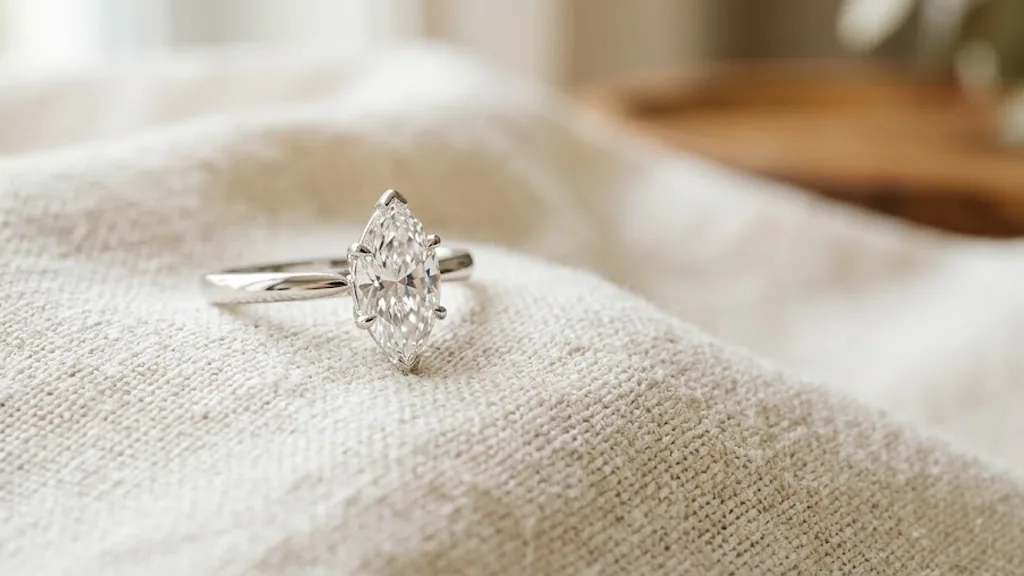
A one carat marquise is the shape to choose when you want the most finger coverage your money can buy. It is a long, pointed oval — sometimes called a navette, French for “little boat” — and no other shape at one carat looks this big.
This guide covers what a one carat marquise costs, why it is usually cheaper than the equivalent round, how large it actually looks, and the one flaw you must check before buying.
What a marquise cut is
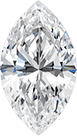
A marquise is an elongated oval with a sharp point at each end. It is a brilliant cut, so it is faceted for sparkle in the same family as a round, not in the long steps of an emerald cut.
The proportion between length and width is called the ratio. Most marquise diamonds sit around 1.85 to 2.10 — noticeably long. Below about 1.75 the shape starts to look like an oval that has been pinched. Above about 2.20 it becomes very slender and the points get fragile.
How big a one carat marquise looks
Carat is weight, not size. One carat is 0.20 grams. Because a marquise stretches that weight along a long axis, it covers more finger than any other common shape at the same weight.
| Shape at 1.00ct | Approximate size across the top |
|---|---|
| Marquise (about 2.00 ratio) | Around 10.5mm long x 5.3mm wide |
| Pear | Around 10.0mm long x 6.5mm wide |
| Oval | Around 7.7mm long x 5.7mm wide |
| Round brilliant | Around 6.4mm across |
A one carat marquise is roughly two thirds longer than a one carat round. Worn with the points running up the finger, it also makes the finger itself look longer and more slender. That optical effect is a large part of why people choose it.
Those figures are working guides. Your stone’s certificate gives the exact measurements, and you should always check it.
How much is a 1 carat marquise cut diamond?
There is no single number. What follows is broad market guidance for the UK to help you orientate — it is not a quote, and prices move.
| What you are buying | Typical UK guidance |
|---|---|
| 1.00ct marquise lab-grown, loose stone | Low hundreds of pounds |
| 1.00ct marquise lab-grown, finished gold or platinum ring | Several hundred to low thousands |
| 1.00ct marquise natural, loose stone | Low thousands of pounds |
| 1.00ct marquise natural, finished gold or platinum ring | Mid thousands upwards |
The lab-grown versus natural gap is the largest single saving available. A lab-grown diamond is a real diamond — the same carbon crystal, the same hardness, the same behaviour in light — grown in a laboratory over weeks rather than formed underground. You cannot tell them apart by eye, and neither can a jeweller with a loupe.
Why marquise costs less than round
Marquise is a fancy shape, meaning simply any shape that is not round. Fancy shapes generally price below round for two structural reasons.
First, cutting a round brilliant throws away a very large share of the original rough crystal. A marquise follows the elongated shape of much natural rough far more closely, so less material is wasted.
Second, round is the most requested engagement ring shape in Britain, and that demand supports its price. Marquise is a deliberate, less common choice.
This is a long-standing rule of thumb in the trade rather than a measured statistic, but it is dependable: at the same colour, clarity and cut quality, expect a marquise to price below a round of equal weight.
The flaw you must check: the bow tie
Every elongated brilliant cut — marquise, oval, pear — can show a dark band across the middle of the stone shaped like a bow tie. It happens when the facets block light from reaching the centre.
A faint bow tie that appears only at certain angles is normal and nothing to worry about. A heavy dark band that you notice immediately is a badly cut stone, and it will bother you forever.
Critically, bow ties are not graded on any certificate. A stone can carry perfect clarity and colour grades and still look dead in the middle. The only way to check is to look at the actual stone or a real video of it moving. Marquise cuts are the shape most prone to a bad bow tie, so this matters more here than anywhere else.
The other two things to check
Symmetry. A marquise has two points that must line up exactly. Look at the stone from directly above with the points running vertically. Both halves should mirror each other, and the widest part should sit exactly in the middle. Wonky marquises are common at the cheap end and impossible to unsee.
The points. Two sharp tips means two vulnerable spots. Each one needs a V-shaped prong — a small claw shaped like a V that wraps over the point. Never buy a marquise ring with exposed tips.
Our marquise rings
We hold around six marquise designs. Every ring is hand-made in solid gold or platinum with lab-grown diamonds, and every centre stone carries a free IGI certificate. Prices correct at the time of writing.
| Ring | Style | Price |
|---|---|---|
| Solitaire Marquise Cut Engagement Ring | Single stone, nothing to distract from the outline | £538 |
| Three Stone Marquise Cut Engagement Ring | Centre stone with a companion each side | £1,143 |
| Halo Marquise Cut Engagement Ring in White Gold | Small stones ringing the centre, adding visible width | £1,143 |
The solitaire at £538 makes the point neatly: a marquise solitaire sits below the price of most round solitaires while covering considerably more finger. Browse the full marquise cut collection, or compare shapes across our engagement rings.
Practical points before you commit
- Wedding bands need planning. A long pointed stone rarely allows a straight band to sit flush. A curved or chevron band is usually the answer, and it is easier to design both together.
- Consider daily life. Long stones sit across the finger and can catch on gloves and pockets. A lower setting helps.
- Colour concentrates at the points. Warmth shows at the tips first. G colour or better reads white in a white metal setting.
- Do not over-buy clarity. Eye-clean is the target — VS2 or a well-chosen SI1. Just check nothing sits near a point.
Frequently asked questions
How much is a 1 carat marquise cut diamond?
As guidance only: a loose one carat lab-grown marquise typically sits in the low hundreds of pounds, while a comparable natural stone typically runs into the low thousands. Finished rings add the metal and the making — our marquise engagement rings start at £538 at the time of writing.
Is a marquise cheaper than a round of the same carat?
Generally yes, at the same colour, clarity and cut quality. Cutting a marquise wastes less rough than cutting a round, and demand for round is higher. Both push the marquise price down.
Does a 1 carat marquise look bigger than a 1 carat round?
Considerably. A one carat marquise runs to around 10.5mm long against roughly 6.4mm across for a round. It is the largest-looking common shape at any given weight.
Are marquise diamonds fragile?
The two points are the weak spots, and they must be covered by V-prongs. With a proper setting a marquise is perfectly practical for everyday wear. Have the prongs checked every year or two, as you would with any diamond ring.
Can you make a marquise ring to my own design?
Yes. Bespoke design carries no extra design cost with us — you pay for materials and making only. Tell us the ratio, weight, metal and budget and we will price it honestly.
Marquise is the shape for someone who wants maximum presence and does not want to see their ring on three other people at the same party. Every order includes free insured UK delivery and 30 days to return, so you can check that bow tie in your own light.
More guides on this topic
Ready to find your perfect ring?
Explore our lab-grown diamond collection or book a virtual appointment with our team.