Do Men Wear Engagement Rings and Wedding Bands?
Men's wedding bands are standard in the UK; men's engagement rings are growing. What to wear, which finger, and honest advice on width.
Short answer: in the UK, most men wear a wedding ring and most men do not wear an engagement ring. But “most” is not “all”, and the engagement ring part is changing. Here is what the traditions actually are, what people are doing now, and how to decide what is right for you without worrying about whether it is allowed.
The wedding band: yes, and it is the normal thing to do
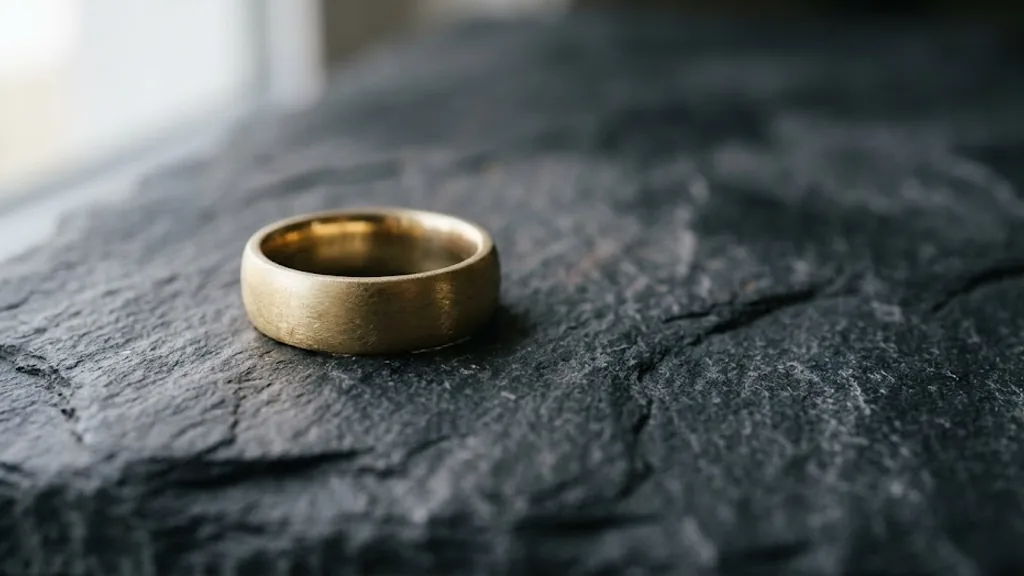
A man wearing a wedding ring is completely standard in Britain today. It is worn on the fourth finger of the left hand, the same finger a bride wears hers on, and it goes on during the ceremony when the rings are exchanged.
What surprises people is how recent this is. For most of history, the wedding ring was worn by the wife and not the husband. Men wearing wedding rings only became widespread in Britain and America around the middle of the twentieth century, spreading particularly during and after the Second World War, when a ring became a way for men serving abroad to carry a reminder of home. Within a couple of generations it went from unusual to expected.
So if you are wondering whether a man wearing a wedding ring is traditional, the honest answer is that it is now traditional, but it is a modern tradition. That is worth knowing, because it means nobody can reasonably tell you that a men’s ring choice is wrong on historical grounds.
The engagement ring: traditionally no, increasingly yes
The engagement ring as we know it was built around one person receiving it. In the standard British pattern, one partner proposes with a ring and the other wears it until the wedding, when a wedding band joins it.
Men wearing engagement rings has never been part of that pattern in the UK, and there is no long-standing custom behind it. What there is instead is a growing group of couples who simply do not see why only one person should wear something during the engagement. You will sometimes hear this called a “management ring”, which is a joke that has stuck.
Where it shows up most often:
- Same-sex couples, where a “one person proposes, one person wears it” model does not map neatly onto the relationship, and both partners often wear engagement rings.
- Couples who propose to each other, or who decide to get engaged as a joint decision rather than a surprise.
- Men who want to signal they are taken during a long engagement, particularly where a wedding is a year or more away.
We will not put a percentage on how common this is, because no reliable UK figure exists that we would trust enough to quote. What we can say from the workshop is that requests for a second engagement ring for the other partner arrive regularly, and they are no longer treated as unusual.
What men’s engagement rings usually look like
The most common approach is a plain or nearly plain band, worn during the engagement, and then either kept on the other hand after the wedding or replaced by the wedding band. Diamonds are not off the table, but they tend to be small, flush-set or bezel-set rather than raised on claws, because a raised stone catches on everything when you work with your hands.
| Style choice | What it means in practice | Best for |
|---|---|---|
| Plain band, 4–6mm wide | Nothing to snag, nothing to maintain, comfortable under gloves | Manual work, sport, anyone who forgets they are wearing it |
| Bezel or flush-set stone | The diamond sits level with the metal surface, held by a rim rather than claws | Someone who wants a stone but no height |
| Textured or patterned band | Hammered, brushed or carved surface; hides scratches well | Anyone who hates the idea of keeping a mirror polish |
| Claw-set stone | Stone raised above the band, more sparkle, more to catch | Desk-based work, occasional wear |
On width: men’s bands are usually wider than women’s. Something in the 4mm to 6mm range covers most people. Wider than 7mm starts to feel restrictive on the knuckle joint for many wearers, though that varies a lot by hand shape. There is no correct width, only what feels right when you try one on — which is a genuine argument for visiting a jeweller rather than guessing online.
Being straight with you about our own range
We do not currently run a dedicated men’s collection. Our wedding bands are designed as bridal styles, mostly narrower and mostly diamond-set, and they sit in our wedding ring collection alongside our women’s rings. We would rather tell you that than pretend otherwise and sell you something that is not what you wanted.
Two things follow from that. First, some of our simpler designs genuinely do work as a unisex band — our Minimalist Round Cut Wedding Band (£687, correct at the time of writing) is the plainest thing we make and the most likely to suit either partner. Our Ocean Wave Round Cut Wedding Band in yellow gold (£657 at the time of writing) is another with enough texture to read as unfussy rather than delicate.
Second, and more usefully: everything we make is hand-made in solid gold or platinum in our North Harrow workshop, and we design bespoke at no extra design cost. If you want a 5mm brushed platinum band with a single flush-set lab-grown diamond, that is a normal bespoke job for us, not a special favour. Bring in a photo or a description and we will quote on the metal and the stone, not on the drawing.
If both partners want a ring during the engagement
A few practical points that come up constantly:
- They do not have to match. Matching engagement rings look lovely in photographs and are entirely optional. Plenty of couples pick very different rings.
- Budget does not have to be equal either. A plain platinum band and a diamond solitaire cost very different amounts. That is a metal and stone question, not a statement about the relationship.
- Decide early what happens at the wedding. Some men move the engagement ring to the right hand and wear the wedding band on the left. Some stop wearing it. Some have it made deliberately so the two stack together. Knowing which you want changes the design.
- Sizes change. Fingers swell in heat and after exercise. Get sized properly rather than measuring at home with string, and get sized at a normal time of day.
Frequently asked questions
Do men wear engagement rings in the UK?
Some do, and it is becoming less unusual, but it is still a minority choice rather than a norm. There is no tradition behind it and no tradition against it. If you both want one, wear one.
Which finger does a man’s engagement ring go on?
Usually the fourth finger of the left hand, the same as the wedding ring, and then it moves to the right hand at the wedding so the wedding band can take its place. Some men wear the engagement ring on the right hand from the start and skip the swap entirely. Both are correct.
Do men wear both an engagement ring and a wedding band at the same time?
They can. Two rings on the same finger, stacked, works well if the bands are made to sit flush against each other. If they were bought separately and do not fit together neatly, wearing them on different hands looks better.
Is it strange for a man to have a diamond in his ring?
No. Diamonds in men’s rings are common; they are just usually set differently — smaller, and set into the metal rather than raised above it, so the ring stays comfortable and hard-wearing.
Should a man’s ring match his partner’s?
Only if you want it to. A shared metal is the easiest way to make two different designs look like a pair without forcing them to be identical.
Do you make wider men’s bands to order?
Yes, as bespoke pieces with no extra design cost, in solid gold or platinum, with lab-grown diamonds and a free IGI certificate on any centre stone. Tell us the width, the metal and the finish and we will make it.
If you are working out the practicalities of who wears what and where, you may also want to read which hand a wedding ring goes on. Otherwise, have a look through the wedding bands we currently make and tell us what you would change — that conversation is usually where a bespoke ring starts.
Ready to find your perfect ring?
Explore our lab-grown diamond collection or book a virtual appointment with our team.