
Which Hand Does a Wedding Ring Go On?
Left hand in the UK and France, right hand across much of Europe. Which finger, which order, and why some women wear theirs on the right.
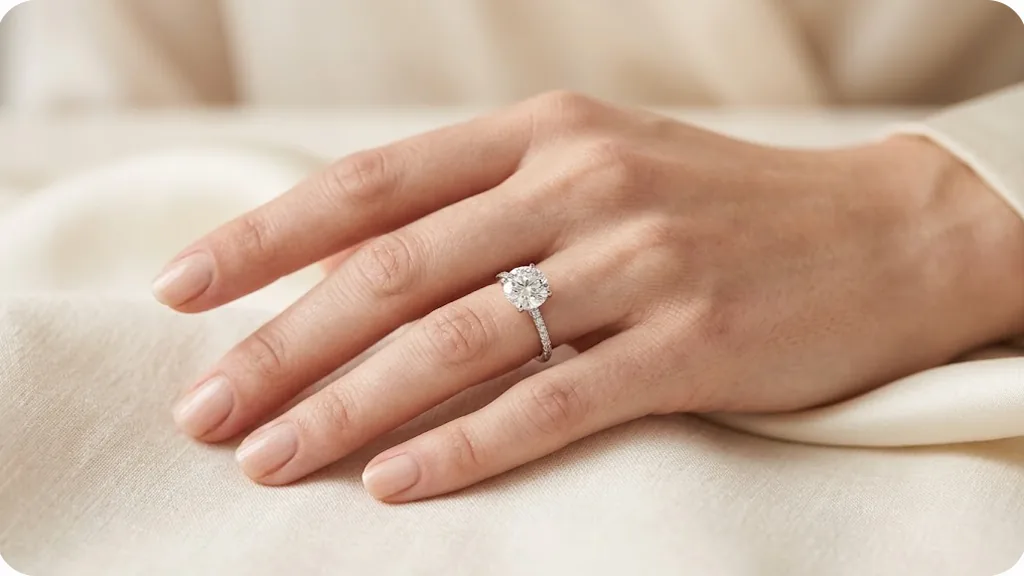
In the UK, the wedding ring goes on the fourth finger of the left hand — the one next to the little finger. That is the answer most readers need, and it is the end of the matter for most British weddings.
But it is only the answer for here. Across a large part of Europe the wedding ring is worn on the right hand, and plenty of women in Britain wear theirs on the right for reasons that have nothing to do with tradition. This guide covers which hand, which finger, which order, and why some people do it differently.
Which finger, and the story about the vein
The wedding finger is the fourth finger, counting the thumb as the first. Jewellers call it the ring finger. On the left hand, it sits between your middle finger and your little finger.
You will often be told that this finger was chosen because a vein — the vena amoris, or “vein of love” — runs directly from it to the heart. It is a lovely story and it is worth knowing that it is not anatomically true. Every finger has veins that return blood to the heart; there is nothing special about the fourth one. The Romans believed it, the belief stuck, and the custom outlived the biology.
The more practical reason the tradition survives is that the fourth finger is the least used finger on most hands. A ring there gets knocked about less than one on an index or middle finger.
Which hand, country by country
There is no worldwide standard. Roughly speaking, the split follows old religious and linguistic lines rather than any modern logic.
| Country or region | Wedding ring hand | Notes |
|---|---|---|
| United Kingdom and Ireland | Left | Fourth finger. Engagement ring on the same finger |
| France | Left | The ring is called an alliance. Same finger as the UK |
| United States, Canada, Australia, New Zealand | Left | Follows the British pattern |
| Italy, Sweden, Portugal (varies) | Left | Portugal is mixed in practice |
| Germany and Austria | Right | The engagement ring is worn on the left, then moved to the right at the wedding |
| Russia, Poland, Ukraine, Bulgaria | Right | Strongly established, linked to Orthodox and Catholic custom |
| Greece | Right | Orthodox tradition |
| Spain | Right | Though the left hand is common in Catalonia |
| Norway and Denmark | Right | Left is also seen, particularly among younger couples |
| Netherlands | Both | Historically split along religious lines; genuinely varies household to household |
| India | Usually right | The left hand is traditionally considered unclean in many communities |
| Brazil | Right, then left | Bands are worn on the right during the engagement and swap to the left at the wedding |
Treat this as a general guide rather than a rulebook. Within every country listed there are families and communities who do it the other way, and immigration has mixed the customs thoroughly. If you are marrying into a family from one of the right-hand countries, ask them rather than assuming.
So do French people wear wedding rings?
Yes. The French wedding ring is the alliance and it is worn on the fourth finger of the left hand, exactly as in Britain. What differs slightly is emphasis: the French tradition has historically leaned on the wedding band as the important ring, with the diamond engagement ring — the bague de fiançailles — playing a smaller part than it does in the UK or America. Plain or lightly diamond-set bands are common, and so are the interlocking three-band designs that French houses made famous.
Why some women wear their wedding ring on the right hand
Setting nationality aside, here are the reasons that come up most often in the shop. None of them is unusual and none of them requires an explanation to anybody.
- They are left-handed. Wearing rings on the less-used hand means fewer knocks and less wear on the setting. This is a genuinely sensible reason, not a superstition.
- Their job makes it impractical. Nurses, chefs, mechanics, carers and anyone who wears gloves all day often move rings to the hand that suffers less, or take them off entirely.
- The knuckle no longer allows it. Arthritis, injury or simple swelling can make the left ring finger impossible while the right one is fine.
- They are widowed. In many cultures, moving the wedding ring to the right hand marks widowhood while keeping the ring on.
- They are divorced but keep the ring. Same idea in reverse — the right hand signals that the ring is now jewellery rather than a marriage.
- The engagement ring is too big to stack. A tall or wide engagement ring sometimes simply will not sit next to a band. Splitting them across two hands solves it instantly.
- They prefer it. Which is a complete reason on its own.
How to wear a wedding ring correctly
“Correctly” mostly means comfortably, but there are a few conventions and a few real practicalities.
Order on the finger. The traditional order is the wedding band first — closest to the base of the finger, “closest to the heart” — with the engagement ring above it. This comes from the idea that the wedding vow ring should sit nearest to you. It is a convention, not a rule, and plenty of people wear the engagement ring underneath because it looks better that way with their particular pair.
The right way up. Shaped bands have a right way round. A curved or chevron band is cut to nest around the point or edge of an engagement ring, so it only sits flush one way. Our Curved Round Cut Wedding Band in yellow gold (£707, correct at the time of writing) is a good example — the dip in the band is there to receive the stone above it. A straight band like our Minimalist Round Cut Wedding Band (£687 at the time of writing) has no wrong way up at all, which is one of the quiet advantages of a plain design. Patterned bands sit somewhere between the two — our Tiara Round Cut Wedding Band (£707 at the time of writing) has a clear top edge, so it wants to be worn one way up even though it will physically fit either way.
On the wedding day. The band is placed on an empty finger during the ceremony. Most brides move the engagement ring to the right hand for the day and move it back afterwards, so the band goes on first and the engagement ring sits above it for the rest of the marriage.
Fit. A wedding ring should slide on with mild resistance and come off over the knuckle with a firm pull. If it spins loosely it will eventually go missing; if you have to force it past the knuckle it is too tight. Get sized at a normal time of day — fingers are smaller first thing in the morning and in cold weather, and larger after exercise or a hot day.
When to take it off. Swimming pools and hot tubs (chlorine attacks gold alloys), the gym (bar work bends bands out of round), gardening and heavy cleaning. Cold water shrinks fingers, which is how rings disappear down drains and into the sea.
Frequently asked questions
Which hand does a wedding ring go on in the UK?
The left, fourth finger. The engagement ring goes on the same finger.
Is it wrong for a woman to wear her wedding ring on the right hand?
No. It is standard practice across much of Europe, and in Britain it is a common personal choice for left-handed women, for anyone whose job is hard on hands, and for anyone whose knuckles have changed. Nobody is doing it incorrectly.
Which ring goes on first, the wedding band or the engagement ring?
Traditionally the wedding band goes on first, closest to the hand, with the engagement ring above it. Reversing that order is common and perfectly acceptable, particularly if it makes the two rings sit flush.
Do men wear their wedding ring on the same hand as women?
In any given country, yes — both partners follow the same national custom. In the UK that means the left hand for both. You can read more in our guide to whether men wear engagement rings and wedding bands.
What do I do if my wedding ring no longer fits my left hand?
You have three options: have it resized, move it to the right hand, or wear it on a chain. Resizing is straightforward for most plain and half-set bands and much harder for full eternity rings, where there is no plain metal to work with.
Can I wear my wedding ring on a different finger?
Yes. Some people wear a wedding ring on the middle finger or the index finger because of fit, comfort or preference. It is unconventional in Britain but it is not incorrect, and most people will not notice.
Whichever hand yours ends up on, the ring has to be comfortable enough to forget about. Have a look through our wedding ring collection and our engagement rings — all hand-made in solid gold or platinum with lab-grown diamonds, free IGI certification on centre stones, and free insured UK delivery.
More guides on this topic
Ready to find your perfect ring?
Explore our lab-grown diamond collection or book a virtual appointment with our team.











