
Which Finger and Hand Does a Wedding Ring Go On?
Which finger a wedding ring goes on in the UK, why some countries use the right hand, and how women wear a band with an engagement ring.
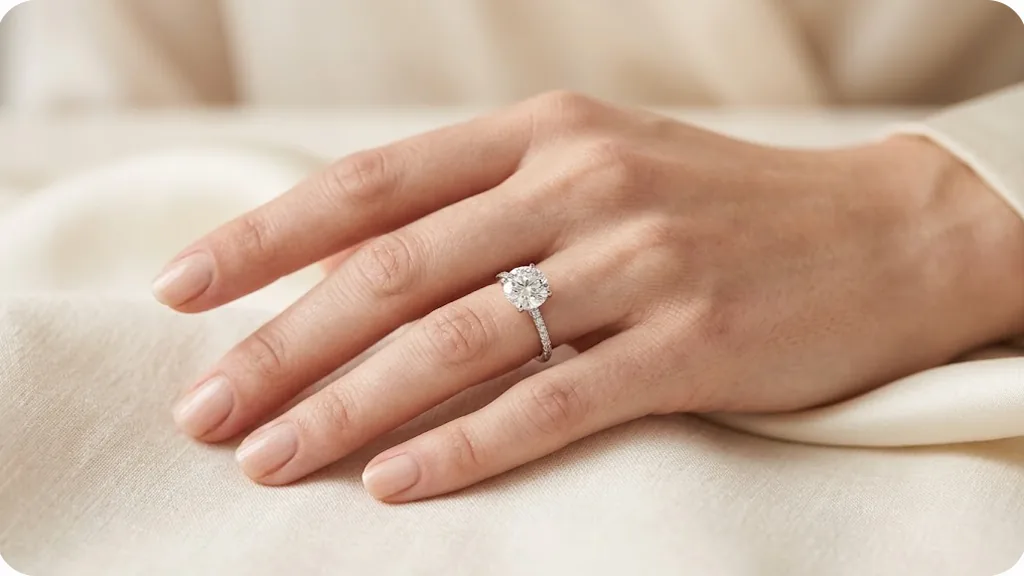
In the UK, a wedding ring goes on the fourth finger of the left hand — the one between your middle finger and your little finger, counting the thumb as the first digit. That is the answer most people are looking for, and for a British wedding it is all you need.
But it is genuinely not universal. Roughly half the world wears wedding rings on the right hand, and there are good reasons some people in Britain do too. Here is the whole picture, including how women typically wear the ring alongside an engagement ring.
Why the fourth finger of the left hand?
The romantic explanation is the vena amoris — the “vein of love” — a vein believed by the Romans to run directly from that finger to the heart. It is a lovely story and it is anatomically wrong. Every finger has veins that return blood to the heart; there is nothing special about the fourth one.
The tradition is real and old; the anatomy behind it is not. Any jeweller who tells you the vein story as fact is repeating a myth. It is still worth knowing, because it is where the custom came from, but it belongs in the folklore column.
There is a more practical explanation too. The ring finger is one of the least independently used fingers on the hand — try lifting it on its own while your others are flat and you will feel how limited it is. A ring there is less in the way than on an index finger or a thumb.
Do people wear wedding rings on the right hand?
Yes — a great many, and it is entirely correct in those traditions rather than a mistake.
Countries where the right hand is the norm include Germany, Austria, Spain, Poland, Russia, Ukraine, Norway, Denmark, Greece, Bulgaria and India, among others. In several Orthodox Christian traditions the right hand carries particular significance because it is the hand used for blessing.
Some countries do both at different stages. In Germany and the Netherlands, for instance, it is common for the engagement ring to be worn on the left and then moved to the right hand at the wedding — the exact reverse of the British pattern.
| Tradition | Engagement ring | Wedding ring |
|---|---|---|
| UK, Ireland, USA, France, Italy (much of it) | Left hand | Left hand |
| Germany, Austria, Netherlands | Left hand | Right hand |
| Russia, Poland, Greece, Ukraine | Right hand | Right hand |
| India (varies widely by region) | Often right hand | Often right hand |
| Brazil, Spain | Right hand | Right hand |
Customs vary within countries and within families, so this table is a general guide rather than a definitive map. If you are marrying across two traditions, pick whichever suits you — nobody is going to check.
Practical reasons to wear it on the right hand in Britain
Beyond tradition, there are everyday reasons people switch:
- You are left-handed. Your dominant hand takes more knocks, so many left-handers wear the ring on the right to protect it. This is sensible and increasingly common.
- Your left ring finger will not take a ring. Arthritis, a healed fracture, or a joint that is much wider than the base of the finger — all genuine reasons to move it.
- Work. Some jobs make one hand far more exposed than the other.
- An existing ring. A signet ring or a family piece already occupies the spot.
None of these is a statement about the marriage. It is just a hand.
How do women usually wear a wedding ring?
When there is an engagement ring in the picture, the traditional arrangement is: wedding band closest to the hand, engagement ring stacked above it, both on the left ring finger. The idea is that the ring marking the marriage sits nearest the heart with nothing between.
In real life, five arrangements are all common:
- Band below, engagement ring above — the traditional stack, and the most protective of the band.
- Engagement ring below, band above — chosen when the band’s design reads better on the outside.
- One on each hand — practical when both rings are substantial and clash side by side.
- Band only day to day — engagement ring kept for evenings and occasions. Very common among nurses, teachers, chefs, gardeners and parents of small children.
- Soldered as one — the two rings permanently joined so they never spin apart.
A stack works best when the two rings sit flush against each other. If your engagement ring has a pointed or low-set stone, a shaped band closes the gap — the Curved Round Cut Wedding Band in Yellow Gold and the Chevron Pear Cut Wedding Band in Rose Gold are both designed to do exactly that. Prices on our product pages are correct at the time of writing.
Which way round should the ring face?
Most wedding bands are symmetrical, so it does not arise. Where it does matter:
- Shaped and chevron bands have a definite top. The point or curve should cradle the engagement ring, not point away from it.
- Three-quarter and half eternity bands should have their stones facing outward, across the back of the hand, with the plain section against the palm. The plain part is there deliberately — it is the section that takes the wear.
- Signet and Claddagh rings have their own orientation conventions entirely.
What if you cannot wear it on your finger at all?
Common, and there are proper solutions rather than compromises:
- On a chain around the neck — the standard answer for surgeons, machinists, electricians, and anyone whose workplace bans hand jewellery. Choose a chain strong enough for the ring’s weight.
- A silicone band for work, with the real ring worn the rest of the time. Silicone breaks under load rather than trapping a finger, which is why it is standard in trades with degloving risk.
- On a different finger — the middle finger of either hand works well if the ring finger is unsuitable.
Frequently asked questions
Is it wrong to wear a wedding ring on the right hand in the UK?
Not at all. It is simply less common here. Nobody will assume anything about your marriage from which hand you use, and if they do, that says more about them.
Which finger is the fourth finger?
Counting from the thumb: thumb, index, middle, ring, little. The ring finger is the fourth, sitting between the middle finger and the little finger. It is the one that is hardest to lift independently.
Can I wear my wedding ring on my thumb or index finger?
You can wear it anywhere you like. Bear in mind that fingers differ in size considerably — a thumb is typically several sizes larger than a ring finger — so a ring made for one will not fit the other without resizing.
Does the ring go on before or after the engagement ring during the ceremony?
Traditionally the band goes on the bare finger, which is why many people move their engagement ring to their right hand for the ceremony and swap it back afterwards. It saves an awkward moment at the altar.
Do men wear their wedding ring on the same hand?
Yes — the same tradition applies, left ring finger in the UK, right hand in the countries listed above. Men’s bands are typically wider, usually 4 to 6 mm, and almost always worn alone.
The short version
Fourth finger, left hand, in Britain. Right hand across much of Europe and beyond, and for left-handers and anyone whose work demands it. Band beneath the engagement ring if you are wearing both.
If you are choosing a band that has to share a finger with an engagement ring, look at the shaped and stackable designs in our wedding ring collection — they are made to sit flush rather than fight for space. Everything is hand-made in solid gold, platinum or sterling silver with lab-grown diamonds, with free insured UK delivery and 30 days to return.
Ready to find your perfect ring?
Explore our lab-grown diamond collection or book a virtual appointment with our team.