
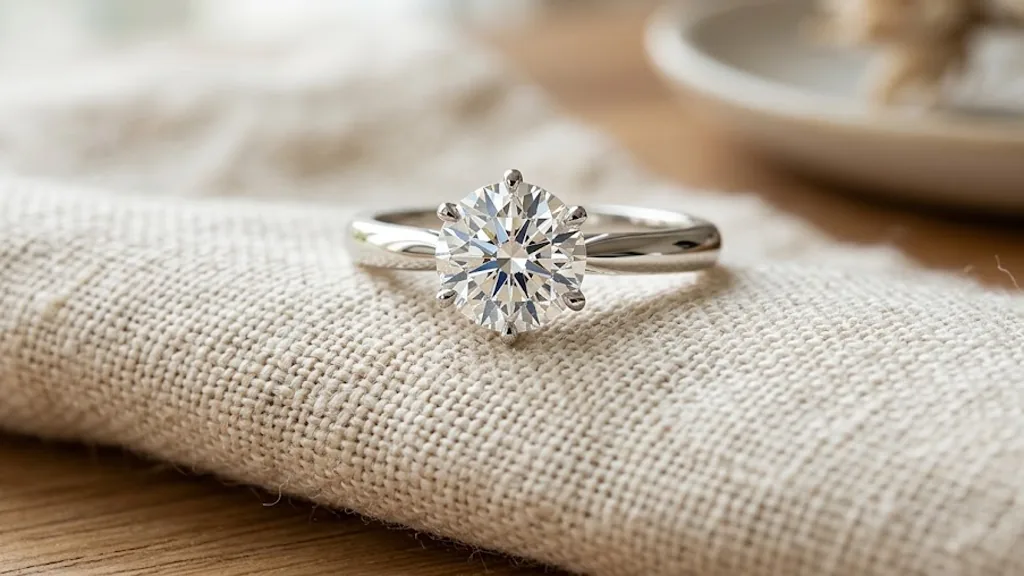
Round Diamond MM to Carat: How Many Carats Is a 6.5 mm or 2 mm Round?
A 6.5 mm round diamond is about 1.00 carat and a 2 mm round about 0.03 carat. Full mm to carat chart plus the formula behind it.
Carat is a measure of weight, not size. Millimetres measure size. That is why two diamonds can both be sold as one carat and sit differently on the finger — and why the question “how many carats is a 6.5 mm round diamond?” needs a slightly longer answer than a single number.
The short version, for round brilliant diamonds cut to normal proportions:
- A 6.5 mm round diamond weighs roughly 1.00 to 1.05 carats.
- A 2 mm round diamond weighs roughly 0.03 carats — about three points, the size used for pavé and accent stones.
Below is the full conversion chart, the arithmetic behind it, and the reason the numbers shift a little from stone to stone.
Round diamond mm to carat chart
These figures assume a round brilliant cut to standard depth (around 60 to 62 per cent) with a normal girdle. Treat them as close estimates, not certified weights.
| Diameter (mm) | Approximate carat weight | What it is normally used for |
|---|---|---|
| 1.0 mm | 0.005 ct | Tiny pavé and micro-set detail |
| 1.5 mm | 0.015 ct | Pavé bands, hidden halos |
| 2.0 mm | 0.03 ct | Standard pavé and accent stones |
| 2.5 mm | 0.06 ct | Larger accents, eternity bands |
| 3.0 mm | 0.10 ct | Eternity bands, small side stones |
| 3.5 mm | 0.16 ct | Side stones on three-stone rings |
| 4.0 mm | 0.25 ct | Small solitaires, earrings |
| 4.5 mm | 0.36 ct | Modest solitaire |
| 5.0 mm | 0.50 ct | Half-carat solitaire |
| 5.5 mm | 0.65 ct | Popular in-between size |
| 6.0 mm | 0.84 ct | Just under a carat |
| 6.5 mm | 1.00 ct | The classic one-carat solitaire |
| 7.0 mm | 1.25 ct | Noticeably larger than a carat |
| 7.5 mm | 1.50 ct | Statement solitaire |
| 8.0 mm | 2.00 ct | Two-carat centre stone |
| 8.5 mm | 2.40 ct | Large centre stone |
| 9.0 mm | 2.75 ct | Very large centre stone |
Why 6.5 mm is not always exactly 1.00 carat
Weight sits in three dimensions, but the diameter only tells you about two of them. The third — how deep the stone is below the surface — is where the variation comes from.
Two 6.5 mm rounds can differ by several points of weight because of:
- Depth. A deeper stone hides extra weight underneath the girdle. It weighs more but does not look bigger from above.
- Girdle thickness. A thick girdle — the band around the widest point — adds weight that contributes nothing to how the diamond looks face-up.
- Slight ovality. Certificates give round diamonds two diameters, such as 6.48 × 6.52 mm. Perfectly circular stones are rare.
This matters more than it sounds. A poorly cut 1.05 ct round can measure 6.3 mm across and look smaller on the hand than a beautifully cut 0.98 ct that measures 6.4 mm. If you are shopping by how large the ring looks, measure in millimetres, not carats.
How to picture these sizes without a ruler
Millimetres are hard to imagine in the abstract, so here are some everyday reference points. A standard staple is about 10 mm wide. The lead in a mechanical pencil is 0.5 or 0.7 mm. A grain of uncooked rice is roughly 6 to 7 mm long — which makes a 6.5 mm round diamond about as wide as a grain of rice is long.
The easiest practical test costs nothing: take a ruler with millimetre markings, mark out a circle of the diameter you are considering on a piece of paper, cut it out and rest it on your own finger. It will not sparkle, but it will tell you honestly whether the size is right for your hand. We recommend this to customers regularly, and it saves a surprising number of returns.
The rough formula, if you want to check it yourself
For a round brilliant, a widely used trade estimate is:
Carat weight ≈ diameter (mm) × diameter (mm) × depth (mm) × 0.0061
Try it on a 6.5 mm stone at a normal 4.0 mm depth: 6.5 × 6.5 × 4.0 × 0.0061 = 1.03 carats. Try it on a 2 mm stone at 1.23 mm depth: 2 × 2 × 1.23 × 0.0061 = 0.03 carats. Both land where the chart says they should.
This is an estimating formula used when a stone is already set and cannot be weighed. It is a rule of thumb in the trade, not a measured figure, and it does not account for an unusually thick girdle. For a loose stone, the certificate weight is always the number to trust.
What a 2 mm round diamond is actually for
At 0.03 ct, a 2 mm round is not a centre stone — it is a supporting one. This is the workhorse size for pavé, the small stones set in a row along a band or around a halo. You will find dozens of them on a single ring.
Because they are small, individual clarity and colour grades matter far less than they do on a centre stone. What matters is that they are matched to each other and set evenly. A row of pavé where one stone sits crooked is far more noticeable than one where a stone is a grade lower in colour.
If you want to see how 2 mm stones read in practice, the Stackable Round Cut Full Eternity Band at £707 at the time of writing runs them the whole way round, and the Twisted Round Cut Half Eternity Band at £657 at the time of writing sets them along a twist so you can see how the light moves.
What a 6.5 mm round looks like on the hand
A 6.5 mm round is a touch wider than a standard pencil eraser and covers a good portion of the width of an average finger. On a smaller finger — say a UK size H or I — it reads as generous. On a size Q or R it reads as neat and classic rather than large.
The setting changes the impression considerably. A plain solitaire shows the stone at its true size. A halo of small rounds around it can add roughly 1.5 to 2 mm to the overall width of the head, which is why a haloed 0.75 ct often reads similar to a solo 1.00 ct.
Our Solitaire Round Cut Engagement Ring at £657 at the time of writing is the simplest way to judge a round centre stone at its honest size. The whole shape is in the round cut collection, and you can compare it against other shapes in the engagement ring range.
Frequently asked questions
How many carats is a 6.5 mm round diamond?
Roughly 1.00 to 1.05 carats for a round brilliant cut to standard proportions. A deeper stone at the same diameter will weigh a little more; a shallower one a little less.
How many carats is a 2 mm round diamond?
Roughly 0.03 carats, often written as 3 points. It is an accent size rather than a centre stone size.
Can I work out carat weight from millimetres exactly?
No. You can get very close, but weight depends on depth and girdle thickness, which a diameter measurement does not reveal. Any mm-to-carat chart is an estimate.
Which should I shop by — millimetres or carats?
Millimetres, if what you care about is how large the ring looks. Carats, if what you care about is the certified weight. The two usually agree, but not always.
Do these numbers work for oval, pear or emerald cuts?
No. Every shape has its own relationship between size and weight, because they distribute weight differently. This chart is for round brilliants only.
Does a lab-grown diamond weigh the same as a mined one at the same size?
Yes. They have the same density, so a 6.5 mm lab-grown round weighs the same as a 6.5 mm mined round of identical proportions. The only real difference is where it was formed and what it costs.
If you would like us to check the measurements on a certificate before you buy, send it over and we will read it with you. Every centre stone we set comes with a free IGI certificate, free insured UK delivery and 30-day returns.
Ready to find your perfect ring?
Explore our lab-grown diamond collection or book a virtual appointment with our team.











