
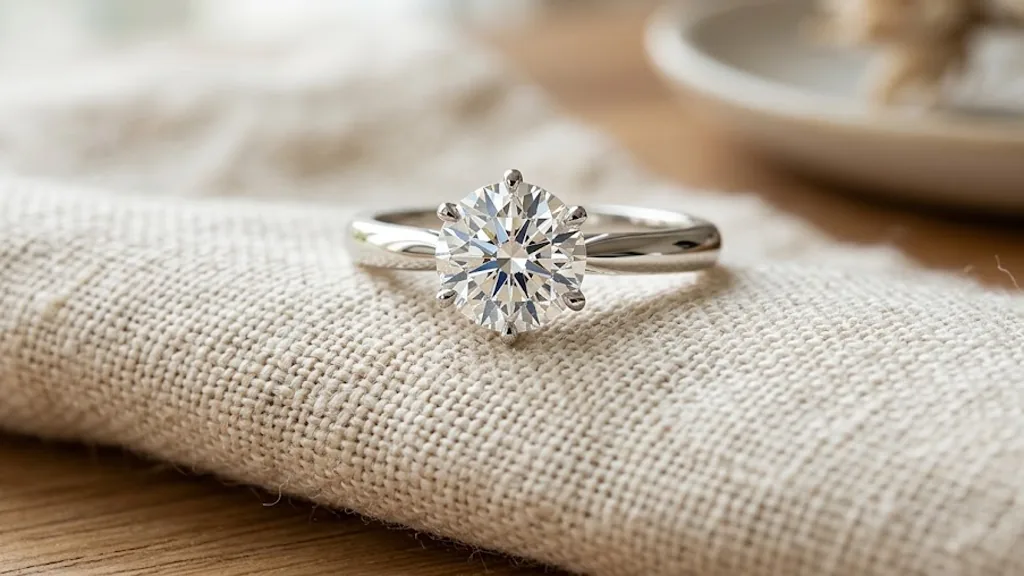
How Many Facets Does a Round Cut Diamond Have? (And What It Is Really Called)
A round cut diamond has 57 or 58 facets. Every facet named and explained, plus why it is properly called a round brilliant cut.
The round diamond is the shape almost everyone pictures when they hear the word “diamond”. It is also the most precisely engineered of all the shapes — and the number of facets on it is not an accident. It is the result of about a century of maths.
A round cut diamond has 57 or 58 facets. Whether you say 57 or 58 depends on one tiny detail at the very bottom of the stone. Here is the full breakdown, plus the answer to the other question people ask in the same breath: what is a round cut diamond actually called?
The 58 facets, counted properly
A facet is a flat polished surface. Each one bends and bounces light. On a round diamond they are arranged in a fixed pattern, and every one has a name.
| Part of the diamond | Facets | What they are |
|---|---|---|
| Table | 1 | The large flat facet on top that you look through |
| Crown — bezel facets | 8 | The big kite-shaped facets around the table |
| Crown — star facets | 8 | Small triangles between the table and the bezels |
| Crown — upper girdle facets | 16 | The narrow row just above the widest point |
| Pavilion — lower girdle facets | 16 | The narrow row just below the widest point |
| Pavilion — main facets | 8 | The long facets running down to the tip |
| Culet | 1 or 0 | The tiny flat facet at the very bottom tip |
| Total | 57 or 58 |
Modern cutting usually brings the pavilion down to a sharp point rather than a small flat culet. When that happens, the count is 57. When there is a culet, it is 58. Both are completely normal and neither affects value in any meaningful way. Older diamonds nearly always have a visible culet; you can sometimes see it as a small dark dot when you look straight down through the table.
So what is a round cut diamond called?
Its proper name is a round brilliant cut, and you will often see the full name written as the modern round brilliant or the standard round brilliant. Some older trade documents call it the American ideal cut or the Tolkowsky cut, after Marcel Tolkowsky, the man who published the proportions in 1919.
“Brilliant” is not a marketing word. It is a technical term for a cutting style — a design built out of triangular and kite-shaped facets radiating from the centre, intended to maximise the light that comes back up through the top. Pear, oval, marquise, heart and radiant cuts are all brilliant cuts too. Round is simply the brilliant cut in its original circular outline.
The opposite family is the step cut, where facets run in long parallel rows like steps — that is your emerald cut, asscher and baguette. Step cuts give you flashes of white light and a glassy, hall-of-mirrors look instead of fiery sparkle.
Names you may also see on a listing, and what they really mean:
- Round brilliant cut (RBC) — the normal, correct name.
- Ideal cut / Excellent cut — not a shape, a grade. It describes how well the proportions were executed.
- Hearts and arrows — a round brilliant with exceptional optical symmetry, which shows a pattern of eight arrows from the top and eight hearts from below under a special viewer.
- Old European cut — a genuinely different, older round design with a smaller table, taller crown and a large open culet. We do not stock Old European cuts; if you want that antique look we can produce it as a bespoke commission at no extra design cost.
Why 58 and not 100?
Because more facets is not better. It is a genuine misunderstanding worth clearing up.
Every facet has a job. The pavilion mains catch light coming in through the table and bounce it back up. The crown facets split white light into colours on the way out, which is what jewellers call fire. The arrangement of 57 to 58 facets, cut at specific angles, was worked out to return the maximum amount of light to the eye.
Add more facets to the same size stone and each one gets smaller. The flashes get finer and busier, and the fire tends to reduce. Some brands sell rounds with 70, 80 or over 100 facets. They can be lovely, but they are a different look, not an upgrade. A standard round brilliant cut to excellent proportions is still the benchmark the whole trade measures against.
What actually decides how a round diamond looks
Since every round brilliant has the same facet count, the difference between a dull one and a stunning one comes entirely from execution:
- Table percentage — how wide the top facet is compared with the whole stone. Roughly 54 to 58 per cent is the sweet spot most graders favour.
- Depth percentage — how tall the stone is. Too deep and light escapes out the bottom; too shallow and it leaks out the sides, giving a glassy “fish-eye” look.
- Crown angle and pavilion angle — the two angles that decide whether light comes back to your eye at all.
- Symmetry and polish — whether facet points meet cleanly and the surfaces are free of polish lines.
All of these are printed on the IGI certificate that comes free with every centre stone we set. If you are choosing between two rounds, that page is more useful than any photograph.
Round rings we make
Round is our largest collection — twenty designs at the time of writing — because it suits almost everyone and it is the most forgiving shape to set. A few worth looking at:
- Solitaire Round Cut Engagement Ring in White Gold — £563 at the time of writing. The plainest possible setting, which is exactly why it shows the facet pattern so clearly.
- Halo Round Cut Engagement Ring — £707 at the time of writing. A ring of small rounds around the centre makes the whole head read larger.
- Vintage Round Cut Engagement Ring in Yellow Gold — £1,051 at the time of writing, for the antique feel without the compromises of a genuinely old stone.
Browse the full round cut collection, or compare it against the rest of the engagement ring range.
Frequently asked questions
How many facets are in a round cut diamond?
57 or 58. The count is 58 when the diamond has a culet — a small flat facet at the bottom tip — and 57 when the pavilion comes to a sharp point instead.
What is a round cut diamond called?
A round brilliant cut. You may also see “modern round brilliant”, “standard round brilliant” or, in older writing, the “Tolkowsky” or “American ideal” cut. They all describe the same design.
Is “brilliant cut” the same as “round cut”?
Not quite. Brilliant is the cutting style — the radiating triangular and kite-shaped facet layout. Round is the outline. Pear, oval, marquise and heart shapes are also brilliant cuts.
Do diamonds with more than 58 facets sparkle more?
They sparkle differently, not more. Extra facets make each flash smaller and finer. A well-proportioned 57-facet round will usually show more fire than a poorly proportioned stone with a higher facet count.
Does a lab-grown round brilliant have the same facets?
Yes, exactly the same. Cutting is cutting. A lab-grown diamond is cut on the same wheels, to the same angles, by the same cutters as a mined stone of the same shape.
How can I tell if a round is well cut without a certificate?
Look straight down at it under a normal ceiling light and move it slowly. You want an even pattern with no large dark hole in the centre and no washed-out glassy patch. If the middle looks lifeless, the proportions are off.
If you want a straight opinion on two stones you are weighing up, send us the certificate numbers and we will read them for you. Everything we make comes with free insured UK delivery and 30-day returns.
Ready to find your perfect ring?
Explore our lab-grown diamond collection or book a virtual appointment with our team.











