
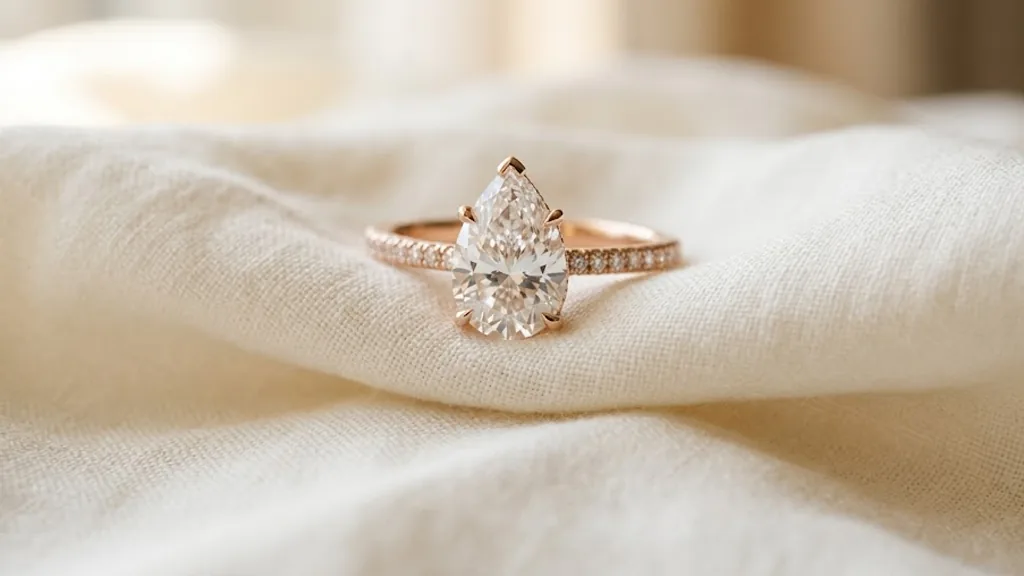
How Big is a 1 Carat Pear Shaped Diamond?
A 1 carat pear is about 8.5 x 5.5mm. Size by ratio, how it compares to a round, and the bow-tie effect no certificate shows.
A one carat pear shaped diamond typically measures around 8.5mm long by 5.5mm wide. Depending on how the stone is proportioned, anything from roughly 8.0 × 5.7mm to 9.1 × 5.2mm is normal at that weight.
Unlike a round diamond, a pear cannot be described by a single number, because the same carat weight can be cut short and plump or long and slender. That choice changes how the ring looks far more than most people expect, so it is worth understanding before you buy.
Why one carat gives you a range, not a measurement
Carat is a unit of weight — 0.2 grams — not of size. A pear cut has a rounded end and a pointed tip, and the cutter decides how much to stretch that outline. Stretch it and the stone gets longer and narrower at the same weight. Keep it compact and it gets shorter and wider.
The number that describes this is the length-to-width ratio: divide the length by the width. It appears on the measurements line of every certificate, and it is the single most useful figure for a pear.
| Ratio | Approximate size at 1.00ct | How it looks |
|---|---|---|
| 1.40 | 8.0 × 5.7mm | Short and full; almost droplet-like |
| 1.50 | 8.3 × 5.5mm | Classic and balanced |
| 1.55 | 8.5 × 5.5mm | The most requested proportion |
| 1.65 | 8.8 × 5.3mm | Noticeably elongated and elegant |
| 1.75 | 9.1 × 5.2mm | Long and dramatic; a deliberate statement |
Individual stones vary by a tenth of a millimetre or two either way, and a deeply cut pear will measure smaller across the top than a well-spread one of the same weight.
How that compares with a one carat round
A one carat round brilliant measures about 6.4 to 6.5mm across. A one carat pear at 8.5 × 5.5mm is therefore around 2mm longer but roughly a millimetre narrower.
The total surface area facing up is broadly similar between the two — the pear does not magically give you more diamond. What it gives you is a different distribution. Because the stone is normally worn with the point towards the fingernail, it runs along the finger rather than sitting across it, and that length is what people read as “big”.
In practice, most people find a one carat pear looks larger on the hand than a one carat round. That impression is real, even though the arithmetic says the areas are close.
What one carat looks like on different hands
The same stone behaves differently depending on finger width. On a slim finger — roughly a UK size G to J — an 8.5mm pear covers a substantial portion of the finger between the knuckles and reads as generous. On a size P or Q, the same stone looks neat and proportionate rather than large.
Ratio interacts with this. If you have shorter fingers, a longer pear at 1.65 or above will make your hand look longer. If you have long slim fingers, a fuller pear at 1.40 to 1.50 usually sits better, because a very elongated stone can look stretched.
The bow-tie: the thing to check that no certificate tells you
Every pear shaped diamond has some degree of bow-tie — a dark shadow shaped like a bow tie running across the widest part of the stone. It is caused by the facets on either side of the centre reflecting your own head and shoulders back at you rather than returning light.
A faint bow-tie is normal and adds contrast. A heavy one leaves a dead grey band across the middle of the diamond and it will bother you forever.
Grading reports do not measure it. There is no bow-tie grade. You have to look at the specific stone, ideally in a video where it moves, because a still photograph taken under studio lights can hide a serious one completely.
Other things that affect how big a one carat pear looks
- Depth percentage. Around 58 to 68% is the usual working range. Deeper than that and weight is hidden below the girdle where nobody sees it, so the stone measures small for its carat.
- Symmetry of the point. The tip should sit exactly on the centre line of the stone. An off-centre point makes the whole ring look crooked once it is on the finger, and it is surprisingly common.
- Shoulders and wings. The curved sides should be smooth. Flat wings make the stone look like a teardrop that has been squashed; high shoulders make it look like it is wearing a hat.
- The band. A narrow band makes the stone read wider by contrast. A chunky band competes with it.
Protecting the point
The tip of a pear is the most vulnerable spot on any diamond shape. Diamond is extremely hard but it is not tough — it can chip along its cleavage planes if struck at the wrong angle, and a fine point concentrates any impact.
Two practical protections. First, ask for a V-claw at the tip, a claw shaped like the letter V that wraps the point from both sides rather than sitting on top of it. Second, avoid settings that leave the tip standing proud with nothing around it.
Beyond that, a pear is perfectly wearable every day. Take it off for the gym and for gardening, as you would with any ring.
One carat pear rings, and what each style does
A single pear on a plain band is the purest expression of the shape — and the most demanding, because the stone has nowhere to hide. Our Pear Cut Engagement Ring in Yellow Gold (£938, correct at the time of writing) sets the pear with flanking stones that emphasise the length of the outline.
If you want the engagement ring and wedding band to fit together from the start, the Curved Pear Cut Bridal Set (£999) comes as a matched pair, with the band shaped to nest against the point rather than fight it — a genuine practical advantage with this shape, since straight bands leave a visible gap.
For something with more character than a solitaire, the Toi et Moi Pear Cut Engagement Ring in White Gold (£685) sets two stones side by side — a design with a long history and an obvious meaning.
Pear is our second deepest shape category after round. Browse the full pear cut collection, or compare shapes across engagement rings. For round equivalents, our round diamond size chart converts carats to millimetres.
Frequently asked questions
Is a one carat pear bigger than a one carat round?
Longer, yes — about 2mm longer. Wider, no. The surface area facing up is similar, but because the pear runs along the finger it usually reads as the larger stone.
Which way should a pear shaped ring be worn?
Point towards the fingernail is the convention, because it elongates the finger. Point towards the wrist is a legitimate choice and some people prefer it; there is no rule, only fashion.
What is the best length-to-width ratio for a pear?
Between 1.45 and 1.65 covers what most people mean by a classic pear, with 1.55 the most commonly requested. Outside that range the stone starts to look either stubby or stretched, though both can be striking if chosen on purpose.
What clarity and colour should a one carat pear be?
Because a pear is a brilliant cut, its sparkle hides inclusions reasonably well — VS2 is usually safe and many SI1 stones are eye-clean once set. Colour needs slightly more care than a round, because the point can concentrate any warmth. G or better in white metals; H or I is fine in yellow and rose gold.
Do lab-grown pears come in the same sizes?
Exactly the same. A lab-grown diamond has the same density and optical properties as a mined one, so a 1.00ct lab-grown pear measures the same as a 1.00ct mined pear. Every centre stone we set comes with a free IGI certificate listing the measurements.
Before you commit
Ask for three things on any one carat pear: the exact millimetre measurements, the length-to-width ratio, and a video of the stone moving so you can judge the bow-tie. Those three answers will tell you more than the carat weight ever will.
Every ring is hand-made in solid gold, platinum or sterling silver here in the UK, with free insured delivery and 30-day returns. If you want a specific ratio or a particular setting, we design bespoke at no extra design cost.
Ready to find your perfect ring?
Explore our lab-grown diamond collection or book a virtual appointment with our team.











