What Is a Halo Engagement Ring? Style, Meaning and Choices
A halo is a circle of small diamonds around the centre stone. What it does to size, price and everyday wear, explained plainly.
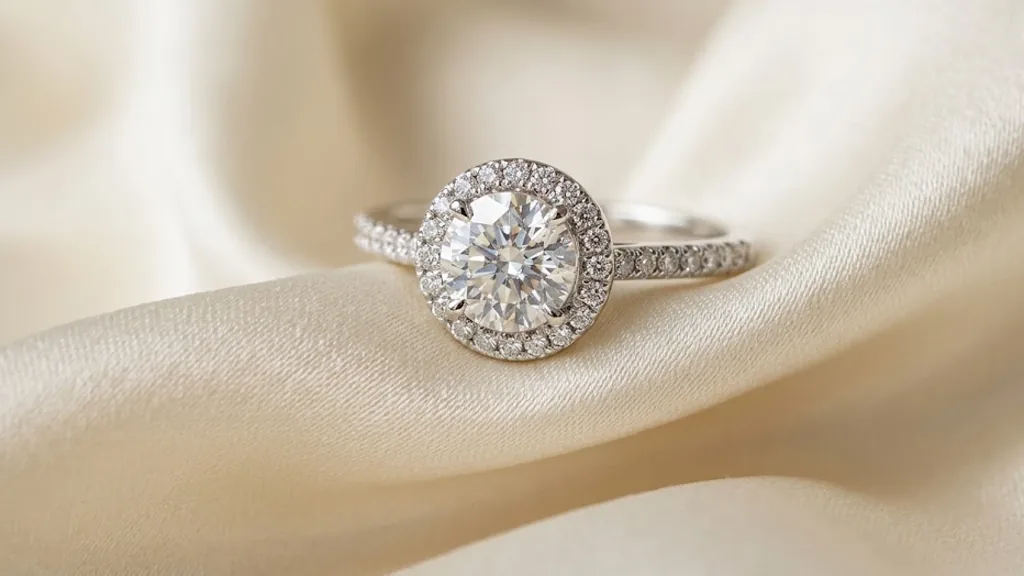
A halo engagement ring has one main diamond in the middle, with a ring of much smaller diamonds set closely around it. That circle of small stones is the halo. It is one of the most popular engagement ring styles in the UK, and it is also one of the most misunderstood.
This guide explains what a halo actually is, what it does to the look and the price of a ring, the different types you will come across, and how to judge whether it suits the person who will wear it.
What a halo is, in plain terms
Picture a solitaire ring: one diamond, held by claws, on a plain band. Now imagine a tight circle of tiny diamonds sitting flat around that centre stone, like a frame around a picture. That frame is the halo.
The small stones are usually between 0.8mm and 1.5mm across. They are set very close together so the eye reads them as one continuous sparkling outline rather than as individual stones.
Two things happen when you add a halo. First, the centre stone looks bigger, because the eye measures the whole bright shape, not just the middle diamond. Second, the ring throws off more light overall, because there are simply more facets catching it.
Does a halo really make the diamond look bigger?
Yes, visibly so. A halo typically adds around 1.5mm to 2.5mm to the overall width of the top of the ring. On a 1 carat round diamond, which measures roughly 6.4mm across, that is a jump to somewhere near 9mm of bright surface.
To be honest about it: the centre diamond is not bigger, and anyone who picks the ring up will see that. What changes is how the ring reads from arm’s length, which is how a ring is actually seen most of the time.
This is why a halo is often chosen when someone wants presence on the finger without paying for a much larger centre stone. It is a genuine, well-established way of getting a bigger look for less money, not a marketing trick.
The main types of halo
| Type | What it looks like | Best for |
|---|---|---|
| Classic halo | One row of small diamonds around the centre stone, visible from above | Maximum size illusion and sparkle |
| Hidden halo | The small diamonds sit under the centre stone, facing sideways, invisible from above | Someone who wants a clean solitaire look with a detail only they know about |
| Double halo | Two rows of small stones around the centre | A deliberately bold, high-impact ring |
| Cluster | Several similar-sized stones arranged as one flower-like shape, with no single dominant centre | Vintage-leaning taste, and a lower price for a wide top |
A classic halo follows the shape of the centre stone. A round diamond gets a round halo, a marquise gets a pointed oval halo, a heart gets a heart-shaped one. Our Halo Marquise Cut Engagement Ring in White Gold shows this well: the halo traces the two points of the marquise, which makes an already long stone look even longer on the finger.
If you want the effect but not the obvious frame, a hidden halo is the answer. We cover that in detail in our guide to what a hidden halo means on an engagement ring.
What a halo does to the price
Small diamonds cost far less per carat than one large diamond. Twenty stones of 0.01 carat each add up to 0.20 carat in total, but they cost a small fraction of what a single 0.20 carat stone would.
The result is that a halo usually adds a modest amount to the price while adding a lot to the visible size. There is more setting labour involved, since each small stone has to be seated and secured by hand, and that labour is a real part of the cost.
For a sense of where our own halo pieces sit, our Halo Round Cut Engagement Ring is £707 and the Halo Heart Cut Engagement Ring in Rose Gold is £949, both correct at the time of writing. These are lab-grown diamonds in solid metal, hand-made, with a free IGI certificate on the centre stone.
Where a halo genuinely helps
There are a few situations where a halo is more than a style choice.
- A slightly lower colour grade centre stone. A halo in white gold or platinum surrounds the diamond with bright white metal and bright white small stones, which can make a faintly warm centre stone read cooler than it would alone.
- A shallow or spread centre stone. Some cuts look wide but light. A halo adds bright, high-contrast sparkle around the edge, which distracts from a flatter centre.
- Protecting pointed shapes. Marquise, pear and heart cuts have sharp tips that can chip. A halo puts metal and small stones around those tips, which is a real practical benefit.
Where a halo is the wrong choice
A halo is not for everyone, and we would rather say so.
If the wearer likes very plain, architectural jewellery, a halo will feel fussy to them no matter how well it is made. If they work with their hands, wear gloves often, or knit, sew or climb, the extra width and the small claws around the halo will catch more than a plain setting will. And if they want the centre diamond to be unmistakably the whole story, a solitaire says that more clearly. Our guide to what a solitaire engagement ring is covers that side of the decision.
Living with a halo ring
Halo rings need slightly more care than plain settings, and it is worth knowing that before you buy rather than after.
Skin oil, soap and hand cream collect under the small stones, and because the stones are small, even a thin film dulls them noticeably. A soft toothbrush, warm water and a drop of washing-up liquid once a fortnight keeps a halo looking as it did on day one.
Have the small claws checked by a jeweller once a year. Losing a melee stone is not a disaster and it is inexpensive to replace, but you want to find a loose claw before the stone goes, not after.
Choosing a metal for a halo
| Metal | Effect on a halo |
|---|---|
| Platinum | Bright white and very hard-wearing; small claws hold well over decades |
| White gold | Bright white while the rhodium plating is fresh; needs re-plating every few years |
| Yellow gold | Warm contrast against the halo, which makes the diamonds read whiter by comparison |
| Rose gold | Soft, warm frame; flattering on most skin tones and very popular for heart and pear halos |
Frequently asked questions
How many small diamonds are in a halo?
It depends on the size of the centre stone and the size of the melee. A halo around a 1 carat round stone commonly holds somewhere between 16 and 24 small diamonds. There is no fixed number, and more stones is not automatically better; even spacing matters more.
Do the halo diamonds come with a certificate?
No, and no reputable jeweller certificates them individually. Certification is done on the centre stone, which is where the value sits. We include a free IGI certificate on centre stones. The melee is matched by eye and by grade range in-house.
Can a halo be resized?
Usually yes, because the halo sits at the top of the ring and the sizing work happens at the bottom of the band. It becomes harder if the small stones run all the way down the shoulders. Always ask before you buy if you think the size may change.
Is a halo ring harder to pair with a wedding band?
Sometimes. A halo is wider than a solitaire, so a straight band may not sit flush against it and can leave a visible gap. A shaped or curved band solves this. If you are buying both together, a matched bridal set removes the problem entirely.
Can I have a halo made to my own design?
Yes. We design bespoke pieces at no extra design cost, so if you want a specific halo shape, a particular centre stone size, or a hidden halo in a style we do not currently stock, we can make it.
If you would like to see the halo effect in person rather than on a screen, have a look through our engagement ring collection. Everything is made in North Harrow, London, with free insured UK delivery and 30-day returns, so there is time to be sure.
Ready to find your perfect ring?
Explore our lab-grown diamond collection or book a virtual appointment with our team.