Can You Wear a Wedding Ring on Your Middle Finger?
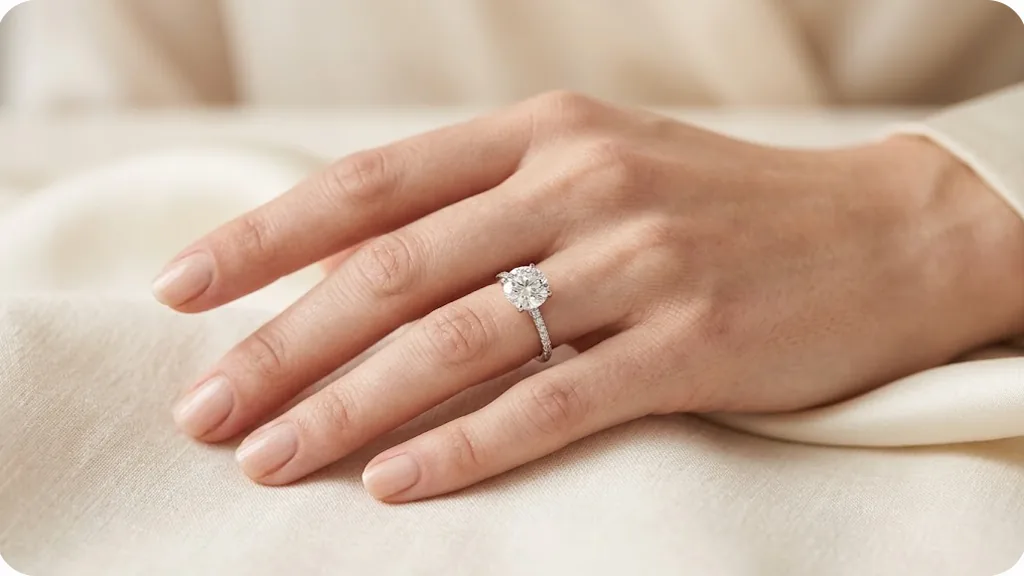
Yes, but the sizing changes. Wearing a wedding ring on the middle finger, on the right hand, or if you are left-handed.
Yes. You can wear a wedding ring on your middle finger, on your right hand, on a chain round your neck, or anywhere else that suits you. There is no law and no jeweller’s rule that says otherwise.
What there is, is a set of practical consequences. A ring made for the fourth finger of the left hand will not automatically fit or look right on the middle finger, and moving it is not simply a matter of sliding it across. Here is what actually changes.
Why people move a wedding ring off the ring finger
The reasons are almost always practical rather than symbolic:
- Arthritis or an enlarged knuckle on the ring finger.
- Swelling in pregnancy, in hot weather or after an injury.
- Weight change that made the original size wrong.
- A job that requires the ring finger to be free, or gloves that catch.
- Wearing an inherited ring that only fits another finger.
- Widowhood, separation or a period where the wearer wants the ring without the statement.
- Simple preference. Some people like how it looks.
None of these need explaining to anyone. But there is one thing worth being aware of: in Britain a band on the middle finger does not read as “married” to most people. If that signal matters to you, you may find yourself explaining it more often than you expect. If it does not matter, wear it wherever you like.
The sizing problem nobody warns you about
This is the real issue. The middle finger is the longest and usually the thickest finger on the hand. For most adults it measures noticeably larger than the ring finger on the same hand.
We would rather not put a number on that gap, because it varies far too much from person to person to be honest about. The trade rule of thumb is roughly one to two UK letter sizes larger, but that is a rough working assumption, not a measured figure. The only reliable approach is to measure the specific finger.
So a ring bought for your ring finger will usually be too tight for your middle finger. Forcing it on is a genuinely bad idea. A ring that will not come off a swelling finger is a medical problem, not just an inconvenience.
| If you want to move the ring | What is involved |
|---|---|
| Plain band | Straightforward to size up or down. The most flexible option. |
| Half or three-quarter eternity band | Usually resizable, because there is plain metal at the back to work with. |
| Full eternity band | Normally cannot be resized. Diamonds run the whole way round, so there is nothing to cut into. It may need remaking. |
| Ring with a raised centre stone | Resizable in most cases, but check the shoulders. Pavé stones near the join can be disturbed. |
| Very wide band (5mm or more) | Wide bands feel tighter than narrow ones at the same size, so allow extra when moving to a larger finger. |
What actually looks good on the middle finger
Proportion changes when a ring moves. The middle finger is longer and sits at the centre of the hand, so it carries more visual weight and can take a bolder ring than the ring finger can.
Things that tend to work:
- A slightly wider band. A 2mm band that looked delicate on the ring finger can look lost on the middle finger. Around 3mm to 4mm usually balances better.
- Repeating patterns rather than a single centre stone. An eternity or stackable design reads well from any angle, which matters more on a finger people see straight on.
- Low profiles. The middle finger sits between two neighbours, so a tall setting rubs against both. A flush or bezel setting is much more comfortable.
Things that tend not to work: tall solitaires, sharp-cornered stones and anything shaped to nest against a specific engagement ring. A curved or chevron band designed to fit around a pear or marquise stone will look odd on its own on another finger.
If you are choosing a ring specifically for the middle finger, look at designs built to stand alone. Our Stackable Marquise Cut Wedding Band in Rose Gold has a repeating pattern that works from any angle, the Stackable Rose Cut Wedding Band in Sterling Silver is a lower-cost way to try the look before committing, and the Minimalist Round Cut Wedding Band keeps everything flush and comfortable between neighbouring fingers. Prices correct at the time of writing.
Wearing your wedding ring on the right hand
This is the other common move, and it is even less unusual. Across Germany, Austria, Poland, Norway, Denmark, Greece, Russia and most of Spain, the right hand is the normal place for a wedding ring. Britain is following one custom among several, not the only one.
People in the UK move their ring to the right hand for all sorts of reasons: an injury to the left hand, a left-handed job, a second marriage, or to wear an inherited ring alongside their own.
Do left-handed people wear their wedding ring on the right hand?
Some do. It is a sensible practical choice rather than a tradition, and it is not a majority habit in Britain.
The logic is straightforward. If you write, cook, play sport or use tools with your left hand, a ring on that hand takes more impact. Impact is the main cause of bent claws and lost stones, so moving the ring to the quieter hand genuinely does reduce wear.
The arguments against are worth weighing too. In Britain people look at the left hand for a ring, so a right-hand band gets noticed less. And if your engagement ring is already on the left, splitting the two rings across separate hands rarely sits well visually.
A better solution for most left-handed people is to keep the ring where they want it and choose a setting that copes. A bezel setting, where a rim of metal wraps right around the stone, protects far better than claws. A flush or channel set band is tougher still. Either will survive a busy left hand better than a raised claw setting will.
One sizing note: your dominant hand is usually very slightly larger. If you are left-handed and buying for the left hand, say so when you are measured, and if you might switch later, have both hands measured before you order.
What about the index finger, little finger or thumb?
All are worn, and none is wrong. A few practical notes:
- Index finger: very visible and takes knocks constantly, so keep the setting low.
- Little finger: traditionally where a signet ring sits in Britain. A wedding band works here but tends to look small unless it is wide.
- Thumb: needs a much larger size and a wide, sturdy band. Delicate diamond bands do not survive thumb wear well.
Frequently asked questions
Can you wear a wedding ring on your middle finger?
Yes. There is no rule against it. The main practical point is that the middle finger is usually larger than the ring finger, so the ring will very likely need resizing before it fits properly.
What does a ring on the middle finger mean?
In Britain, nothing specific. Unlike the fourth finger of the left hand, the middle finger carries no widely understood signal, so people generally will not read a middle-finger band as a wedding ring.
How much bigger is the middle finger than the ring finger?
Usually larger, but by how much varies far too much between people for a reliable figure. The working assumption in the trade is around one to two UK sizes, which is a rule of thumb rather than a measurement. Always have the actual finger measured.
Do left-handed people wear their wedding ring on the right hand?
Some do, to keep the ring off their busiest hand and reduce knocks. It is a practical preference, not a tradition, and most left-handed people in the UK still wear theirs on the left.
Can any wedding ring be moved to a different finger?
Most can, with resizing. The main exception is a full eternity band with diamonds all the way round, which usually cannot be resized and would need remaking in the new size instead.
Wear it where it suits you
A wedding ring only works if you actually wear it, and a ring that hurts, spins or has to be forced past a knuckle will end up in a drawer. If your ring finger is not the right home for yours, move it and have it sized properly for its new one.
Browse the full wedding ring collection or the women’s rings if you are looking for something to wear on its own. Everything is hand-made in solid gold or platinum with lab-grown diamonds, a free IGI certificate on the centre stone, free insured UK delivery and 30-day returns. If you need an unusual size or a wider band than we list, we make bespoke pieces at no extra design cost.
More guides on this topic
Ready to find your perfect ring?
Explore our lab-grown diamond collection or book a virtual appointment with our team.