
What Is a Pave Ring? Setting, Types and What to Look For
Pave means many tiny diamonds set so closely the metal almost disappears. How it is made, the types, and how to judge quality.
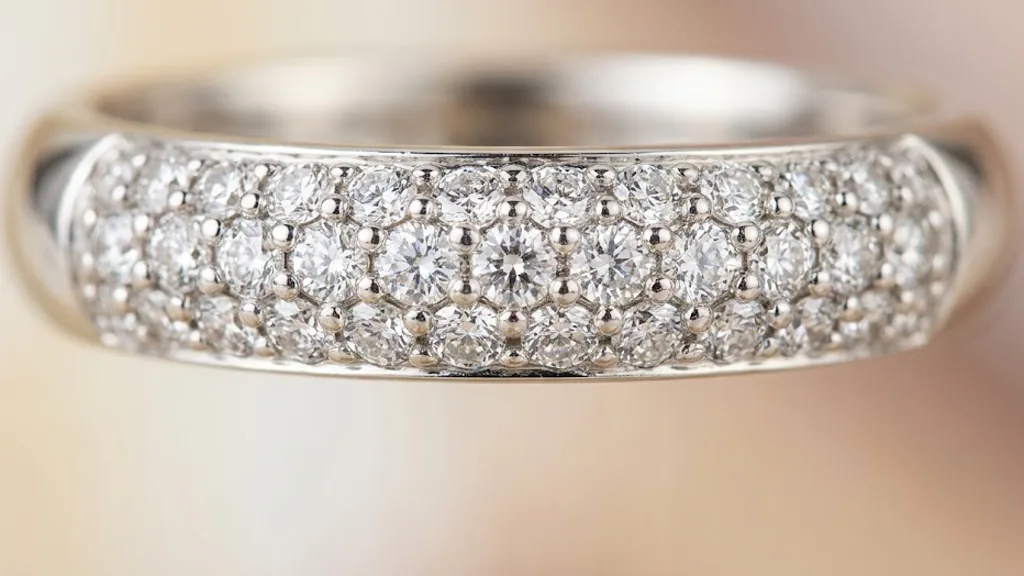
A pavé ring is a ring set with many small diamonds placed so closely together that the metal beneath almost disappears. The word is French for “paved”, as in a cobbled street, and that is exactly the idea: a surface paved with stones.
It is pronounced “pav-ay”. You will see it written pave, pavé and even pavé depending on the website. They all mean the same thing.
How pavé is actually made
The jeweller drills small seats into the metal and drops a tiny diamond into each one. Then, using a fine tool, they raise slivers of metal from the surrounding surface and push them over the edge of each stone to grip it. Those slivers are shaped into neat round beads.
Those beads are the whole craft. On good pavé they are even in size, evenly spaced and polished so they catch light themselves. On poor pavé they are lumpy, uneven, and you can see bare metal between the stones.
The stones themselves are called melee, which is trade shorthand for small diamonds, usually under 0.02 carat each and often much less.
The types of pavé you will be offered
| Type | What it means |
|---|---|
| Standard pavé | Small stones held by tiny metal beads, set in one or more rows |
| Micro pavé | The same technique with much smaller stones, often under a millimetre, set under a microscope |
| French pavé | Small V-shaped cuts under each stone let more light in from below, so the metal shows less |
| Channel setting | Not pavé at all: stones sit in a groove between two walls of metal, with no beads |
| Shared claw | Also not pavé: each claw holds two neighbouring stones, giving a more open look |
The last two are worth knowing because they are often described loosely as pavé in listings. They look different and they behave differently in wear, so it is worth asking which one you are actually buying.
Where pavé appears on a ring
Most commonly along the shoulders, which is the part of the band leading up to the centre stone. It can also run halfway round the band, all the way round as a full eternity, around a halo, or across the surface of a wide band.
Our Pave Hexagon Cut Engagement Ring, £1,078 at the time of writing, is an example of pavé used around an unusual centre shape. Our Vintage Round Cut Engagement Ring in Yellow Gold, £1,051 at the time of writing, shows pavé used in a more detailed, antique-leaning design.
On wedding bands, pavé is the reason a slim band can look so bright. A Pave Baguette Cut Wedding Band is £690 at the time of writing, and sits well next to almost any engagement ring.
What pavé does for the ring
Three real effects, in order of usefulness.
It carries light to the centre stone. A plain band goes dark under low light. A paved band keeps sparkling, which pulls the eye up towards the main diamond rather than letting it stop at the metal.
It makes the centre stone look larger. Pavé shoulders that narrow slightly towards the centre create a visual funnel. The centre stone reads bigger by comparison, in the same way a halo works but more subtly.
It adds total carat weight cheaply. Many tiny diamonds cost far less than one large one. A pavé band might add 0.20 to 0.40 carat of diamond for a fraction of what that weight would cost as a single stone.
The honest downsides
Pavé is beautiful and it is not maintenance-free. Three things are worth knowing before you buy.
Small stones do come loose occasionally, usually after a knock or after years of wear thinning the beads. Replacing one is inexpensive; noticing it late is the problem, because a gap invites the neighbouring stones to loosen too.
Pavé collects grime. Hand cream and soap settle between the stones and dull them faster than they dull a large diamond, simply because the film is proportionally thicker relative to the stone.
Resizing a pavé ring is more limited than resizing a plain band. How much more depends on how far round the stones go. We cover this properly in our guide on whether pavé rings can be resized, and we look at comfort and durability in our guide to whether pavé rings are uncomfortable or hard-wearing.
How to judge pavé quality in a photograph
You can tell a lot from a close-up image if you know what to look for.
- Are the stones the same size, or do they vary noticeably along the row?
- Are the gaps between stones even, or does the spacing wander?
- Can you see flat, bare metal between the stones? On good pavé you should see very little.
- Are the beads round and bright, or flattened and dull?
- Do the stones sit level, or does one tilt so its table catches light differently from the rest?
One tilted stone in a row is the single most common sign of rushed setting, and once you have seen it you will never unsee it.
Pavé and metal choice
Platinum is the most forgiving metal for pavé because it is dense and the beads hold their shape well over decades. White gold looks similar when new but is a harder, more brittle alloy, and the rhodium plating that makes it bright will need renewing every few years, which means the ring goes back to a workshop periodically anyway.
Yellow and rose gold create a contrast that makes the small diamonds read whiter than they would against white metal. That is genuinely useful if your stones sit in the middle of the colour range.
Frequently asked questions
Are pavé diamonds real diamonds?
In our rings, yes. They are lab-grown diamonds, chemically and optically the same material as mined diamond. Some jewellers use cubic zirconia or crystal for melee on inexpensive pieces, so it is a fair question to ask any seller directly.
Do pavé stones come with certificates?
No, and nobody certificates melee individually because the cost of grading would exceed the value of the stone. Certification applies to the centre stone. We include a free IGI certificate on centre stones so you know exactly what the main diamond is.
How much carat weight does pavé add?
It varies with the design. A short row of shoulder pavé might add 0.10 carat in total; a full eternity band of pavé can add well over half a carat. Ask for the total melee weight if it matters to you, as it should be recorded.
Is micro pavé more fragile?
The stones are smaller, so the beads holding them are smaller too. Set well, it wears fine. Set badly, it is the first thing to fail. Quality of setting matters more than the size of the stones.
Can I have pavé added to a plain ring?
Often yes, provided the band is thick enough to take the seats without weakening. We make bespoke pieces at no extra design cost and can advise honestly on whether a particular band can carry it.
To see pavé in different settings, browse our engagement rings and wedding rings. Everything is hand-made in North Harrow, London, with free insured UK delivery and 30-day returns.
Ready to find your perfect ring?
Explore our lab-grown diamond collection or book a virtual appointment with our team.











