Can Pave Rings Be Resized? What Is Possible and What Is Not
Most pave rings resize, but how far depends on where the stones stop. Realistic ranges, full eternity limits and how to avoid it.
Yes, most pavé rings can be resized, but not by as much as a plain band and not always in both directions. How much room you have depends almost entirely on one thing: how far around the band the small diamonds go.
This guide explains what a jeweller can and cannot do, how much movement is realistic, and how to buy a pavé ring so that resizing never becomes a problem in the first place.
Why pavé limits resizing
Resizing a plain ring is simple. To make it smaller, the jeweller cuts out a piece of the band, joins the ends and polishes the seam. To make it larger, they cut it, add a matching piece of metal, join, and polish.
The work happens at the bottom of the band, opposite the centre stone. That area is called the shank. If the shank is plain metal, there is nothing in the way and the job is straightforward.
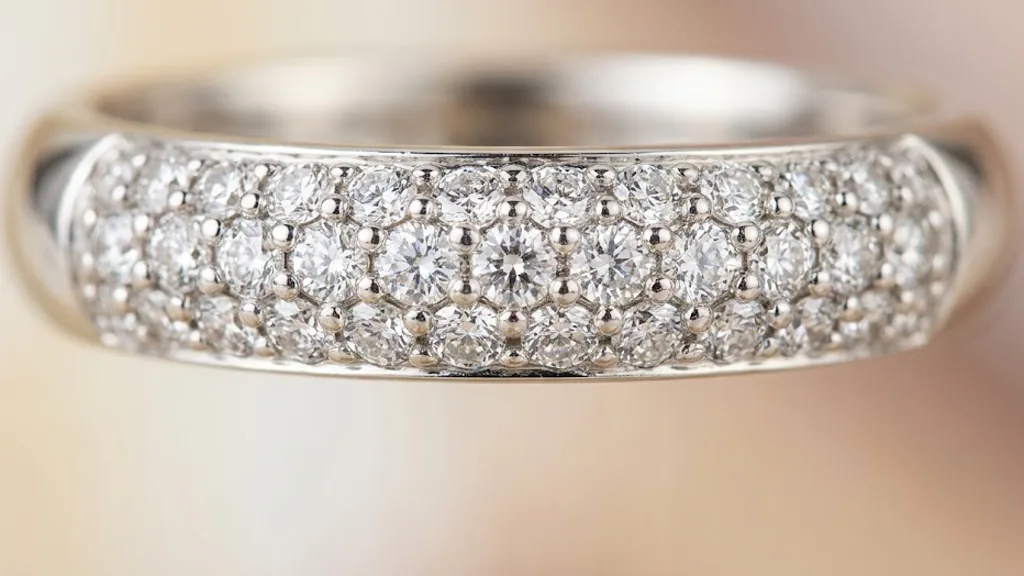
Pavé changes this because every small diamond sits in a drilled seat with metal beads pushed over it. Heat, hammering and stretching all move metal. Move the metal and you move the seat, and a stone that has been in a seat for years does not appreciate being nudged.
How much movement you realistically have
| How far the pavé goes | Realistic resizing range | Notes |
|---|---|---|
| Shoulders only, plain shank | Two to three sizes either way | Effectively the same as a plain band |
| Half eternity (stones over the top half) | Roughly one to two sizes | The usual and most flexible stone-set option |
| Three quarter eternity | About one size, sometimes less | Depends on where the stones stop |
| Full eternity (stones all the way round) | Not resizable in the normal sense | Must be remade, or stones removed and reset |
Treat these as guidance rather than promises. The actual limit depends on the width of the band, how thick the metal is, how close the stones sit to the shank, and the metal itself. A jeweller has to see the ring to give you a real answer.
Sizing down versus sizing up
Going smaller is generally easier on a pavé ring. Metal is removed and the remaining band is joined, so the paved section is compressed slightly rather than stretched. Compression is kinder to seats than stretching.
Going larger is harder. Adding metal is fine in itself, but the whole band has to be trued back to a perfect circle afterwards, and that means putting it on a mandrel and tapping it round. Every tap travels through the paved section.
A shortcut some jewellers use is stretching, where the ring is simply forced larger on a mandrel without cutting. On a plain band this is acceptable for a fraction of a size. On a pavé band it is the fastest way to loosen every stone at once. If a jeweller offers to stretch your pavé ring, ask them to cut and add metal instead.
What a good jeweller will do
On a pavé ring, careful resizing looks like this. The stones nearest the work are protected, sometimes by removing them first. Heat is controlled and localised. The joint is made cleanly rather than flooded with solder. The band is trued gently. Afterwards, every bead in the paved section is checked and tightened, and any stone that has shifted is reset.
That last step is the one that separates a proper job from a cheap one. Ask specifically whether the setting will be checked and tightened after resizing, and whether that is included in the price.
Full eternity bands: the honest answer
A full eternity ring has diamonds continuously around the entire band. There is no plain section to cut, so conventional resizing is not possible.
The options are to have stones removed, the band altered, and stones reset, which is expensive and involves re-making part of the setting; or to have the ring remade in the correct size. On most full eternity bands, remaking is the more sensible route.
This is worth knowing before you buy one. Fingers change size over a lifetime, through pregnancy, weight change, medication and simply through age. If you want a ring you will never have to think about, a half or three quarter eternity gives you the same look from above with room to move later. Our Stackable Emerald Cut Three Quarter Eternity Band is £1,074 and the Stackable Emerald Cut Half Eternity Band is £770, both correct at the time of writing.
How to avoid ever needing a resize
Get the size right at the start, properly.
- Measure at the end of the day, when fingers are at their largest. Morning measurements run small.
- Do not measure when your hands are cold. Cold fingers can read a full size down.
- Measure the same finger on the correct hand. The two hands are usually not the same.
- Account for the knuckle. The ring has to pass the knuckle and then sit comfortably below it. If your knuckle is much larger than the base of your finger, say so when ordering, because the fit needs designing rather than just sizing.
- A wider band feels tighter than a narrow one at the same size. If you are moving from a 2mm band to a 4mm band, you may need a quarter to a half size larger.
If you are not sure of the size and the ring is a surprise, order the size you think is right and use the returns window. We give 30 days, with free insured UK delivery, precisely so that sizing can be sorted out without pressure.
Frequently asked questions
How much does resizing a pavé ring cost?
More than a plain band, because of the extra care and the setting check afterwards. The exact figure depends on metal, width and how much work the paved section needs, so any jeweller quoting without seeing the ring is guessing. Ask whether tightening the melee is included.
Will you be able to see where it was resized?
On a plain shank, a properly finished joint is effectively invisible. In white gold the ring will usually be re-plated afterwards, which hides everything. If the pavé itself has to be interrupted, the join is more likely to show, which is another reason to keep the work away from the stones.
Can a pavé ring be resized more than once?
It can, but each resize means more heat and more handling of the same metal. Two resizes over a lifetime is unremarkable. Five is asking a lot of the setting.
Is a hidden halo or halo ring easier to resize than pavé?
Usually yes, because a halo sits at the top of the ring and the resizing happens at the bottom. It is the stones on the band, not the stones at the top, that cause the problem. Our guide to what a pavé ring is explains where the stones sit in each design.
What if my ring cannot be resized?
Then the practical options are a permanent ring guard fitted inside the band, wearing it on a different finger, or having it remade. We make bespoke pieces at no extra design cost from our workshop in North Harrow, London, and we can often rebuild a ring in the right size using your existing centre stone.
If you are choosing a band now and want one that will age with you, browse our wedding ring collection or the full engagement ring range, and ask us about sizing before you order rather than after.
Ready to find your perfect ring?
Explore our lab-grown diamond collection or book a virtual appointment with our team.