Where Can I Get My Wedding Ring Cleaned?
Jeweller's counter, workshop deep clean, at home or an ultrasonic tank. Which one your ring actually needs, and what to ask for.
A wedding ring that has gone dull is almost never damaged. It is coated. Hand cream, soap film, sun cream and skin oils build up behind the stones and under the band, and light stops getting through. The fix is cleaning, and the question is where to have it done.
There are four realistic options in the UK, and they suit different situations.
1. A jeweller’s counter — usually free
Most high-street jewellers will clean a ring while you wait, and a great many do it at no charge whether or not you bought the ring from them. It takes a few minutes: a run through an ultrasonic bath, a steam blast, a polish with a cloth.
We do this for customers at our North Harrow workshop, and we are happy to look at rings we did not make. If you are passing, bring it in.
What to ask for while you are there: a claw check. This is the genuinely valuable part. A jeweller with a loupe can see in about a minute whether a claw has worn thin, and worn claws are how centre stones get lost. Cleaning makes the ring look better; the claw check is what stops an expensive accident.
2. A workshop deep clean and polish
Different from a counter clean. The ring goes to a bench, gets stripped of build-up, is repolished to remove fine scratches, and — on white gold — is usually rhodium plated again.
This is what you want when:
- The ring is visibly scratched rather than just dull
- A white gold ring has gone slightly warm or yellowish (that is the rhodium plating wearing off, which is normal and expected)
- Stones are loose or a claw is catching on fabric
- It has been several years since anyone looked at it properly
It takes days rather than minutes, because it is real bench work. Prices vary widely between jewellers and depend on the ring, so we will not quote a figure for the trade — ask for a price before you leave the ring.
As a rough guide, plan on a deep clean and check every couple of years for a ring worn daily. Rings with lots of small pavé stones — such as a twisted round cut half eternity band — trap more dirt in more places than a plain band, so they benefit more often.
3. At home, in five minutes
For ordinary dullness, home cleaning genuinely works and there is no reason to go anywhere.
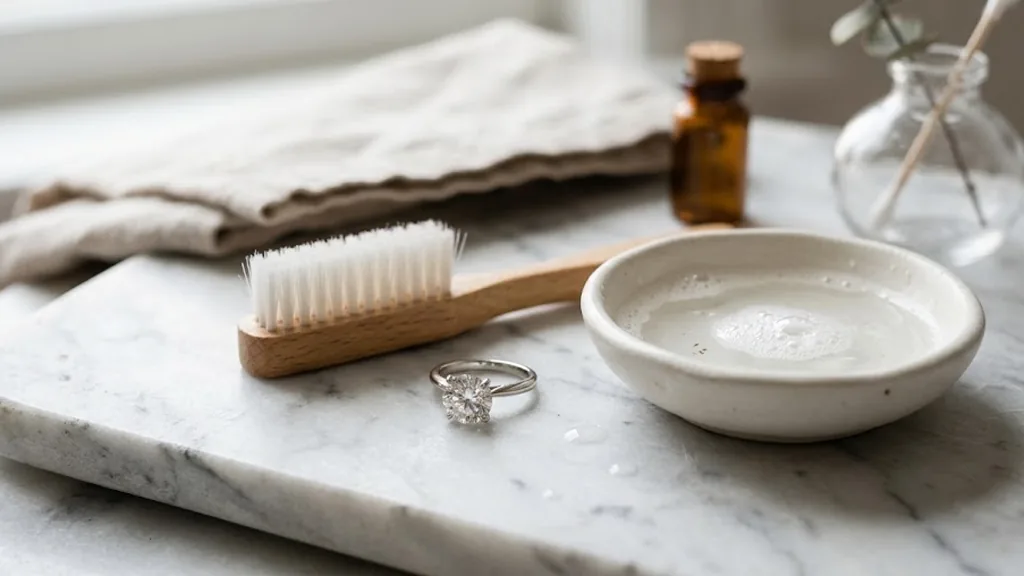
- Warm water — comfortable to touch, not hot — with a drop of ordinary washing-up liquid.
- Soak the ring for ten to fifteen minutes.
- Brush gently with a soft toothbrush, concentrating on the underside of the setting. That is where the film sits, and that is the surface light enters through.
- Rinse in clean water. Put the plug in first.
- Pat dry with a lint-free cloth, or let it air dry.
That is the whole method. We go into it in more detail in how to clean a diamond ring at home.
What not to use: bleach and chlorine, which attack the alloy metals in gold over time; toothpaste, which is abrasive and will scratch soft metals; and anything described as a “jewellery dip” unless you know exactly what your stones are.
4. Home ultrasonic cleaners
The small tabletop tanks sold online do work — they are the same principle as a jeweller’s machine, just less powerful. They are fine for a plain gold or platinum band with securely set diamonds.
Be careful, though. Ultrasonic vibration will loosen a stone that was already loose, and if a claw is worn the machine can be the moment it finally lets go. It is also unsuitable for some gemstones — emeralds, opals, pearls and anything fracture-filled or heavily treated should never go near one.
The safe order is: get the ring checked once by a jeweller, and if the settings are sound, use the machine at home between checks.
Which option for which problem
| What’s wrong | Where to go | Rough timescale |
|---|---|---|
| Just looks dull and greasy | Home clean, washing-up liquid | 15 minutes |
| Dirt trapped behind pavé stones | Jeweller’s counter, ultrasonic | While you wait |
| Fine scratches all over the band | Workshop polish | A few days |
| White gold looking yellowish | Workshop, re-rhodium | A few days |
| Stone rattles or catches on clothing | Jeweller, urgently — stop wearing it | Same day assessment |
| Ring has gone out of round | Workshop reshaping | A few days |
Metal makes a difference
Platinum does not tarnish and does not need plating. Scratches on platinum push the metal aside rather than removing it, which is why old platinum rings develop a soft satin surface — many people prefer it, and a polish will bring the shine back whenever you want it.
White gold is yellow gold alloyed pale and then plated with rhodium to make it bright white. The plating wears — that is not a defect, it is how white gold works. Replating is a routine job.
Yellow and rose gold need nothing but cleaning and the occasional polish.
Sterling silver tarnishes, which is a chemical film rather than dirt. Washing-up liquid will not shift it; a silver polishing cloth will.
Frequently asked questions
Where can I get my wedding ring cleaned for free?
Most high-street jewellers will clean a ring at the counter at no charge, including rings bought elsewhere. We do the same at our North Harrow workshop — bring it in and ask for a claw check at the same time.
How often should a wedding ring be professionally cleaned?
For a ring worn every day, a counter clean and inspection once a year is sensible, with a proper workshop clean and polish every couple of years. That is a practical guideline from the trade, not a fixed rule.
Will cleaning damage my diamond?
No. Diamond, whether lab-grown or mined, is the hardest natural material and is unaffected by soap, water or ultrasonic cleaning. The risk is never to the stone — it is to a setting that was already weak.
Can I take a ring bought elsewhere to any jeweller?
Yes. Cleaning and checking are routine services and jewellers do not restrict them to their own pieces. For structural repairs a jeweller may decline unfamiliar work, but cleaning is not in that category.
My white gold ring has gone slightly yellow. Is it fake?
No — it is genuine white gold with the rhodium plating worn thin. Underneath, white gold is naturally a pale champagne colour. Replating restores it.
Keeping it clean for longer
Take the ring off before hand cream, before washing up, before the gym, and before swimming pools and hot tubs. Those five habits do more than any cleaning routine. Keep it in one fixed place when it is off, because rings left on kitchen windowsills are the ones that disappear.
If your ring turns out to need more than a clean, we are happy to look at it, whoever made it. Everything in our own wedding ring collection is hand-made here in solid gold or platinum with lab-grown diamonds and a free IGI certificate on the centre stone — including hard-wearing everyday pieces like the minimalist round cut wedding band, which has nothing standing up to trap dirt in the first place.
More guides on this topic
Ready to find your perfect ring?
Explore our lab-grown diamond collection or book a virtual appointment with our team.