How Is Diamond Clarity Measured? Inside the Grading Process
How laboratories grade diamond clarity at 10x magnification, why graders disagree, and a simple method to judge a stone yourself.
Diamond clarity is not measured with an instrument. There is no machine you point at a stone that prints out “VS1”. Clarity is a trained human judgement, made under strictly controlled conditions and cross-checked by more than one grader.
Knowing how that judgement is made tells you a lot about how much weight to give the grade — and how to sensibly assess a diamond yourself before you buy.
The one rule that governs everything: 10x magnification
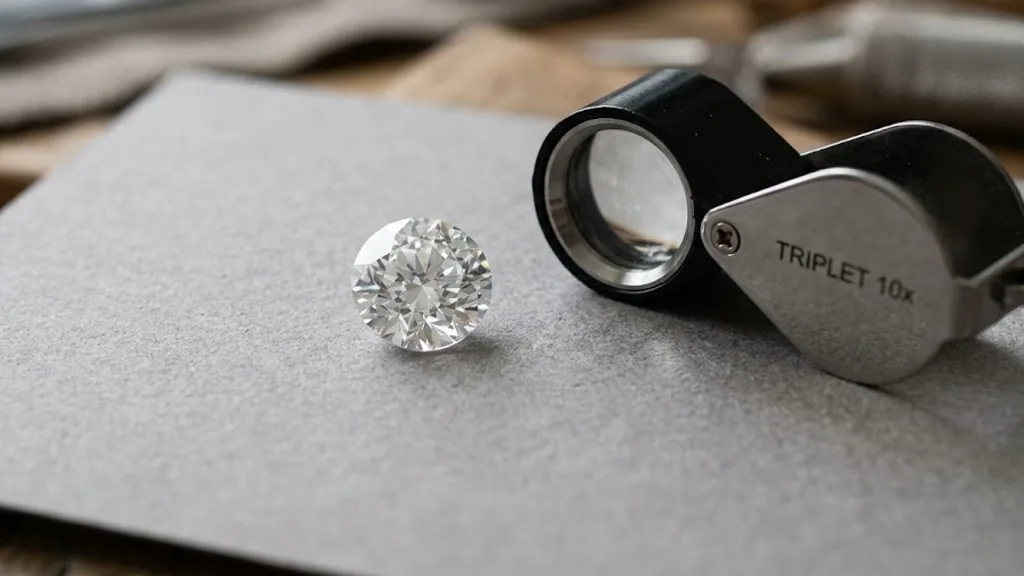
Diamond clarity is graded at ten times magnification. That figure is not arbitrary — it has been the industry standard for decades, and every grade on the scale is defined by what a skilled grader can see at exactly that power.
This is why clarity grades so often surprise people. A stone graded SI2 sounds compromised, but the description “inclusions easy to see” means easy to see under a loupe. Your eye works at 1x. The gap between those two things is the whole reason clarity is such a confusing grade to shop for.
How a laboratory actually does it
Step 1: cleaning
The stone is cleaned thoroughly, usually in an ultrasonic bath and then with alcohol. A speck of dust or a fingerprint smear can be mistaken for a surface blemish, so this matters more than it sounds.
Step 2: examination under controlled light
The grader uses a binocular microscope with darkfield illumination — light directed from the side rather than from below. Against a dark background, inclusions light up sharply and become far easier to locate than in ordinary lighting. Overhead light is then added to check the surface.
The stone is examined from every direction: face-up through the table, from the side, and from below through the pavilion.
Step 3: the loupe confirmation
Anything found under the microscope is then verified with a 10x loupe, because the loupe is the official standard. A microscope at higher power might reveal characteristics that simply do not count towards the grade.
Step 4: weighing the five factors
The grader assesses size, number, position, nature and relief together. Relief means how strongly a characteristic contrasts against the diamond — a black crystal has high relief and hurts the grade far more than a colourless one of identical size.
Step 5: independent agreement
At the major laboratories, more than one grader examines the stone independently, without seeing each other’s conclusions. If they disagree, further graders are brought in until there is consensus. This is the step that makes a laboratory report worth having, and it is exactly what an in-house grade from a seller lacks.
Step 6: plotting
The characteristics are mapped onto a diagram of the stone. Inclusions are marked in red, surface blemishes in green. This plot becomes a fingerprint for the individual diamond and is one way of confirming later that a stone is the one described on its report.
Why the same stone can get different grades
Clarity grading is judgement, so borderline stones genuinely sit between grades. A one-grade difference between two respected laboratories on the same diamond is normal, not evidence of error.
Larger differences usually mean the two laboratories apply different standards. This is why buyers stick to the well-known names — an IGI or GIA grade means the same thing everywhere, which is precisely what a grade is for. Every centre stone we set comes with a free IGI certificate for that reason.
How to assess clarity yourself
You do not need to replicate a laboratory. You need to answer one practical question: is this diamond eye-clean? Here is a reliable way to check.
- Clean the stone first. Warm water, a drop of washing-up liquid, a soft toothbrush. Skin oils on the underside dull a diamond dramatically and are routinely mistaken for a clarity problem.
- Look face-up, at arm’s length first. Hold it about 30 centimetres away in ordinary indoor light. This is how the ring will be seen in real life.
- Then bring it to about 20 centimetres. If nothing catches your eye at that distance, the stone is eye-clean by any reasonable definition.
- Check in more than one light. Daylight near a window, then normal room lighting. Bright spotlights hide inclusions by flooding the stone with sparkle, so a jeweller’s display light is the least honest test there is.
- Look for dark spots, not for “flaws”. Colourless characteristics rarely register. What your eye picks up is contrast — a dark dot or a grey haze.
- Only then use a loupe, if you want. A 10x loupe costs very little. Use it to identify what you are seeing rather than to hunt for reasons to reject a stone. Almost every diamond has something.
Reading a report instead
If you are buying online you cannot do the above, so the report does the work. Three things to check:
- Which laboratory issued it, and whether the report number verifies on that laboratory’s own public lookup.
- The listed characteristics, in the comments or the key to symbols. “Crystal, feather” reads very differently from “cloud” spread across the whole plot.
- Where the symbols sit on the plot. Characteristics near the girdle are frequently covered by the setting. Ones dead centre under the table are not.
What the setting does to the answer
A grade is given to a loose stone. The ring changes what you can see.
A four-prong solitaire such as a solitaire round cut engagement ring leaves the stone almost fully exposed, so the grade is the whole story. Add a halo or side stones — as in a three stone oval cut engagement ring — and the surrounding sparkle genuinely makes central characteristics harder to notice.
Fine pavé work does the same thing on a larger scale. A vintage round cut engagement ring in yellow gold puts light in every direction around the centre stone, which is a real, practical reason such designs let you buy a grade lower without any visible compromise.
Frequently asked questions
Can I measure diamond clarity with a phone camera?
Not reliably. Phone macro modes and clip-on lenses can show large inclusions, but they distort scale badly and cannot reproduce darkfield lighting. Use a phone to spot obvious problems, not to confirm a grade.
What magnification do I need to see clarity?
10x is the standard, and a 10x triplet loupe is the right tool. Higher magnification is not more useful for grading — it reveals characteristics that do not count and will only worry you unnecessarily.
Do jewellers grade clarity in the shop?
A good jeweller can give you an informed opinion with a loupe, and that opinion is useful. It is not the same as a laboratory grade, which involves controlled lighting and independent agreement between graders. Both have their place — just do not confuse one for the other.
Is clarity measured the same way for lab-grown diamonds?
Identically. Same scale, same 10x standard, same five factors, same laboratories. A lab-grown VS1 and a mined VS1 have met exactly the same requirement.
My ring looks cloudy but the certificate says VS2. Why?
Almost always dirt. A film of soap, hand cream and skin oil on the underside of the stone blocks light from returning through the top, and it builds up quickly. Clean it properly and check again before assuming anything is wrong with the diamond.
Next steps
Once you understand how the grade is arrived at, choosing one gets easier: buy the lowest grade that stays eye-clean in your chosen shape, and put the saving into cut or carat.
Our guide to every clarity grade from FL to I3 covers the whole scale, and clarity characteristics explained tells you what the individual symbols on a plot mean. When you are ready, browse the engagement ring collection.
Ready to find your perfect ring?
Explore our lab-grown diamond collection or book a virtual appointment with our team.