Which Ring Goes On First: Engagement Ring or Wedding Band?
The wedding band goes on first, closest to the palm, with the engagement ring above it. Here is why, and when to break the tradition.
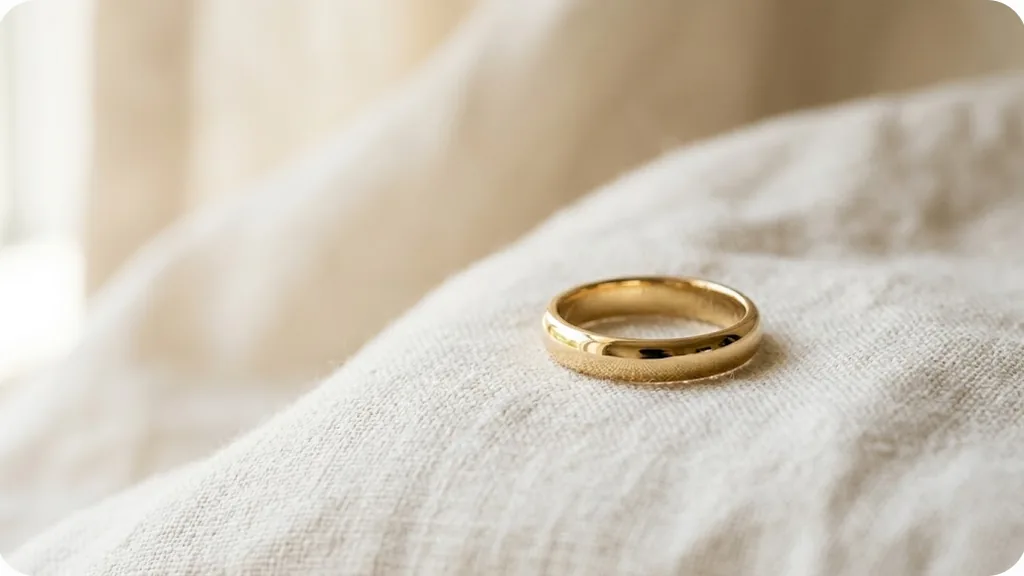
The wedding band goes on first, closest to the palm. The engagement ring sits above it, further up the finger. That is the traditional order in the UK, and it is what most people do.
The reason is straightforward: at the ceremony the wedding band is placed on a bare finger, so it naturally ends up nearest the hand and the engagement ring goes back on over the top afterwards. The romantic explanation is that the ring exchanged during the vows stays closest to the heart.
None of it is a rule. Plenty of people wear them the other way round for entirely practical reasons, and nobody will know or care.
Which ring goes on first, in plain terms
| Position on the finger | Ring |
|---|---|
| Closest to the palm (bottom) | Wedding band |
| Above it (top) | Engagement ring |
| Above that, if worn | Eternity band, usually added later |
So when someone asks “does the wedding ring go on top of the engagement ring?” — no, it goes underneath. The engagement ring is the one on top, sitting further from the hand.
Read it the other way and you get the same answer: the wedding band goes on the finger first, and the engagement ring goes on second.
What happens at the ceremony itself
This is the bit that catches people out on the day, so here is the sequence most UK weddings follow.
- Before the ceremony, the bride moves her engagement ring to her right hand, or takes it off entirely and gives it to someone she trusts.
- During the vows, the wedding band is placed onto the bare left ring finger.
- After the ceremony — often not until the reception — the engagement ring goes back onto the left hand, above the new band.
Doing it this way means nobody is fumbling with two rings in front of a room full of people. It also means the band goes on cleanly rather than being wrestled over an engagement ring.
When to break the tradition
There are good reasons to wear them the other way round, and they are all practical.
- The engagement ring is hard to get over the knuckle. If the engagement ring is a tighter fit, put it on first and the band above it. Otherwise you are pushing the tighter ring past the looser one every single day.
- The band is wider than the engagement ring. A wide band underneath can force the engagement ring to sit at an angle.
- A raised centre stone digs in. If the engagement ring’s setting has a high basket, it can rub against the band beneath it and wear a groove.
- You wear them on different hands. Also completely normal, and the usual solution when the two rings simply refuse to sit together.
Making the two rings sit together properly
A lot of the confusion about order is really a complaint about fit. If the two rings do not nest, they rock, spin, gap and rub — and the order you wear them in will not fix that.
The answer is a shaped band. A shaped or curved band is cut with a notch or an arc so it fits around the engagement ring’s centre stone rather than butting up against it.
- A curved round cut wedding band in yellow gold has a gentle arc that clears a raised solitaire setting.
- A chevron round cut wedding band in rose gold has a sharper V, which suits a pointed stone such as a pear or a marquise.
- A chevron pear cut wedding band in rose gold does the same job with pear-shaped stones set into it.
The cleanest solution of all is to buy both rings together as a set, designed from the start to fit. Our bridal sets pair an engagement ring with a band cut to nest against it, which removes the guesswork completely.
A note on soldering the rings together
Some jewellers will solder the engagement ring and wedding band into one piece so they always sit correctly and never spin apart. It works, and it stops the two rings wearing against each other.
Be aware of the trade-offs before you do it:
- You can no longer wear either ring on its own.
- Resizing becomes more complicated and more expensive.
- Cleaning underneath is harder, so dirt collects between the bands.
- It is reversible, but reversing it means refinishing both rings.
It is a reasonable choice for someone whose rings genuinely will not behave, and an unnecessary one if a shaped band would have solved it.
Where does an eternity band go?
Eternity bands are usually given later — a first anniversary, a significant birthday, the birth of a child. The common order is wedding band at the bottom, engagement ring in the middle, eternity band on top.
That said, many people put the eternity band at the bottom with the wedding ring, so the two plain-ish bands frame the engagement ring between them. Both look good. It depends on the profiles of the rings you actually own.
If you know an eternity band is coming, choose one that stacks flat. A stackable round cut three quarter eternity band is designed to sit flush against another ring rather than rocking on it.
Why the order affects how the rings wear
Two rings on one finger rub against each other all day. Over years that rubbing wears both, and the order they sit in changes which one takes the damage.
- The bottom ring takes more punishment from your hand. It sits against the palm side of the finger, where you grip things.
- The top ring is more exposed to knocks. It is the one that catches on door handles and pockets.
- Both wear where they touch each other. This is the wear people notice first: a flattened, shiny line on the facing edges of each ring.
Two things reduce it. First, match the metals. A softer metal worn against a harder one wears away much faster — 18ct gold against platinum, for example, will lose material while the platinum barely changes. Second, use a shaped band that actually nests, so the two rings sit still against each other rather than rocking.
This is normal wear, not damage, and a jeweller can polish and restore both rings. It just happens sooner if the pairing is badly matched.
What to do if you own the engagement ring already
Take it with you when you choose the band, or measure it carefully if you are buying online. Three measurements matter:
- The height of the setting above the band. A high basket needs a band with a deeper curve.
- The width of the engagement ring’s own band. Matching widths usually look more deliberate than mismatched ones.
- The profile of the underside. A flat-bottomed engagement ring sits against a flat band; a rounded one does not.
Photograph the ring side-on against a ruler. That single photograph tells a jeweller almost everything they need to know about which bands will nest with it.
Frequently asked questions
Does the wedding ring go on top of or under the engagement ring?
Under it. The wedding band sits closest to the palm and the engagement ring sits above it.
What goes on first, the engagement ring or the wedding band?
The wedding band goes on the finger first. It is placed on a bare finger during the ceremony, which is how it ends up at the bottom of the stack.
Is it wrong to wear the engagement ring underneath?
No. If the engagement ring is a tighter fit or sits better underneath, wear it that way. This is a custom, not a rule, and it is invisible to anyone looking at your hand.
Can I wear the two rings on different hands?
Yes, and many people do — particularly when the rings will not sit flush or when the engagement ring is too delicate for daily wear alongside a band.
Should I have my rings soldered together?
Only if they genuinely will not sit correctly and a shaped band will not fix it. Soldering solves spinning and rubbing but makes resizing harder and means you can never wear either ring alone.
Which ring do I wear during the ceremony?
Neither, on the left hand. Move the engagement ring to your right hand or hand it to someone before the ceremony, so the band can be placed on a bare finger.
Choosing a band that will actually fit
The order matters far less than whether the two rings sit together comfortably. If you already have the engagement ring, take it with you or measure its profile carefully before choosing a band.
Our bands are hand-made in solid gold and platinum with lab-grown diamonds, and we design bespoke pieces at no extra design cost — so if nothing off the shelf nests against your engagement ring, we can cut one that does. Browse the wedding ring collection whenever you are ready.
More guides on this topic
Ready to find your perfect ring?
Explore our lab-grown diamond collection or book a virtual appointment with our team.