Why Are Engagement Rings Bigger Than Wedding Bands?
The four real reasons engagement rings outsize wedding bands, typical widths compared, and when to break the pattern.
Look at almost any wedding ring stack and you will see the same thing: a substantial engagement ring sitting above a slimmer, quieter band. It looks so consistent that people assume there is a rule behind it. There is not. There are four reasons, and once you know them you can decide whether to follow the pattern or ignore it.
Reason one: they are doing different jobs
The engagement ring exists to be looked at. It marks a single moment — a proposal — and it is meant to be noticed, shown, and photographed. That is why it carries a centre stone, and why the design is built to display that stone from every angle.
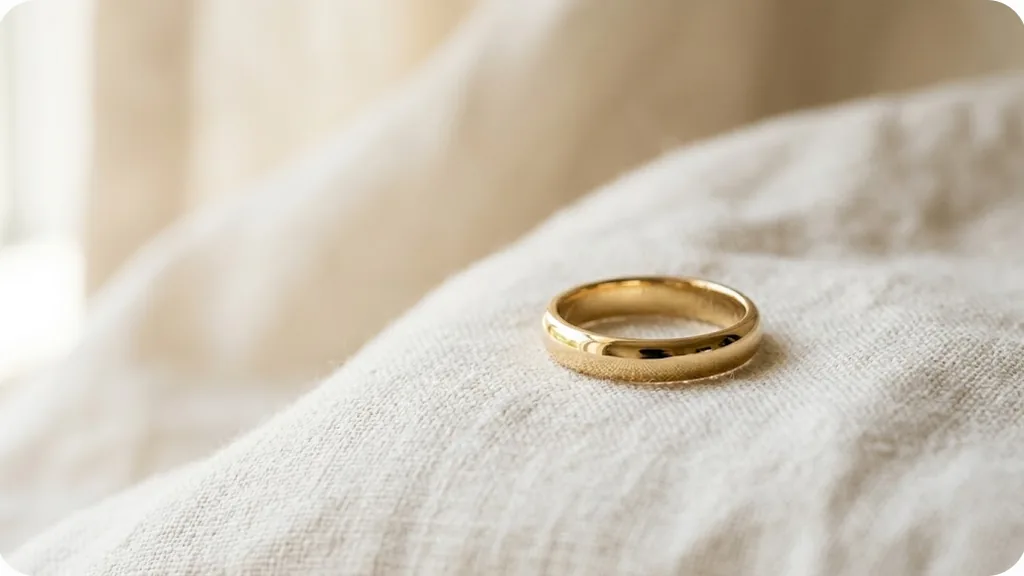
The wedding band marks something quieter and longer: the marriage itself. Traditionally it is unbroken, plain, and continuous — a circle without a beginning or an end. Its symbolism is about permanence, not display. A plain band is not a lesser ring; it is a different idea.
So the difference in size follows the difference in purpose. One announces; the other endures.
Reason two: money, and where it goes
Most of the cost of an engagement ring is in the centre stone. A single larger diamond costs considerably more than the same total carat weight split into many small ones, because large rough diamonds are rarer and more of the rough is lost in cutting.
The wedding band has either no centre stone or many small ones, which is why it costs less. That is a structural fact about how diamonds are priced, not a judgement about which ring matters more.
You can see the effect clearly across a real collection. A solitaire engagement ring built around one prominent stone — our Solitaire Round Cut Engagement Ring in Platinum, for example — is priced quite differently from a band set with a row of small stones such as the Twisted Round Cut Half Eternity Band, even though both are hand-made in the same way. Prices on our product pages are correct at the time of writing.
Reason three: the band has to fit underneath
This is the practical reason, and the one nobody mentions. The two rings share one finger. If both were wide, tall and heavily set, they would fight each other.
Three specific problems come up:
- Total width. A 4 mm engagement ring plus a 4 mm band covers 8 mm of finger, which reaches the knuckle joint on many hands and stops the finger bending comfortably.
- Wear against each other. Two diamond-set bands rubbing together will chip stones. Diamond is hard but brittle at the edges, and a stone-to-stone contact point is the most common cause of a chipped pavé stone we see across a bench.
- Sitting flush. A slim, shaped band can tuck neatly under a large setting. A wide, tall band cannot get near it.
So the narrower band is partly there to protect the ring above it.
Reason four: proportion on the hand
Visually, one dominant element and one supporting element reads as a designed pair. Two dominant elements read as competition. This is basic design, and it is why the pattern persists even among couples who care nothing for tradition.
Typical widths side by side
These are common ranges in UK retail rather than rules, and they vary a great deal by hand size and taste.
| Ring | Common width range | Typical setting height |
|---|---|---|
| Solitaire engagement ring | 1.8–2.5 mm at the band, wider at the head | Raised — the stone sits well above the finger |
| Halo engagement ring | 2–3 mm band, noticeably wider head | Raised, and wider across |
| Women’s wedding band | 2–3 mm | Low or flat |
| Men’s wedding band | 4–6 mm | Flat |
| Eternity band | 2–3 mm | Low |
Notice the interesting inversion: men’s wedding bands are usually the widest rings in the whole set, often twice the width of the engagement ring’s shank. Width and visual prominence are not the same thing. The engagement ring looks bigger because the stone rises off the hand, not because the metal is wider.
Does the band have to be smaller?
No. And there are good reasons to break the pattern.
If you wear the band alone most days — for work, sport, or because you prefer it — a wider or diamond-set band earns its place. It has to carry the finger on its own.
If your engagement ring is deliberately understated — a bezel-set solitaire, a minimalist design — a substantial band balances it beautifully. Two quiet rings of similar weight look considered rather than mismatched.
If you want the stack to be the statement — some of the best-looking hands I have seen have three or four narrow bands of similar prominence and no dominant stone at all.
If the engagement ring is inherited and modest by modern standards, matching the band’s scale to it is far better than adding something that overshadows it.
What actually matters when pairing the two
Forget size for a moment. In practice, these three things decide whether a pair looks right:
- Do they sit flush? An even join looks deliberate. A wedge-shaped gap looks like a mistake. Curved and chevron bands exist to solve this — see the Curved Round Cut Wedding Band in Yellow Gold.
- Do the stone sizes relate? Tiny pavé stones under a large centre stone look fine. Medium stones in the band competing with a medium centre stone look muddled.
- Do the metals and finishes agree? Same metal is safest. Deliberate contrast works. Accidental near-matches — two slightly different whites — are the only genuinely poor outcome.
Frequently asked questions
Should the wedding band cost less than the engagement ring?
There is no rule, and the widely quoted “spend X months’ salary” figures are marketing inventions with no basis in anything measurable. Most people do spend more on the engagement ring, because that is where the large centre stone is. Spend what makes sense for you.
Can I wear a wide band with a large engagement ring?
You can, and some hands carry it superbly. Try both on together before buying, and check that your finger still bends comfortably at the knuckle with both rings on. That is the test that matters.
Will a diamond band scratch my engagement ring?
It can. Diamond is the hardest natural material, so a diamond in the band can and will mark the metal of the ring next to it over time. A plain band, or a band with protected settings such as channel or bezel, is gentler on its neighbour.
My band and engagement ring look mismatched. What now?
Usually fixable. A band can be gently contoured, narrowed, or re-finished to match. Bring both rings to a jeweller together — this is not something anyone can judge from photographs.
Is it better to buy them as a set?
If you want a guaranteed fit, yes. A bridal set is designed as one object split into two rings, so the proportions and the fit are settled from the start. If you prefer to choose the band later, that is fine too — just keep the engagement ring’s shape in mind when you do.
The takeaway
Engagement rings are bigger because they carry a single large stone, because the band has to fit underneath without fighting it, and because one dominant ring plus one supporting ring simply looks right. None of that is a rule you have to follow.
What matters far more is whether the two rings sit flush and whether you enjoy looking at them. Browse the wedding ring collection or the engagement ring collection to see how different proportions work together. Everything is hand-made in solid gold and platinum with lab-grown diamonds and a free IGI certificate on centre stones, and if the pairing you want does not exist yet, we design bespoke at no extra design cost.
More guides on this topic
Ready to find your perfect ring?
Explore our lab-grown diamond collection or book a virtual appointment with our team.