Who Invented Diamond Engagement Rings?
From Maximilian of Austria in 1477 to the 1947 slogan that made diamonds universal - the real history of the engagement ring.
Nobody invented the diamond engagement ring in the way somebody invented the telephone. It arrived in stages, over roughly five hundred years, and the modern version we all recognise was shaped as much by an advertising agency as by any jeweller. Here is the honest story, with the names that genuinely belong in it.
The short answer
The first well-documented diamond engagement ring was given in 1477 by Archduke Maximilian of Austria to Mary of Burgundy. It was set with small flat diamonds arranged in the shape of an M.
But the ring only became a mass tradition after 1947, when a copywriter named Frances Gerety, working at the agency N.W. Ayer for the diamond company De Beers, wrote the line “A Diamond Is Forever”.
Those are the two moments that matter. Everything else is context — but the context is what makes sense of it.
Before diamonds: rings as contracts
Betrothal rings are far older than diamond ones. Ancient Rome used them as part of a legal agreement rather than a romantic gesture. A ring was given as a token that a promise had been made and, in practice, that property arrangements had been settled. Some were iron, some gold, and the ring was as much a receipt as a symbol.
The idea that the ring belongs on the fourth finger of the left hand comes from the same period. The Romans believed a vein ran directly from that finger to the heart, and called it the vena amoris — the vein of love. Anatomically it is not true; every finger has the same blood supply. The tradition survived anyway, which tells you something about how traditions work.
1477: Maximilian and Mary
Diamonds were known in Europe long before this, but they were extremely rare, came from India, and were hard to cut. An uncut diamond crystal looks far less impressive than a polished one, so diamonds were valued more for their supposed properties — strength, invincibility, protection — than for their appearance.
Maximilian of Austria’s gift to Mary of Burgundy is the first diamond betrothal ring with a solid documentary trail. It set a fashion among European nobility, and for the next few centuries diamond rings were a marker of royalty and wealth rather than a normal part of getting married.
Cutting technology was the limiting factor. Early diamond rings used simple table cuts and rose cuts — flat-topped or domed stones with relatively few facets — because nobody yet knew how to release the brilliance we take for granted. Rose cuts are still made today, and they have a soft, gentle glow rather than a hard sparkle. Our Vintage Pear Rose Cut Engagement Ring uses that historic style in a modern setting.
1866 onwards: diamonds stop being rare
The story changes completely with the discovery of major diamond deposits in South Africa in the second half of the nineteenth century. Supply went from a trickle to a flood. Cecil Rhodes consolidated the mines and founded De Beers in 1888, and the new company had a clear commercial interest in making sure that a suddenly abundant material did not start being priced like one.
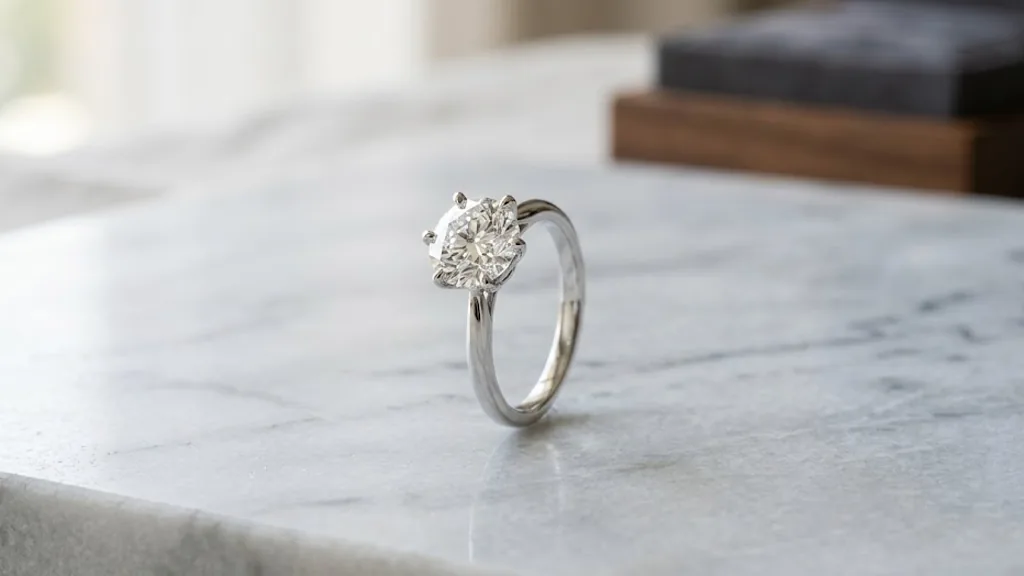
Meanwhile, cutting improved dramatically. In 1886 Tiffany introduced the setting that still bears its name: six claws lifting a single diamond clear of the band so light could enter from every direction. That design is the ancestor of every modern solitaire, including our Solitaire Round Cut Engagement Ring in White Gold.
1947: the sentence that built the tradition
Diamond sales fell badly during the Depression. In 1938 De Beers hired the American agency N.W. Ayer with a straightforward brief: make diamonds essential to engagement. The campaign that followed placed diamonds in films, put them on film stars, and taught a generation that a proposal came with a stone.
In 1947 Frances Gerety, then a young copywriter at the agency, wrote “A Diamond Is Forever” late one night. It has been the company’s line ever since and is routinely described as one of the most effective advertising slogans ever written.
The campaign also produced the “spend two months’ salary” guideline. That figure was a marketing device, not a rule and not a measured average of what anyone actually spent. It is worth knowing that, because a great many people still feel obliged by a number invented to sell diamonds.
A timeline
| Date | What happened |
|---|---|
| Ancient Rome | Betrothal rings used as part of a legal agreement |
| 860 AD | Pope Nicholas I is recorded describing the engagement ring as a formal statement of intent to marry |
| 1477 | Maximilian of Austria gives Mary of Burgundy a diamond betrothal ring |
| 1600s–1700s | Table cuts and rose cuts; diamond rings remain aristocratic |
| 1866–1871 | Major South African diamond discoveries transform supply |
| 1886 | Tiffany introduces the raised six-claw solitaire setting |
| 1888 | De Beers founded |
| 1919 | The modern round brilliant cut is formalised, based on Marcel Tolkowsky’s proportions |
| 1938 | De Beers appoints N.W. Ayer to make diamonds central to engagement |
| 1947 | Frances Gerety writes “A Diamond Is Forever” |
| 1950s onwards | Diamond engagement rings become the mainstream expectation in Britain and America |
| 2010s onwards | Lab-grown diamonds reach commercial scale and change the price of entry |
What this history should tell you
Two useful things, we think.
First, that the “rules” around engagement rings are much younger and much more commercial than they appear. The two months’ salary guideline, the assumption that the stone must be as large as possible, the idea that a solitaire is the only correct design — none of these are ancient traditions. They are twentieth-century marketing that stuck.
Second, that the tradition has always changed with the technology available. Table cuts gave way to rose cuts, rose cuts to old mine cuts, old mine cuts to the brilliant. Lab-grown diamonds are the current step in exactly that sequence: the same material, produced in a different way, at a price that lets people buy the ring they actually want rather than the one they can just about afford.
Frequently asked questions
Who gave the first diamond engagement ring?
Archduke Maximilian of Austria, to Mary of Burgundy, in 1477. It is the earliest example with reliable documentation, though it is possible that earlier ones existed without surviving records.
Did De Beers invent the diamond engagement ring?
No, but they made it universal. Diamond betrothal rings existed for centuries before De Beers. What the company’s advertising from 1938 onwards did was turn a rare aristocratic custom into a normal expectation for ordinary couples.
Is the two months’ salary rule real?
It is real advertising, not a real rule. It came from the De Beers campaign and has no basis in etiquette, tradition or any measured figure. Spend what suits your circumstances.
Why the fourth finger of the left hand?
From the Roman belief in the vena amoris, a vein supposedly running from that finger straight to the heart. The anatomy is wrong, but the custom survived. In several countries — Germany, Poland, Russia, India among them — the ring is worn on the right hand instead.
Do engagement rings have to be diamonds?
Not remotely. Sapphires, emeralds and coloured stones have long histories in engagement rings, and plain bands are a perfectly valid choice. We work with diamonds because that is our craft, but the only requirement is that the ring means something to the two of you.
Where to go from here
If the older cutting styles appeal, look at the Vintage Round Cut Engagement Ring in Yellow Gold or browse the full engagement ring collection. Every ring is hand-made in North Harrow with a lab-grown centre stone and a free IGI certificate, delivered free and insured anywhere in the UK.
More guides on this topic
Ready to find your perfect ring?
Explore our lab-grown diamond collection or book a virtual appointment with our team.