Are Gold Engagement Rings Out of Style?
Yellow gold is firmly back. Why metal colour runs in cycles, the white gold catch nobody mentions, and how to choose one you will still like.
Short answer: no. Gold engagement rings are not out of style, and yellow gold in particular has had one of the strongest comebacks in modern jewellery.
The longer answer is more useful, because the worry behind the question is usually not really about gold. It is about buying something that will look dated in ten years. That is a fair thing to worry about, and there is a sensible way to think about it.
Metal colour runs in cycles — it always has
Look back across the last century and the fashionable metal keeps changing places.
Yellow gold dominated for most of the twentieth century. White metals — platinum, then white gold — took over strongly from roughly the 1990s, to the point where a whole generation grew up assuming an engagement ring was silver-coloured by default. Rose gold surged in the 2010s. Yellow gold came back firmly in the years after that, and it has not gone anywhere since.
We will not attach percentages to any of that, because we cannot verify a reliable source for UK metal preferences and inventing one would be worse than useless. What we can tell you is what we see: yellow gold requests are entirely routine again, and nobody treats them as unusual.
The pattern worth taking from this is that no metal stays out of fashion permanently. If you choose the currently unfashionable one, wait long enough and it will be fashionable again — with your ring having been right all along.
What “out of style” actually means for a ring
Rings date for three reasons, and metal colour is the weakest of them.
- Setting proportions date fastest. Very tall settings, chunky shoulders and unusual profiles tie a ring to a decade far more firmly than its colour does.
- Stone quality never dates. A well-cut diamond looked good in 1960 and will look good in 2060.
- Metal colour cycles, and can be changed. Which brings us to the most reassuring fact in this article.
If you genuinely fall out of love with the colour, a goldsmith can reset the stones into a new band in a different metal. It costs money, but it is a straightforward job — the diamond is the expensive part and it comes across unchanged.
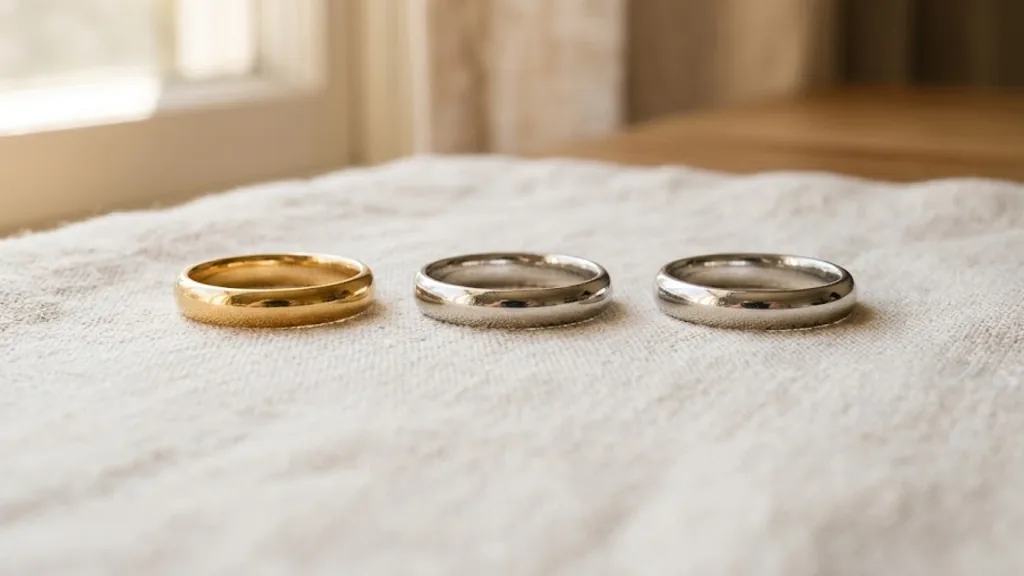
The four metals, compared honestly
| Metal | Character | Upkeep | Best suited to |
|---|---|---|---|
| Yellow gold | Warm, traditional, unmistakably gold | Very low — occasional polish | Warm skin tones; vintage and antique styling; anyone who wants the ring to read as gold |
| White gold | Crisp and bright; makes diamonds look whiter | Needs re-plating periodically | Cool skin tones; matching existing silver-coloured jewellery |
| Rose gold | Soft pink, distinctive, romantic | Very low; hard-wearing thanks to copper content | Anyone wanting something a little different that still reads as classic |
| Platinum | Naturally white throughout; heavy and substantial | None beyond polishing if you dislike the patina | Everyday wear, sensitive skin, and anyone who never wants to think about upkeep |
The white gold catch nobody mentions at the counter
This matters if you are weighing white gold against yellow.
Gold is naturally yellow. White gold is gold alloyed with paler metals and then plated with rhodium, a bright white metal from the platinum family. That plating is what makes it look crisp and cool.
Rhodium plating is a surface layer, and it wears off with use — usually starting on the underside of the band. When it thins, a faint warm tone shows through. It is not damage and it is not a fault; it is how the metal works. Re-plating restores it completely and takes a jeweller very little time.
Yellow gold and platinum have no equivalent maintenance. Yellow gold is the same colour all the way through, so wear simply reveals more of the same metal. Platinum is naturally white throughout and develops a soft satin patina that many people prefer to the original shine.
So if low maintenance is a priority, yellow gold and platinum are the easier lives. A solitaire round cut engagement ring in platinum is about as maintenance-free as an engagement ring gets.
A word on the other kind of carat
Confusingly, “carat” means two different things in a jeweller’s.
For diamonds, a carat is a weight. For gold, carat is a measure of purity — 24ct is pure gold, 18ct is 75% gold, 14ct is about 58%, and 9ct is 37.5%. Higher carat means richer colour and higher value; lower carat means a harder, more scratch-resistant alloy.
For engagement rings, 18ct and 14ct are the usual choices. We have set out the trade-offs in detail in our guide to 14ct versus 18ct gold engagement rings.
How to choose a metal you will still like
Four questions that settle it in about a minute.
- What is already in her jewellery box? If everything she owns is yellow gold, a white gold engagement ring will sit oddly against it every day. This is the strongest signal you have.
- What does she wear against her skin daily? People generally know what suits them without articulating it.
- How much upkeep will she tolerate? If the answer is “none”, steer away from white gold.
- What will the wedding band be? Mixed metals can look wonderful and deliberate, but it works best as a decision rather than an accident.
Gold styles that are genuinely current
If you want gold that reads as modern rather than inherited:
Yellow gold with a vintage setting. The combination that has driven gold’s return. A vintage round cut engagement ring in yellow gold uses fine detail and a warm metal without looking like a period piece.
Yellow gold with multiple stones. Warm metal flatters a row of diamonds particularly well. A 5 stone pear cut engagement ring in yellow gold is a good example, and one of our most accessible pieces — price correct at the time of writing.
Rose gold with a soft shape. Rose gold and rounded shapes such as heart, cushion and oval belong together. It is a distinctive choice that has settled into being a classic rather than a fad.
Frequently asked questions
Is yellow gold out of fashion for engagement rings?
No. It fell out of favour for roughly two decades and has been firmly back for years. Nobody in a jeweller’s raises an eyebrow at a yellow gold engagement ring.
Does yellow gold make a diamond look yellow?
It can lend a very slight warm cast, which is worth knowing but is rarely a problem. If you are choosing yellow gold, you can often choose a slightly warmer colour grade and save money, because the metal masks it. In white metal, colour grade shows more.
Is rose gold a passing trend?
It has been popular long enough now to have outlasted the definition of a trend. It also has genuine practical merit — the copper in the alloy makes it hard-wearing.
Can I change the metal colour later?
Not the metal itself, but the stones can be reset into a new band in a different colour. Plating a yellow gold ring white is possible but wears off and needs redoing, so it is a short-term fix rather than a solution.
Which metal is the most hard-wearing?
Platinum is the most durable in practice — it is dense, and when it scratches the metal displaces rather than being lost. Among golds, lower carat alloys such as 14ct are harder than 18ct.
Should the engagement ring and wedding band match?
They usually do, but they need not. Mixing metals deliberately, particularly yellow with white, looks considered when it is planned from the start.
See the colours side by side
Metal colour is genuinely hard to judge from a description — it needs eyes. Browse the engagement ring collection to compare yellow, white, rose and platinum against the same shapes, or look through the women’s jewellery range more widely. Everything is hand-made in solid metal, with a lab-grown centre stone, a free IGI certificate, free insured UK delivery and 30-day returns.
Ready to find your perfect ring?
Explore our lab-grown diamond collection or book a virtual appointment with our team.