Why Some Married Women Leave Their Wedding Rings at Home
Work, safety, swelling, chemicals and plain forgetfulness: the real reasons a wedding ring gets left in a dish by the sink.
A wedding ring left in a dish by the sink is one of the most misread objects in the country. People assume it means something is wrong. Almost always, it means the ring was going to get damaged, or the hand was going to get hurt, or the wearer simply forgot to put it back on. Here are the real reasons, in roughly the order they occur.
Work — the most common reason by a distance
Whole professions require rings to come off, and most of them are staffed heavily by women.
Healthcare. Hand hygiene policies in the NHS and private care settings commonly restrict jewellery below the elbow, because rings and stones harbour bacteria and interfere with proper handwashing. Nurses, midwives, dentists, care workers and surgeons routinely work ringless.
Food preparation. Similar hygiene rules apply in professional kitchens and food manufacturing.
Machinery and manual work. A ring caught in moving equipment or on a fixed edge can cause a degloving injury, where the ring strips soft tissue from the finger as the hand pulls away. This is a real and serious hazard, and it is why many employers ban rings outright on production floors and building sites.
Beauty, hairdressing and cleaning. Constant exposure to bleach, peroxide, acetone and salon chemicals. Chlorine and bleach attack the alloys in gold, and repeated contact will weaken claws and solder joints over time.
None of these are statements about a marriage. They are statements about a job.
Protecting the ring itself
The second big category is people who take the ring off because they know what would happen if they did not.
- The gym. A barbell against a diamond-set band bends the metal and pushes stones out of their settings. Weights ruin more rings than anything else.
- Swimming. Cold water shrinks fingers, and rings slide off. Chlorine damages gold alloys. Both problems in one activity.
- Gardening and DIY. Grit gets into settings, and knocks against tools chip and bend.
- Cleaning. Bleach-based products are directly harmful to gold.
- Hand cream, fake tan and make-up. Not damaging, but they build a film under the stones that dulls the ring quickly.
Fine claw-set designs are the most vulnerable. If a ring needs constant removal, the honest answer is often that the design does not suit the life. Bezel and channel settings — where the stones sit inside or between metal rather than raised on claws — survive far more. A bezel rose cut eternity band is about as robust as a diamond-set band gets, and a minimalist round cut wedding band has almost nothing to catch on at all.
The ring does not fit any more
Fingers change. They swell in heat, shrink in cold, and change permanently with pregnancy, weight, medication and age. Arthritis changes the knuckle so that a ring either will not go on or will not come off.
A ring that spins constantly or feels tight gets left at home, and then quietly stops being worn at all. This is fixable — resizing is routine for plain bands and half eternity designs — but people put it off for years.
One exception worth knowing: a full eternity ring usually cannot be resized, because there is no plain metal for a jeweller to cut and rejoin. If yours no longer fits, the options are wearing it elsewhere or having it remade.
Travel and safety
Plenty of people take a wedding ring off for holidays, particularly in cities where visible jewellery attracts attention. Others leave it behind for anything involving hostels, beaches or hire cars.
Insurance is a factor too. Many home contents policies cover jewellery only within the home unless you have added personal possessions cover. A ring worn abroad may not be insured at all, which makes leaving it in a safe the rational choice.
Pregnancy and after
Swelling in pregnancy, particularly in the third trimester, makes rings uncomfortable or impossible. Many women take them off around the middle of the pregnancy rather than risk needing a ring cut off in hospital.
Afterwards, hands often do not return to exactly their previous size, and the ring stays off while the wearer waits to see. Add newborn care, hand-washing and skin sensitivity, and months can pass.
Medical reasons
Rings are removed for surgery as standard, because of swelling and because of the risk of burns from surgical diathermy equipment. They come off for MRI scans, for hand injuries, and for eczema or contact dermatitis under the band — which is common and often caused by soap trapped underneath rather than by the metal itself.
Nickel sensitivity is a genuine and sometimes late-developing problem with some white gold alloys. Platinum or higher-purity gold usually resolves it.
And sometimes, simply forgetting
The ring came off to wash up, went into a dish, and the wearer left the house. This accounts for an enormous share of rings-not-worn on any given day, and it is the least interesting explanation, which is presumably why nobody suggests it first.
The fix is dull and effective: one designated spot for the ring, and never anywhere else. A small dish by the sink, a hook, a box on the bedside table.
Practical alternatives
If you need your hands free but do not want to be ringless:
- Silicone bands. Cheap, safe around machinery, and standard among medical and trade professionals.
- A chain around the neck. Keeps the actual ring with you.
- A second, plain ring for work, keeping the diamond-set one for the rest of the time.
- A simpler main ring. If yours comes off five times a day, the design may be the problem.
Before you read anything into it
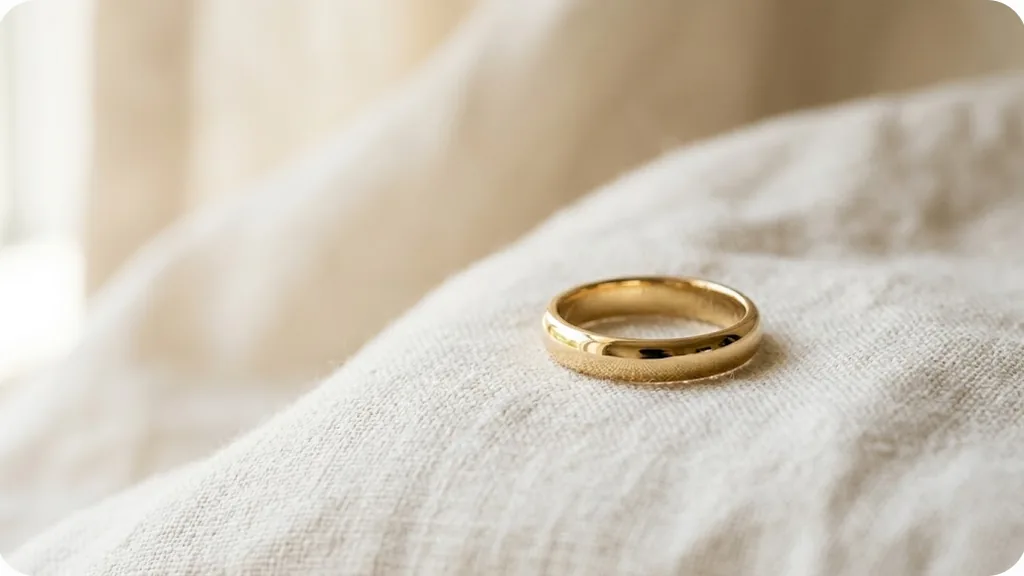
Given the list above, a ring on a windowsill is very weak evidence of anything. Nurses, chefs, engineers, gardeners, swimmers, new mothers and people with swollen knuckles all go ringless routinely, and none of it says a word about their marriages.
If the ring is off because it does not fit, or because the design is impractical, that is a jeweller’s problem and it is solvable. Our rings are hand-made in North Harrow in solid gold, platinum and sterling silver with lab-grown diamonds and a free IGI certificate on centre stones. If you want a lower-profile band that survives real life, we design bespoke at no extra design cost.
If you want to wear it but cannot
Most of the reasons above are fixable, and it is worth knowing which.
Fit. Resizing is routine for plain bands and half eternity designs. If the knuckle is the problem rather than the finger, a jeweller can fit a hinged shank or a sizing device that opens to pass the joint and closes below it. These are common solutions for arthritis and they work well.
Skin irritation. Often it is soap trapped under the band rather than the metal. Removing and drying the ring properly for a fortnight usually settles it. If it does not, a nickel-free alloy or platinum will.
Design. If the ring comes off five times a day because it catches on everything, the design is wrong for your life. A lower-profile band with bezel or channel-set stones solves it permanently.
None of these require giving up the ring. They require an hour with a jeweller, which most people put off for years.
Frequently asked questions
Is it normal not to wear a wedding ring every day?
Yes. Work, sport, health and comfort all keep rings off hands routinely. Our note on whether to wear a wedding ring every day goes into it further.
Why do nurses not wear wedding rings?
Hand hygiene policies commonly restrict jewellery below the elbow, because rings interfere with effective handwashing and can carry bacteria.
Does taking your ring off mean marriage trouble?
Very rarely. The overwhelming majority of removals are practical. If you are worried, ask rather than infer.
Where is the safest place to leave a ring at home?
One consistent spot, away from sinks and drains, ideally a closed box. Most rings are lost at home rather than out.
Should I resize a ring that does not fit any more?
Yes, if it is a plain band or a half eternity — it is routine work. A full eternity ring usually cannot be resized and may need remaking instead.
If your current ring is impractical rather than unloved, browse our wedding ring collection for lower-profile designs, and see our advice on taking a wedding ring off without losing it.
Ready to find your perfect ring?
Explore our lab-grown diamond collection or book a virtual appointment with our team.