Why Are Wedding Rings Made of Gold?
Gold does not corrode, can be resized for life and can be hallmarked. Why wedding rings are gold, whether they must be, and rose gold compared.
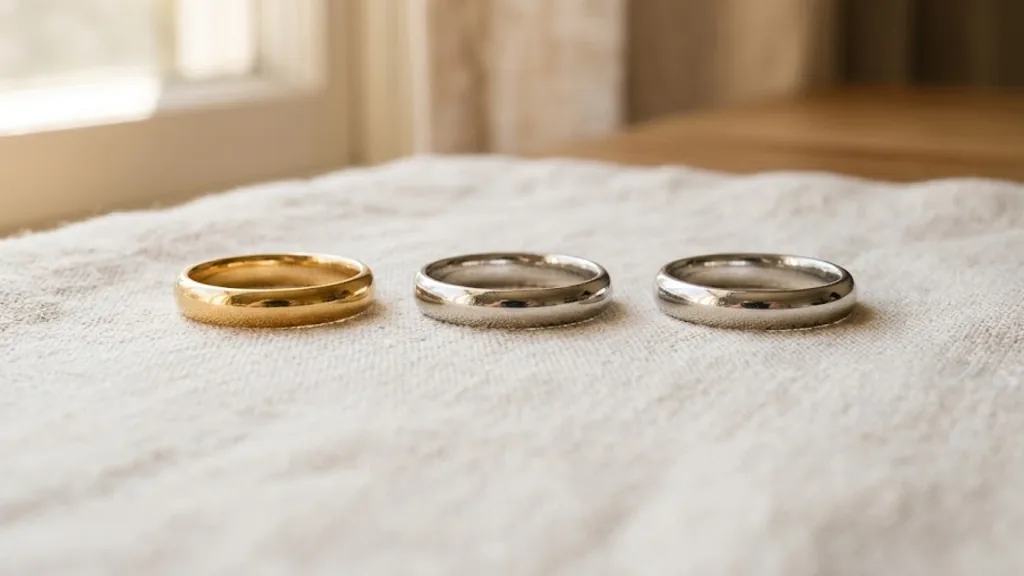
Wedding rings are made of gold because gold does not corrode, tarnish or rust, it is soft enough for a jeweller to size and repair for a lifetime, and it can be legally hallmarked to prove its purity. A ring worn every day for fifty years needs all three of those properties. No other affordable metal offers them together.
Why are wedding rings made of gold?
Wedding rings are made of gold for reasons that are metallurgical before they are romantic. Pure gold is chemically inert: it does not react with air, water, sweat or soap, so it will not corrode or turn a finger green. It is also malleable, which means a goldsmith can size it up or down, close a worn shank and re-polish it decades later. And because gold has been valued for millennia, it carries an inherited meaning that a newer metal cannot borrow. Permanence, repairability and worth in one material is the whole answer.
Does a wedding ring have to be gold?
No. A wedding ring does not have to be gold, and there is no rule, tradition or law in the UK requiring it. Platinum is the main alternative in fine jewellery — denser, naturally white and harder wearing at the surface. Beyond that, titanium, zirconium, tungsten and sterling silver are all used. Each involves a genuine trade-off, usually the inability to resize or the lack of a hallmark. We cover the specific cases in is titanium good for a wedding ring and is 925 sterling silver good for wedding rings.
Why is a wedding ring not made of pure gold?
A wedding ring is not made of pure 24ct gold because pure gold is too soft to hold its shape. A 24ct band would go oval within months of daily wear and would pick up dents from ordinary handling. Gold is therefore alloyed with metals such as copper, silver, zinc and palladium to harden it. The carat number states how much gold is in the mix: 9ct is 37.5% gold, 14ct is 58.5% and 18ct is 75%. Our full explanation is in how many carats of gold for a wedding ring.
How do gold, platinum and the alternatives compare for a wedding ring?
The table below compares the metals we are asked about most, on the three things that actually decide the choice: whether it can be resized, whether it needs re-plating, and whether it carries a UK hallmark.
| Metal | Can it be resized? | Needs re-plating? | UK hallmarked? |
|---|---|---|---|
| 18ct yellow gold | Yes | No | Yes |
| 18ct white gold | Yes | Yes — rhodium plating wears through | Yes |
| 18ct rose gold | Yes | No — the colour is in the alloy | Yes |
| 9ct gold | Yes | No (yellow and rose) | Yes |
| Platinum | Yes | No — naturally white throughout | Yes |
| Titanium | No | No | No — not a precious metal |
| Tungsten | No | No | No |
| Sterling silver | Yes | No, but it tarnishes and wears fast | Yes |
The resizing column is the one people wish they had read first. A finger changes size over a lifetime, and a ring that cannot be resized has to be replaced instead.
Are gold wedding rings back in style?
Yellow and rose gold wedding rings are clearly back in demand after a long period where white metals dominated. Metal colour runs in cycles and always has, so a jeweller would call this a return rather than a novelty. Be careful with the word “style” here, though: a wedding ring is worn for decades, which is far longer than any trend lasts. The sounder question is which colour suits your skin, your engagement ring and your other jewellery, because that will not change. We looked at the same question for engagement rings in are gold engagement rings out of style.
Is rose gold good for wedding rings?
Rose gold is a very good choice for a wedding ring, and in one respect it beats white gold outright: the pink colour comes from copper in the alloy, so it runs all the way through the metal and never needs re-plating. White gold is plated with rhodium, and that plating wears through on a ring within a couple of years and needs redoing. Rose gold also hides fine scratches well because the warm surface breaks up the light. The two honest cautions are that copper can irritate a small number of very sensitive skins, and that rose gold is harder to match exactly to an existing ring made elsewhere. Our detailed piece is are rose gold engagement rings popular.
How can you tell a wedding ring is really gold?
You check the hallmark. UK law requires precious metal articles above a small weight threshold to be hallmarked by an Assay Office, and the mark is struck inside the band. A full hallmark shows the sponsor’s mark, the Assay Office mark and the fineness number — 375 for 9ct, 585 for 14ct, 750 for 18ct and 950 for platinum. A ring described as gold with no hallmark inside it should prompt a question. This is the single most useful check any buyer can make, and it takes a loupe and ten seconds.
What CarbonstoneUK makes in gold
Every band we make is solid gold or platinum, hand-made in North Harrow, London — never plated, never filled. In yellow gold, the Ocean Wave Round Cut Wedding Band in Yellow Gold is £657 and the Curved Round Cut Wedding Band in Yellow Gold is £707 if you need a band that fits around a raised engagement ring. In rose gold, the Chevron Round Cut Wedding Band in Rose Gold is £707. Prices are correct at the time of writing. Centre stones come with a free IGI certificate, UK delivery is free and insured, and returns run for 30 days. The whole range is in our wedding ring collection.
Frequently asked questions
Why are wedding rings made of gold rather than another metal?
Gold does not corrode, tarnish or react with skin, it is soft enough to be resized and repaired for a lifetime, and it can be hallmarked to prove its purity. Very few metals combine all three. Platinum does, which is why it is the other metal used in fine wedding rings.
Can wedding rings be gold?
Yes — gold is the most common wedding ring metal in the UK, in yellow, white or rose. It is available in 9ct, 14ct and 18ct, all of which are real gold at different purities. Solid gold bands can be resized, repaired, engraved and re-polished for as long as they are worn.
Does a wedding ring have to be gold?
No. There is no legal or traditional requirement for a wedding ring to be gold. Platinum, titanium, zirconium, tungsten and silver are all worn as wedding rings. The main practical questions to ask about any alternative are whether it can be resized and whether it carries a hallmark.
Which gold carat is best for a wedding ring?
For most people 18ct or 14ct is the sensible balance. 18ct is 75% gold, has the richest colour and is the traditional UK choice for fine jewellery. 14ct at 58.5% is a little harder wearing. 9ct at 37.5% is the most affordable and the most scratch-resistant, but the colour is noticeably paler.
Do gold wedding rings wear out?
They thin rather than fail. Decades of contact with hard surfaces slowly wears the underside of any gold band, and eventually a jeweller will build the shank back up. This is routine work, not a defect, and it is the reason gold’s repairability matters more than its hardness for a ring worn every day.
Is white gold or yellow gold better for a wedding ring?
Yellow gold needs less maintenance. White gold is a gold alloy plated with rhodium to give the bright white finish, and that plating wears through with daily use and needs redoing periodically at a cost. If you want a permanently white metal with no upkeep, platinum is the answer rather than white gold.
Do both wedding rings have to be the same gold colour?
No. Two partners’ rings do not have to match in metal or colour, and mixed pairs are now completely ordinary. What is worth matching is your own wedding band to your own engagement ring, because two different gold colours sitting side by side on the same finger is far more noticeable than two rings on two hands.
If you are choosing between metals, decide first whether you will ever want the ring resized — that one answer rules several options in or out. Our wedding rings are hand-made to order in solid gold and platinum, and we will make a bespoke band in any of our metals at no extra design cost.
More guides on this topic
Ready to find your perfect ring?
Explore our lab-grown diamond collection or book a virtual appointment with our team.