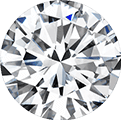
What Is the Best Girdle Thickness for a Round Diamond?
Thin to slightly thick is the answer, and here is why. What the girdle does, why the extremes cause problems, and how much this really matters.
The girdle is the thin band around the widest part of a diamond, where the top half meets the bottom half. It is the part the setting grips, and it is one of the few lines on a certificate that most buyers skip over entirely.
For a round brilliant, the short answer is that you want a girdle described as thin, medium or slightly thick. Anything thinner risks chipping, anything thicker hides weight where you cannot see it. Below is what those words mean, why the extremes cause problems, and how much attention this actually deserves.
What the girdle does
Three jobs. It defines the outline of the stone, it gives the setting something to hold, and it protects the edge where the two halves of the diamond meet — the most exposed part of the whole stone.
Because it sits at the widest point, the girdle is also where a diamond is most likely to be struck. Everything about girdle thickness comes back to a balance between two risks: too thin and the edge is fragile, too thick and you are paying for carat weight that does nothing for how the diamond looks.
The grading scale
Certificates describe girdle thickness in words rather than numbers, usually as a range because the girdle varies around the stone.
| Description | Verdict for a round brilliant | Why |
|---|---|---|
| Extremely thin | Avoid | Genuinely fragile; can chip during setting or in normal wear |
| Very thin | Caution | Acceptable in a protective setting, risky in exposed claws |
| Thin | Good | Efficient use of weight with reasonable durability |
| Medium | Ideal | The safest balance of strength and efficiency |
| Slightly thick | Good | Very slightly more weight in the edge; no visible penalty |
| Thick | Acceptable with care | Some weight hidden in the rim; check the stone’s diameter |
| Very thick / extremely thick | Avoid | The stone looks small for its carat weight and can show a grey rim |
A stone graded, for example, “thin to slightly thick” is entirely normal. Girdles are rarely uniform.
The problem with a girdle that is too thin
A knife-thin edge has almost no material in it. It can chip when the stone is being set, when a claw is tightened years later, or from an ordinary knock against a door frame. A chip on the girdle is not usually a disaster — it can often be polished out — but doing so removes weight and costs money.
If you have fallen for a stone with a very thin girdle, the fix is the setting. A bezel wraps metal fully around the edge and protects it completely. A bezel-set ring in platinum at £904, correct at the time of writing, shows what full protection looks like, though the principle applies to any shape.
The problem with a girdle that is too thick
This one costs you money rather than risking damage. Carat is a measure of weight, not of size. Weight parked in a thick rim around the middle of the stone does nothing for the view from above, so a diamond with a very thick girdle looks smaller than its carat weight suggests.
There is a visual issue too. A very thick girdle can show as a dull grey band around the edge of the stone when you look at it face-up, which interrupts the sparkle.
The way to catch this is simple: compare the millimetre diameter, not just the carat weight. A well-proportioned one carat round brilliant measures around 6.4 to 6.5mm across. A one carat stone measuring noticeably less than that has weight hidden somewhere you cannot see, and the girdle is the usual culprit.
Faceted, polished or bruted
Girdles are finished in three ways, and the difference is mostly cosmetic.
- Faceted. Small facets cut around the edge. The most common finish on modern round brilliants and generally the most attractive.
- Polished. Smooth and glassy all the way round.
- Bruted. Left with a frosted, matte surface from the shaping process. It looks slightly grey from the side, and on stones with thicker girdles this is more noticeable.
None of these affects durability in any meaningful way. If you are looking at a stone from the side and the edge looks dull, a bruted girdle may be the explanation rather than any fault in the diamond.
How much does this actually matter?
Honestly, less than the overall cut grade. For a round brilliant, the laboratories do give an overall cut grade — excellent, very good and so on — and that grade already takes girdle thickness into account alongside the other proportions.
So the practical advice for most buyers is this: choose a round brilliant with a strong cut grade, then glance at the girdle line to check it does not say extremely thin or extremely thick. If both are fine, you are done. There is no need to become an amateur gemmologist over one measurement.
Where it matters more is with fancy shapes, which the major laboratories do not give an overall cut grade in the same way. There, the individual proportions carry more of the weight of your decision.
How the girdle fits with the other proportions
Girdle thickness never acts alone. It is one of a set of measurements that together decide how a round brilliant handles light, and it is worth knowing which company it keeps on a certificate.
- Table percentage — how wide the flat top facet is relative to the whole stone. Too wide and the stone loses fire; too narrow and it loses brightness.
- Depth percentage — how deep the stone is relative to its width. A very deep stone often has weight hidden below, in the same way a thick girdle hides it around the edge.
- Crown angle and pavilion angle — the two angles that do most of the work of bouncing light back to your eye.
- Culet — the point at the very bottom. A large culet can show as a small dark spot when you look straight down.
A stone can have a perfect girdle and still be dull if the angles are wrong, which is exactly why the overall cut grade exists. Read the grade first and the individual figures second.
Why a thick girdle happens at all
It is rarely carelessness. Diamond cutters are paid by the weight of the finished stone, so there is a constant pull towards keeping every fraction of a carat that can be kept. Leaving extra material in the girdle is one of the easiest ways to hold a stone above a round number such as one carat.
That is worth knowing as a buyer, because it explains a common trap. A stone sold as exactly one carat may have been cut to reach that number rather than to look its best, while a stone at slightly under a carat with better proportions can look larger face-up and cost less. Compare the millimetre diameter across the top and you will see it immediately.
The girdle and your certificate number
One useful detail: laboratory-graded diamonds are usually laser-inscribed with their report number along the girdle. The lettering is far too small to see with the naked eye, and it does not affect the appearance of the stone in any way.
It is how a specific diamond is matched to its specific certificate. Every centre stone we sell comes with a free IGI certificate, so you can check the stone in your ring against the paperwork rather than taking anyone’s word for it.
Rings where the girdle is well protected
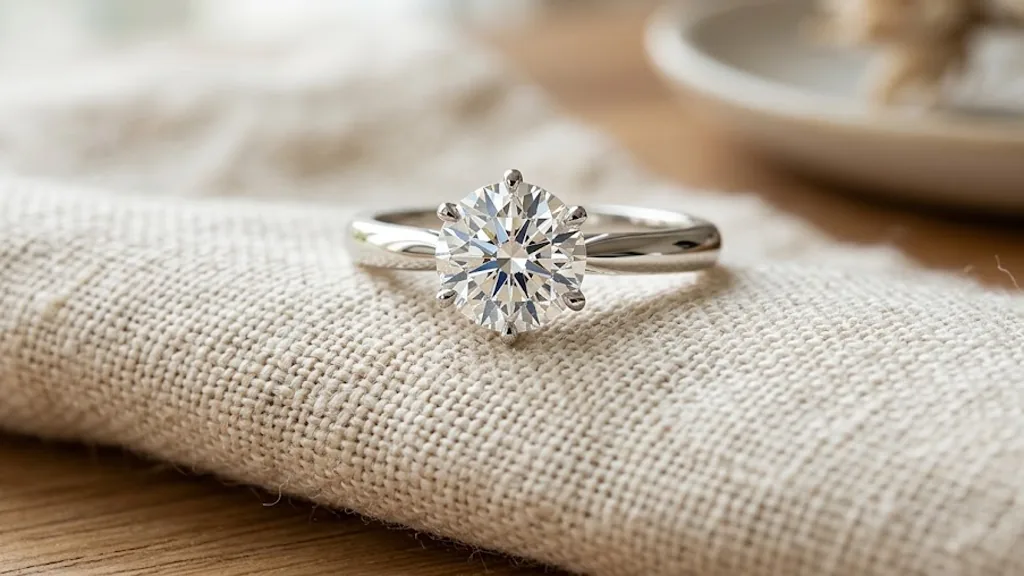
If durability is your main concern, look at how the setting holds the stone. Claw settings leave the girdle exposed between the claws. Halo settings surround the centre stone with smaller diamonds and metal, which buffers it. Bezel settings enclose it entirely.
A halo round cut engagement ring at £707 gives that buffered arrangement, while a solitaire round cut ring in platinum at £657 shows the classic four-claw approach, with platinum claws that hold their shape well over decades. For something with more metal around the stone, a vintage round cut ring in yellow gold at £1,051 sets the diamond into a more substantial mount.
Frequently asked questions
What is the best girdle thickness for a round diamond?
Thin to slightly thick, with medium being the safest single answer. Avoid extremely thin and extremely thick.
Can a chipped girdle be repaired?
Often yes, by repolishing, which removes a small amount of weight. A jeweller can tell you whether it is worth doing for a particular stone.
Does girdle thickness affect sparkle?
Only at the extremes. A very thick girdle can show as a grey rim; otherwise the effect on brilliance is minimal compared with the overall cut.
Do lab-grown diamonds have girdles graded the same way?
Yes. The same laboratories use the same scale, and a lab-grown stone is graded exactly as a mined one is.
Should I reject a stone with a very thin girdle?
Not automatically. In a bezel or a well-designed halo it is far less exposed. In a plain four-claw solitaire worn every day, we would choose a stone with more material in the edge.
You can compare settings across our round cut collection, which is our largest at twenty designs, or browse the full engagement ring range. Free IGI certificate on centre stones, free insured UK delivery, and 30 days to change your mind.
Ready to find your perfect ring?
Explore our lab-grown diamond collection or book a virtual appointment with our team.