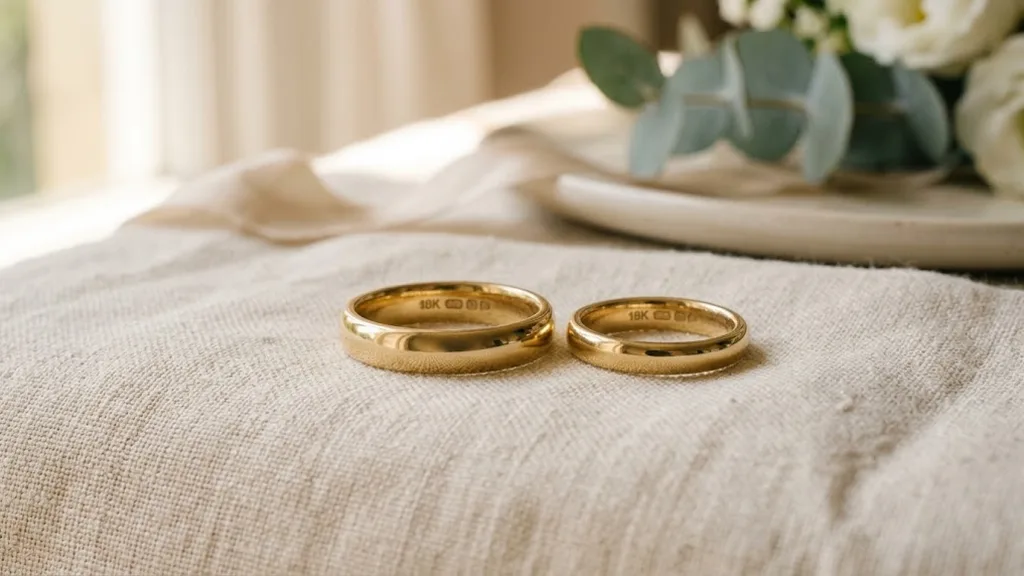
Is 18ct Gold Good for a Wedding Ring? Durability and Price
Yes, 18ct gold is a good wedding ring metal. At 75% pure gold it stands up to daily wear, and we stock it in yellow, rose and white gold options.
Yes, 18ct gold is a good wedding ring metal for most people. At 75% pure gold it gives a richer colour and lower nickel-allergy risk than 9ct or 14ct, the two more common British alternatives. The trade-off is durability: being softer, 18ct scratches and thins faster with daily wear, so expect more frequent polishing or, on white 18ct, rhodium replating.
What does 18ct gold actually mean?
18ct gold means gold that is 75% pure, or 750 parts per 1,000, mixed with other metals such as copper, silver or palladium for strength and colour. In the UK, any gold ring over 1 gram must carry a hallmark struck by one of four UK Assay Offices (London, Birmingham, Sheffield or Edinburgh) confirming that purity by law. If you are still deciding between gold and another metal entirely, our guide on choosing between a gold or silver engagement ring covers that earlier decision.
Is 18ct gold durable enough for daily wear?
18ct gold is durable enough for daily wear for most people, though it is genuinely softer than 9ct or 14ct because it contains less hardening alloy. At the bench, we see more re-tipping and claw wear on 18ct rings over the years than on 9ct rings of the same age and design. That is not a defect, just a known trade-off: a plain 18ct wedding band, kept away from heavy manual work, wears well for decades between routine polishes.
Does 18ct gold scratch or dent easily?
18ct gold does scratch more easily than 9ct or 14ct gold, because a higher gold content leaves the alloy softer and less resistant to everyday knocks. Every gold ring picks up fine surface scratches over time regardless of carat, which is normal wear rather than damage, and a jeweller can polish them out in minutes. A well-made 18ct band still holds its shape and setting for decades; it simply needs that occasional polish sooner than a harder-wearing 9ct equivalent would.
Is 18ct gold better than 9ct or 14ct gold for a wedding ring?
18ct gold is not simply better than 9ct or 14ct gold for a wedding ring; each carat suits a different priority. 18ct gives the richest colour and the lowest nickel content, 9ct is the hardest-wearing and least expensive, and 14ct sits between the two. No reliable UK-wide public figure exists for what proportion of wedding rings are bought in each carat, but 9ct and 14ct are generally the more common choices in the UK.
See our full guide to white gold engagement ring pricing for how that carat choice plays out in real cost.
One US/UK trap worth knowing: American sites often compare gold to “10k”, which is 41.7% pure. There is no UK 10k hallmark at all, and it is not the same as 9ct (37.5% pure) even though it is the closest British equivalent by convention. If you are reading a US source alongside a UK one, treat 9ct and 10k as similar in spirit, not identical in purity.
Is 18ct gold or platinum better for a wedding ring?
18ct gold and platinum both suit a wedding ring, and the honest choice comes down to colour, weight and price rather than one metal being objectively better. Platinum is naturally white, denser, and typically costs more for the same design, while 18ct offers three colour options and a lighter feel on the hand at a lower price point. Neither metal is the wrong answer for daily wear; they simply behave and cost differently.
Gold purity is only one part of a wedding ring’s metal question. We have covered whether titanium suits a wedding ring, whether zirconium suits a wedding ring and whether sterling silver suits a wedding ring separately, if you are comparing beyond the traditional precious metals.
How much does an 18ct gold wedding ring cost?
An 18ct gold wedding ring generally costs more than the same design in 9ct, because more of the ring’s weight is pure gold rather than base alloy. Real prices from our current range, correct at the time of writing, run from the high hundreds to over a thousand pounds depending on width, stone-setting and colour. The table below shows how carat and design affect price on genuinely stocked pieces.
Carat purity is one lever on price; how 9ct, 14ct and 18ct compare in pounds and pence is explained fully in our white gold engagement ring cost guide, which breaks the same three carats down against a real budget.
| Ring | Gold colour | Price (GBP) |
|---|---|---|
| Curved round cut wedding band | Yellow | £707 |
| Chevron round cut wedding band | Rose | £707 |
| Dutch Marquise cut bridal set | White | £932 |
| Ocean Wave round cut wedding band | Yellow | £657 |
Does 18ct gold tarnish or need re-plating?
18ct yellow and rose gold do not tarnish or need re-plating, because their colour comes from the gold and copper alloy itself rather than a surface coating. 18ct white gold is different: it is alloyed to look pale but still carries a faint warm tone, so it is finished with a thin rhodium layer for a bright white shine. That rhodium wears off gradually and typically needs reapplying every 12 to 18 months on a ring worn daily, a little sooner than the same replating on 9ct white gold.
What colours does 18ct gold come in?
18ct gold comes in three colours: yellow, rose and white, each made by alloying the same 75% pure gold with different metals. We stock 22 gold wedding and engagement pieces across the three colours: 9 in yellow gold, 9 in rose gold and 4 in white gold. Examples include the curved round cut wedding band in yellow gold, the chevron round cut wedding band in rose gold and the Dutch Marquise cut bridal set in white gold.
If you want a gold purity or finish we do not carry as standard, that is a bespoke brief rather than a stock choice, made at no extra design cost. Browse the full range in our wedding ring collection to see current stock across all three colours.
Frequently asked questions
Is 18ct gold hypoallergenic?
Yes, 18ct gold suits most sensitive skin well, because at 75% pure gold it contains far less base alloy than 9ct or 14ct. Most reactions blamed on gold actually come from nickel used in the remaining alloy, so ask us to confirm a nickel-free mix if you have a known metal allergy before ordering.
Does 18ct white gold need re-plating?
Yes, 18ct white gold needs rhodium replating to stay bright white, typically every 12 to 18 months with daily wear. Underneath, the gold’s natural warmer tone shows through once the rhodium wears thin, usually first along the shank. Replating is routine bench work, not a repair, and it costs far less than most people expect.
Is 9ct or 18ct gold better for a wedding ring?
Yes, there is a genuine difference worth choosing between: 18ct gives a richer colour and lower nickel content, while 9ct is harder-wearing and less expensive. Neither is better outright. An active daily-wear hand generally suits 9ct best, while someone who prioritises colour and can manage more careful wear tends to prefer 18ct.
What does 18K mean in UK gold terms?
18K is simply the American way of writing what British hallmarking calls 18ct, and both describe exactly the same purity: 75% pure gold. UK jewellers and UK hallmarks use “ct” rather than “K”, so a British-made ring is stamped 18ct inside, never 18K, despite the two terms meaning an identical alloy.
Can an 18ct gold ring be resized?
Yes, 18ct gold rings resize easily in most cases, more easily than harder metals like platinum or titanium. A jeweller cuts the shank, adds or removes a small section of matching 18ct gold, then re-solders and polishes the join invisibly. Heavily set eternity bands can be harder to resize, so check before buying if your size may change.
Is 18ct gold worth more than 9ct?
Yes, 18ct gold is worth more than 9ct gold weight-for-weight, since it holds roughly twice the pure gold content: 75% against 37.5%. An 18ct ring also usually costs more to buy new, because more of the price reflects the gold itself rather than the making, and this same ratio carries through to scrap or resale value.
More guides on this topic
Ready to find your perfect ring?
Explore our lab-grown diamond collection or book a virtual appointment with our team.