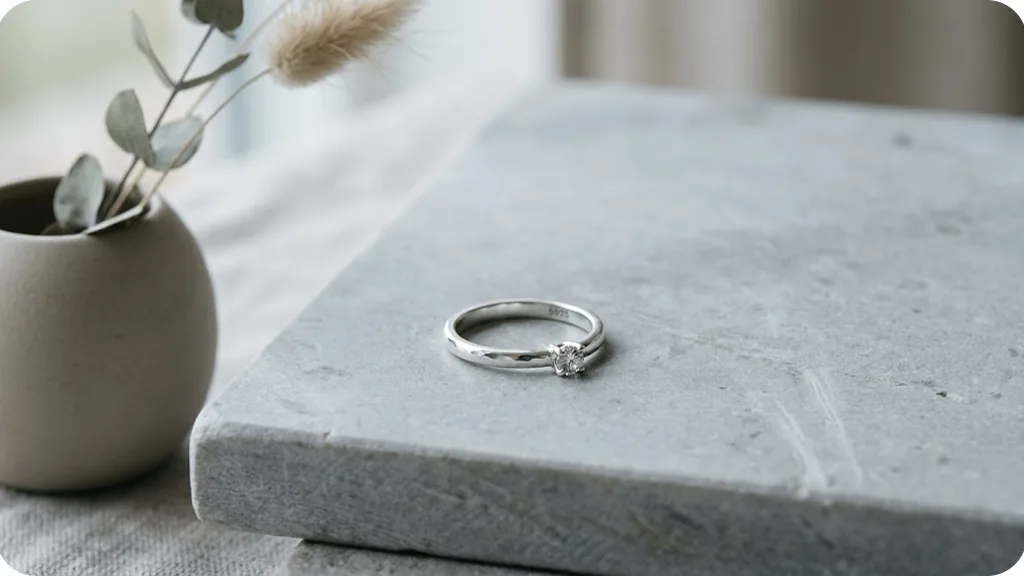
Should an Engagement Ring Be Gold or Silver?
Most rings called silver are actually white gold or platinum. The honest differences, when sterling silver works, and how to choose.
Before answering, there is a correction worth making, because it changes the whole question. When people say an engagement ring is “silver”, they almost never mean silver the metal. They mean the ring is silver in colour — and that ring is far more likely to be white gold or platinum than actual silver.
So there are really two questions hiding here. Should your ring be a warm gold colour or a cool silvery one? And should it be made of sterling silver, the actual metal? The answers are quite different, so let us take them one at a time.
Are engagement rings supposed to be gold or silver?
There is no rule and never has been. No tradition dictates the metal colour of an engagement ring, and nobody will think anything is wrong whichever you choose.
What does exist is fashion, and it moves in long cycles. Yellow gold dominated for most of the twentieth century, white metals took over from roughly the 1990s onwards, and warm tones have been steadily returning. If you pick a metal because it is currently fashionable, you are picking something that will look dated at some point. Pick the one she actually likes and the problem disappears.
The most reliable clue is the jewellery she already owns and wears. Not the pieces in the box — the ones on her. If everything is warm-toned, a cool white ring will sit oddly beside it, and the reverse is equally true.
The four metals people actually mean by “gold or silver”
| Metal | Colour | Hardness for daily wear | Upkeep |
|---|---|---|---|
| Yellow gold | Warm, clearly gold | Good | Very little; occasional polish |
| White gold | Bright silvery white | Good | Needs re-plating from time to time |
| Rose gold | Soft pink | Good — copper content makes it tough | Very little |
| Platinum | Naturally white throughout | Excellent | None, unless you dislike the soft patina it develops |
| Sterling silver | Bright white, slightly grey | Soft — the weak point | Tarnishes; needs regular cleaning |
Notice that four of those five are gold or platinum. That is not snobbery — it is the practical reason engagement rings are made the way they are, which the next section explains.
Why engagement rings are rarely made of actual silver
Sterling silver is a lovely metal, and there is nothing wrong with it. But an engagement ring asks more of a metal than almost any other piece of jewellery, and silver struggles with three of those demands.
It is soft. Sterling silver is noticeably softer than gold or platinum. A ring worn every day for years will scratch more, and a slim band can slowly go out of round. That matters more than it sounds, because a ring that has gone oval is uncomfortable and harder to resize.
It tarnishes. Silver reacts with sulphur compounds in ordinary air and darkens over time. It cleans off easily, but it comes back. Gold and platinum simply do not do this.
Its claws wear faster. This is the one that actually matters. The tiny claws gripping a centre diamond are under constant strain, and softer metal wears thinner sooner. A worn claw is how people lose stones. It is not that silver cannot hold a diamond — it is that it needs checking more often.
None of this makes silver a bad metal. It makes it a metal better suited to jewellery that is worn sometimes rather than constantly.
When sterling silver is genuinely the right choice
There are real situations where it is the sensible answer, and it is worth saying so rather than steering everyone towards the expensive option.
If the budget is tight and you would rather put the money into a better centre stone than into the metal, silver lets you do that. If she wants a bold, unusual design that would be costly in gold, silver makes it reachable. And if the ring is a placeholder — proposing now, choosing the permanent ring together later — silver is a perfectly honest way to do it.
Most of our range is hand-made in solid gold and platinum, but a handful of designs are offered in sterling silver. The Cluster Pear Cut Engagement Ring in Sterling Silver at £729 is a good example — a wide, vintage-feeling cluster that would cost considerably more in gold. The Floral Hexagon Cut Engagement Ring in Sterling Silver at £1,078 is the more unusual option, built around a hexagon-cut stone. Both prices are correct at the time of writing.
If you want the silver look, buy white gold or platinum
This is the practical answer for most people. You get the cool, bright colour without the softness or the tarnishing.
White gold is gold mixed with paler metals and then plated with rhodium, a brilliant white metal from the platinum family. It gives the crispest, whitest finish of any option, and it flatters a diamond by making it look whiter. The catch is that the rhodium is a surface layer and wears with use — when it thins, a faint warm tone shows through and the ring needs re-plating. That is normal, not a fault. Our Solitaire Round Cut Engagement Ring in White Gold at £563 is the classic version.
Platinum is white all the way through, so it never needs plating and never changes colour. It is also the most hard-wearing of the lot, and it is dense, which gives a ring a satisfying weight. It costs more than gold for the same design, and it develops a soft satin patina over the years that some people love and others have polished off. The Solitaire Round Cut Engagement Ring in Platinum at £657 is the same shape in the low-maintenance metal.
A common mix-up: two different meanings of “carat”
Worth clearing up while we are here, because it confuses almost everybody. Carat means two entirely different things depending on what it is describing.
Applied to a diamond, carat is a unit of weight. Applied to gold, carat describes purity — 18ct gold is 18 parts gold out of 24, and 9ct is 9 parts out of 24. Higher carat means richer colour and a softer metal; lower carat means a harder, paler, cheaper one.
Sterling silver uses a different system again. The “925” stamped on silver means 92.5 per cent pure silver, with the remainder usually copper for strength.
How to actually decide
- Look at what she wears now. The single most reliable signal, and it costs nothing to check.
- Think about her hands at work. Someone hard on their jewellery is better served by platinum than by silver.
- Match the wedding band. The two rings will sit together for decades. Mixed metals can look wonderful, but it should be a decision rather than an accident.
- Do not overthink resale. No engagement ring is an investment, in any metal. Choose for wearing.
- Remember it can be changed. A stone can be reset into a different metal later if tastes shift.
Frequently asked questions
Is an engagement ring gold or silver?
Most are gold or platinum. Rings described as silver are usually white gold or platinum — silver in colour rather than in material. Genuine sterling silver engagement rings exist but are much less common.
Are engagement rings supposed to be gold or silver?
Neither. There is no rule. Choose the colour she already wears and you will be right far more often than by following a convention that does not exist.
Can you set a real diamond in sterling silver?
Yes, and we do. The caveat is that silver claws are softer than gold ones, so the setting wants checking more often — roughly once a year for a ring worn daily.
Will a sterling silver ring turn my finger green?
Occasionally, and it is the copper in the alloy reacting with skin rather than anything wrong with the ring. It is harmless and washes off. It happens more in warm weather or with certain skin chemistry.
Is white gold or platinum better if I want a silver colour?
White gold is brighter and costs less but needs periodic re-plating. Platinum costs more but never changes colour and is tougher. If you would rather never think about upkeep, choose platinum. For more on this, see our guide to whether white gold is good for an engagement ring.
Does the metal affect how the diamond looks?
Yes, subtly. White metals make a diamond appear whiter and brighter. Yellow gold can lend a faint warmth to a stone, which some people prefer — it is not a flaw, just a different look.
If you want to see the colours side by side rather than on a screen, browse the full engagement ring collection and the matching wedding ring collection. You may also find our guide on whether gold engagement rings are out of style and our honest look at 925 sterling silver for wedding rings useful. Everything is hand-made in North Harrow, London, every centre stone comes with a free IGI certificate, and UK delivery is free and insured with 30 days to return.
More guides on this topic
Ready to find your perfect ring?
Explore our lab-grown diamond collection or book a virtual appointment with our team.