What Does Milgrain Mean on a Ring?
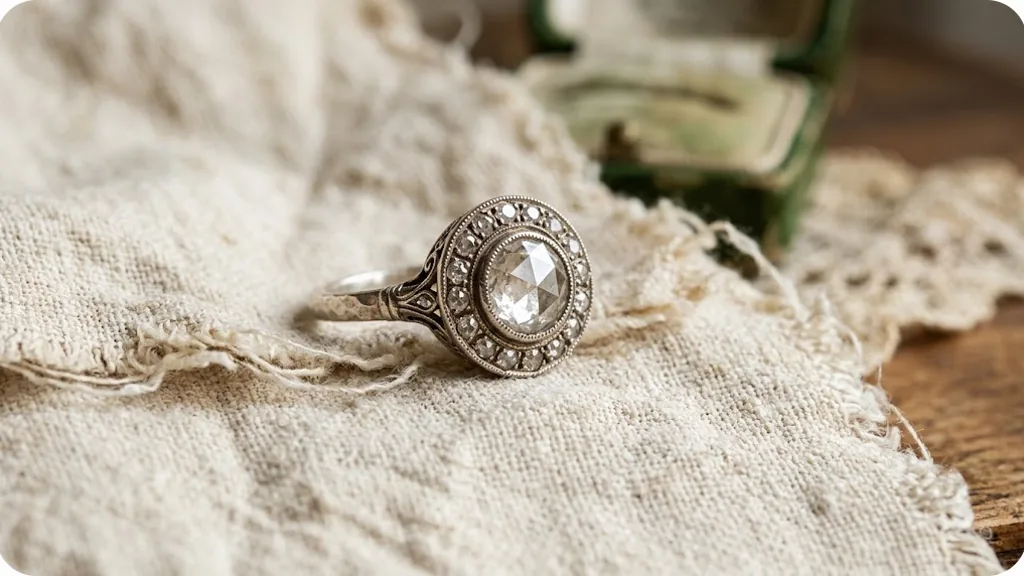
Milgrain is a row of tiny metal beads, each under 0.5 mm, along a ring’s edge. It wears slowly over years, and a jeweller can usually restore it.
Milgrain on a ring means a row of tiny metal beads running along an edge, like a fine line of raised dots. The name comes from the French for “a thousand grains”. Each bead is typically well under 0.5 mm across and is pressed into the metal with a small wheel. Milgrain does wear down slowly over years, but a jeweller can usually restore it.
How is milgrain made on a ring?
Milgrain is made with a milgrain tool: a small hardened steel wheel with tiny cup-shaped hollows around its rim. The jeweller rolls it along a metal edge, and each hollow presses one round bead into the gold or platinum. The edge is often only 1 to 2 mm wide, such as a bezel rim. Some rings have the beads cast in, then sharpened by hand.
You will also see it spelled millgrain or mill grain. All three mean the same beaded edge.
Why does milgrain give a ring a vintage look?
Milgrain gives a ring a vintage look because it was a signature of Edwardian jewellery, from about 1901 to 1910, and of Art Deco pieces in the 1920s and 1930s. Platinum became widely used then, and its strength allowed very fine detail. The beaded line softens hard metal edges and catches light like tiny pearls, so even a new ring reads as an heirloom.
Our Vintage Round Cut Engagement Ring in Yellow Gold pairs milgrain with a pavé band, from £1,051, and the Cluster Pear Cut Engagement Ring starts at £729, both at the time of writing.
Does milgrain wear away over time?
Milgrain does wear away over time, slowly, because the beads stand slightly proud of the metal and take every knock first. The palm side softens soonest. No reliable public figure exists for how many years milgrain lasts; it depends on the metal, your routine and polishing. Each polish removes a thin layer of metal, so a ring polished every 12 months loses detail faster.
Platinum 950 tends to move rather than wear away, so beads blur but the metal stays. Harder 9ct and 14ct gold hold a crisp edge a little longer than 18ct.
Can milgrain be redone by a jeweller?
Milgrain can usually be redone by a jeweller, who rolls a fresh row of beads along the edge after the ring has been cleaned and polished. This is often done during a service, or after a ring is resized by 1 or 2 UK sizes, because the beads near the join are lost. The limit is metal: an edge worn too thin cannot take new beads, so ask early.
How is milgrain different from filigree and bead setting?
Milgrain is different from filigree and bead setting because milgrain is pure decoration and holds nothing. Filigree is lacy openwork made from very fine twisted wire, often under 0.5 mm thick. Bead setting raises tiny grains of metal to hold small diamonds, often around 1 mm, in pavé work. Milgrain decorates an edge, filigree forms a pattern, and beads grip stones.
The table below sorts four common ring details, and the main conclusion is that only bead setting actually holds a diamond in place.
| Detail | What it is | Holds a stone? |
|---|---|---|
| Milgrain | Tiny beads, under 0.5 mm, along an edge | No |
| Filigree | Openwork made from fine twisted wire | No |
| Bead setting | Metal grains gripping stones of about 1 mm | Yes |
| Engraving | Patterns cut into the metal surface | No |
Milgrain suits wedding bands too. The Bezel Rose Cut Eternity Band combines 3.50 mm rose cut diamonds with milgrain edges, from £1,611 at the time of writing. CarbonstoneUK, a lab-grown diamond jeweller in North Harrow, London, makes each by hand. Browse our lab-grown diamond wedding ring collection.
Frequently asked questions
Is milgrain the same as millgrain or mill grain?
Yes. Milgrain, millgrain and mill grain are three spellings of the same detail: a line of tiny raised metal beads along the edge of a ring. Milgrain is the most common spelling in the UK trade. All three come from the French “mille grains”, meaning a thousand grains.
Does milgrain catch on clothes or hair?
No. The beads are rounded and each is typically under 0.5 mm, so milgrain feels lightly textured rather than sharp. It is far less likely to snag than a raised claw. If a milgrain edge ever feels scratchy, it has probably been damaged by a knock and needs a jeweller.
How do you clean a milgrain ring at home?
Soak the ring in warm water with a drop of washing-up liquid for 10 to 15 minutes, then brush the beaded edge gently with a soft toothbrush. Dirt sits between the beads and dulls them. Rinse, then dry with a lint-free cloth. Avoid abrasive pastes, which wear the beads faster.
Can milgrain be added to a ring I already own?
Yes, often, if the edge has enough metal. A jeweller can roll milgrain onto a bezel rim or band edge, but a very thin band, typically under about 1.5 mm, may not leave enough room. Ask for an inspection first, because adding beads to a worn edge can weaken it.
Does milgrain work on platinum and sterling silver?
Yes. Milgrain works on 950 platinum, solid gold and 925 sterling silver. Platinum holds fine detail very well, which is why it was the classic metal for milgrain. Sterling silver is softer, so its beads soften a little sooner, but they can be refreshed in the same way.
Will milgrain make my ring harder to resize?
No, not harder, but it adds a finishing step. A resize of 1 or 2 UK sizes cuts through the base of the band, and any milgrain near the join must be rolled again so the beads match. Mention the milgrain before work starts, so the finish is restored.
More guides on this topic
See our guide to the different types of wedding rings, plus what a cushion cut diamond means and what choosing a cushion cut says.
Ready to find your perfect ring?
Explore our lab-grown diamond collection or book a virtual appointment with our team.