The Different Types of Wedding Rings Explained
Every type of wedding ring by design and metal, which suits which lifestyle, and whether any ring can be a wedding ring.
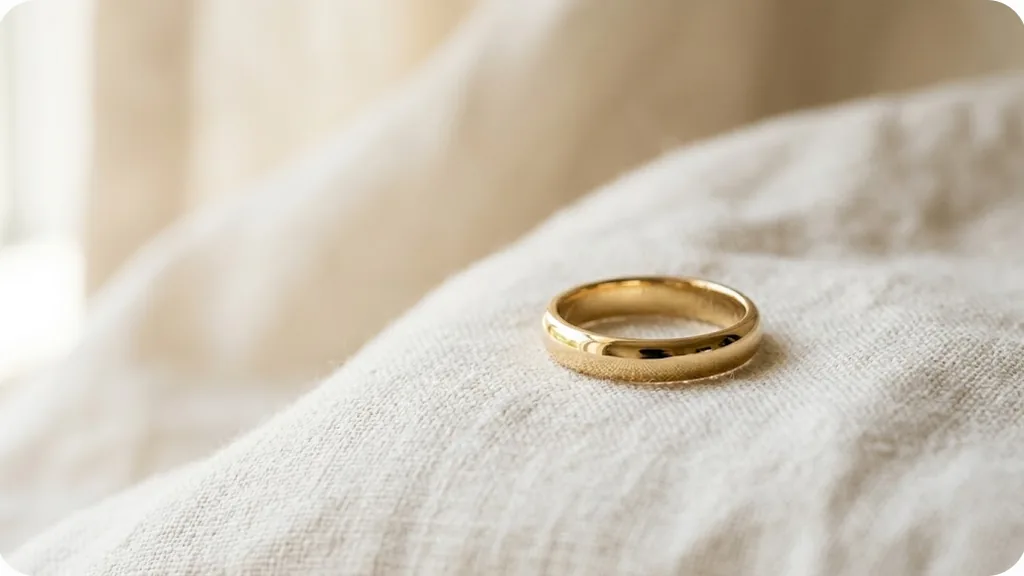
“Wedding ring” sounds like one specific object. It is not. It is a job description — a ring that marks a marriage — and an enormous range of designs do that job. Understanding the main types makes shopping far quicker, because you can rule out three quarters of what is out there in about five minutes.
This guide walks through the types by shape and construction, then by metal, then answers the question underneath all of it: can a wedding ring be any ring you like?
The main types of wedding ring by design
Plain bands
A smooth band of metal, no stones. The oldest and still the most worn design in the world. Plain bands come in different profiles — the cross-section shape you would see if you cut the ring in half:
- Court — curved on both the outside and the inside. The most comfortable and the most popular in Britain.
- D-shape — flat inside, rounded outside. Slightly more traditional look.
- Flat — flat inside and out, with square edges. Modern and architectural.
- Flat court — flat outside, curved inside. Modern look, comfortable fit.
If you only remember one thing about profiles: a curved inside edge is far more comfortable for daily wear. It is the single most useful piece of advice in this whole article.
Diamond-set bands
Stones set into the band itself. These are described by how far round the stones go:
| Type | Stones cover | Can be resized? | Notes |
|---|---|---|---|
| Half eternity | Front half of the ring | Yes, usually | Most practical; plain metal sits against the palm |
| Three-quarter eternity | About 75% of the ring | Sometimes, a little | Looks fully set from every normal viewing angle |
| Full eternity | All the way round | No | Buy the size very carefully; cannot be engraved |
The setting style matters as much as the coverage. Pavé means many small stones held by tiny beads of metal, giving a continuous sparkle. Channel means stones sunk into a groove between two walls of metal — very protected, very durable. Bezel means each stone is surrounded by a rim of metal, which is the toughest setting of all and excellent for anyone rough on jewellery. The Bezel Rose Cut Eternity Band in Sterling Silver shows what that looks like in practice.
Shaped and curved bands
Bands that are not a simple circle. A curved or contoured band dips to fit around an engagement ring so the two sit flush. A chevron or V-shaped band comes to a point, which suits pear and marquise engagement rings. The Chevron Marquise Cut Wedding Band is a good example. These exist to solve the gap problem, and they solve it completely.
Patterned and textured bands
Milgrain (a fine beaded edge), hammered finishes, engraved patterns, twisted or rope designs, and wave shapes such as the Ocean Wave Round Cut Wedding Band in Yellow Gold. Texture hides scratches, which is a genuine practical advantage on a ring you never take off.
Stacking bands
Deliberately narrow bands — often 1.5 to 2 mm — designed to be worn several at a time, sometimes in mixed metals. Couples increasingly buy two or three and add another at anniversaries.
Two-tone and mixed-metal bands
Two colours of metal in one ring, such as a white gold band with a yellow gold rail. Useful if your engagement ring is one metal and you prefer another, because it ties the two together.
Bridal sets
An engagement ring and a matching band sold as a pair, designed to fit each other exactly. Worth considering if you want a guaranteed flush fit — see the bridal sets collection.
Eternity rings and anniversary bands
Strictly these are not wedding rings, but they get worn in the same stack and shop in the same category. Traditionally given at a milestone rather than at the wedding itself.
The main types by metal
Metal changes the price, the colour, the durability and how often the ring needs attention.
| Metal | Colour | Durability | Upkeep |
|---|---|---|---|
| Platinum | Naturally white, stays white | Very high density; develops a soft patina | Occasional polish if you dislike patina |
| 18ct white gold | White, but rhodium-plated | High | Re-plating every few years to keep it bright |
| 18ct yellow gold | Rich warm yellow | High; softer than 9ct | Low; polish occasionally |
| 9ct gold | Paler yellow | Harder but more brittle | Low |
| Rose gold | Warm pink | High; copper content makes it hard | Low; colour does not fade |
| Sterling silver | Bright white | Soft; scratches easily | Tarnishes; needs regular cleaning |
One correction worth making, because it is misunderstood constantly: higher carat gold is softer, not stronger. 18ct gold contains more pure gold than 9ct, which makes it richer in colour and more valuable, but also more easily marked. 9ct is harder yet more brittle. Neither is “better” — they are different trade-offs.
You will also see titanium, tungsten carbide, cobalt and ceramic sold as wedding bands. They are inexpensive and very scratch-resistant. The catch is that most cannot be resized, and tungsten in particular cannot be cut off in the usual way in a medical emergency — it has to be cracked with a specialist tool. We do not stock these; we work in solid gold, platinum and sterling silver only.
Can a wedding ring be any ring?
Legally and practically, yes. There is no rule in UK law, and no religious requirement in most ceremonies, that a wedding ring must be a particular shape, metal, or price. A wedding ring is whatever the two of you exchange and agree is the wedding ring.
People do all sorts of things: a grandmother’s ring, a signet ring, a ring with a coloured gemstone instead of a diamond, a plain silver band bought for very little, matching tattoos instead of rings, or no ring at all.
So the honest answer is that any ring can be a wedding ring. But there are four practical reasons why certain designs became standard, and they are worth knowing before you disregard them.
- It has to survive daily wear. This ring goes on and stays on — through washing up, gym sessions, cold weather, hand cream. A delicate cocktail ring is not built for twelve hours a day, seven days a week, for decades.
- It has to be comfortable next to another ring. If it sits alongside an engagement ring, its edges will rub against it. Sharp edges on a hard metal will wear a groove into a softer neighbour.
- It should be resizable. Fingers change over a lifetime — pregnancy, weight, age, arthritis, hot weather. A ring that cannot be resized commits you to today’s finger.
- It has to come off in an emergency. A&E staff cut rings off swollen or injured fingers routinely. Gold, platinum and silver cut easily. Some hard modern materials do not.
If your chosen ring passes those four tests, wear it with total confidence. If it fails one, you can still wear it — just know what you are choosing.
Which type suits which hand and lifestyle?
- Manual work, sport, childcare — plain court band, or bezel-set stones. Nothing raised, nothing to catch.
- Slim fingers — narrower bands, 2 to 3 mm, or a stack of two thin bands rather than one wide one.
- Broad or long fingers — wider bands, 4 to 6 mm, otherwise the ring can look lost.
- Wearing it alongside a statement engagement ring — keep the band simple, or match it deliberately as a set.
- Wearing it alone — this is where a diamond-set or patterned band earns its keep, because it has to carry the finger by itself. Something like the Stackable Baguette Cut Half Eternity Band works well worn solo.
Frequently asked questions
Do the two rings in a couple have to match?
No. Matching pairs are traditional and look lovely in photographs, but plenty of couples pick completely different rings because their hands, jobs and tastes are completely different. A shared metal is often enough to make two different designs feel like a pair.
What width should I choose?
Most women’s bands in the UK sit between 2 and 4 mm; most men’s between 4 and 6 mm. But this is a matter of proportion, not gender. Try widths on before committing — the difference between 3 and 4 mm looks small on paper and obvious on a finger.
Are diamond-set bands practical for everyday wear?
Half and three-quarter eternity bands, yes — the plain metal section sits against your palm where the wear happens. Full eternity bands take more punishment, and pavé settings occasionally need a stone re-tightened. Have any set band checked every couple of years.
Do you sell titanium or tungsten rings?
No. We make in solid gold, platinum and sterling silver, all hand-made with lab-grown diamonds. If you want a hard alternative metal you will need a different supplier — we would rather say so than sell you something we do not make.
Can you make a type you do not stock?
Usually yes. We design bespoke at no extra design cost, so if you want a profile, width, pattern or stone layout that is not in the collection, that is a conversation rather than a problem.
Where to start
If you are at the very beginning, narrow it down in this order: metal, then width, then plain or set, then profile. Four decisions and you are done.
Have a look through the wedding ring collection to see the types side by side. Everything is hand-made in solid gold, platinum or sterling silver, with lab-grown diamonds and a free IGI certificate on centre stones, free insured UK delivery and 30 days to return. Prices on the product pages are correct at the time of writing.
More guides on this topic
Ready to find your perfect ring?
Explore our lab-grown diamond collection or book a virtual appointment with our team.