What Is the Average Carat Size for a Wedding Ring?
There is no official average carat size for a wedding ring. What carat really means, what each weight looks like on the hand, and how to choose.
Almost every couple who walks into our North Harrow workshop asks some version of the same question: “Is this too small?” It usually comes about ten minutes after they have fallen in love with a ring. Carat size is the number people cling to because it feels objective, and because it is the one thing friends and family will ask about afterwards.
So let us answer it honestly. There is no official register of what everyone buys, and anyone quoting you a precise national average is guessing. What we can give you is something more useful: what carat weight actually means, what different weights look like on a real hand, and how to choose a wedding ring you will still be happy wearing in twenty years.
Carat is a weight, not a size
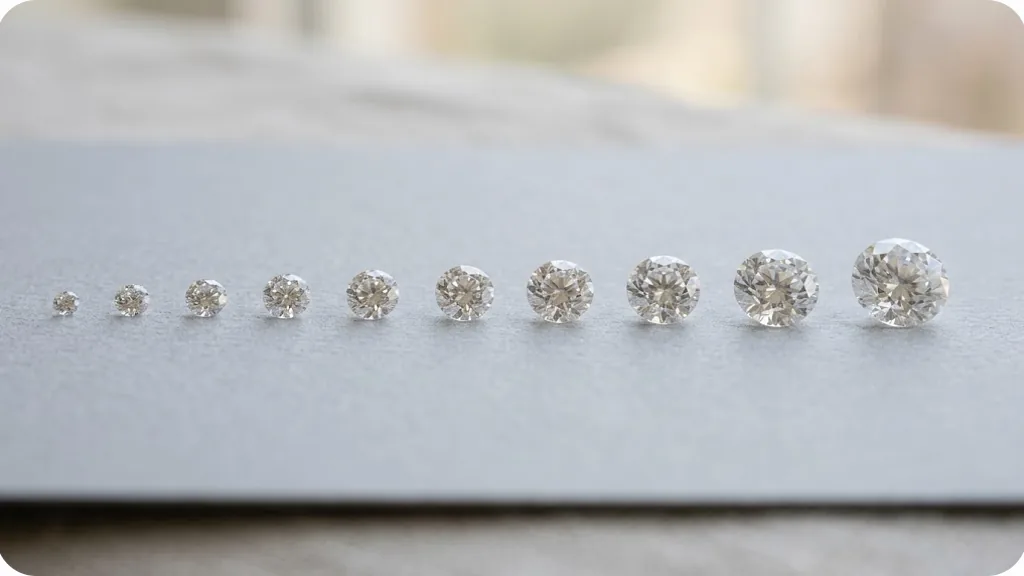
This trips up nearly everyone. A carat (ct) is a unit of weight, not width. One carat equals 0.2 grams. It is written as a decimal, so 0.50ct is half a carat and 0.25ct is a quarter.
Two diamonds of the same carat weight can look noticeably different in size. A shallow-cut stone spreads wider and looks bigger from above. A deep-cut stone hides more of its weight underneath, where nobody sees it. This is why cut quality matters as much as the number on the certificate.
You will also see two different carat figures quoted:
- Centre stone carat — the weight of the single main diamond. This is the number normally quoted for engagement rings.
- Total carat weight (TCW or CTW) — every diamond on the ring added together. This is the number normally quoted for wedding bands, because a band usually holds many small stones rather than one big one.
Comparing a 0.75ct centre stone with a 0.75ct total weight is comparing apples with oranges. One is a single, obvious diamond. The other might be eighteen tiny ones.
Wedding rings and engagement rings do different jobs
An engagement ring is designed to be looked at. A wedding ring is designed to be lived in. It goes on at the ceremony and, for most people, comes off far less often than the engagement ring does.
That difference shapes everything. Wedding bands tend to be lower, flatter and set with smaller stones, because a tall setting catches on jumpers, gloves and car doors. If you are also wearing an engagement ring next to it, the band needs to sit flush against it rather than fight it for height.
Plenty of wedding rings have no diamonds at all, and that is a perfectly traditional choice, not a compromise.
What different carat weights actually look like
Here is a general guide to how total carat weight reads on a wedding band. Treat these as guidance rather than fixed rules, because setting style and finger size both change the effect.
| Total carat weight | Individual stones are roughly | How it reads on the hand | Suits |
|---|---|---|---|
| None (plain band) | — | Clean, quiet, timeless | Manual work, minimal taste, tight budgets |
| 0.10ct – 0.25ct | 1.0–1.5mm | A soft line of light; sparkle you notice up close | Sitting beside a bold engagement ring |
| 0.25ct – 0.50ct | 1.5–2.0mm | Clearly a diamond band from across a table | The most common all-round choice |
| 0.50ct – 1.00ct | 2.0–2.7mm | Confident and bright; a statement in its own right | Worn alone, or as an anniversary upgrade |
| 1.00ct and above | 2.7mm+ | Full eternity look; heavy sparkle | Standalone bands, milestone gifts |
If you are matching a band to an existing engagement ring, the usual advice is to keep the band’s stones smaller than the centre stone. The band supports the ring; it should not compete with it.
Your finger size changes the answer
This is the part nobody mentions. The same 0.50ct band looks generous on a UK size J finger and modest on a size R. If you have slim fingers, a narrower band with smaller stones will look better proportioned and more elegant. If you have broader fingers or longer hands, a wider band carries more carat weight comfortably and can actually look under-scaled if you go too delicate.
Band width matters too. Most women’s wedding bands sit between 1.8mm and 3mm wide. Most men’s sit between 4mm and 7mm. A wider band needs more stone to look balanced.
Three things that beat carat weight
1. Cut. A well-cut smaller diamond outshines a badly cut larger one every time. Light has to bounce back out of the stone to reach your eye, and that is the cutter’s job, not the carat’s.
2. Setting style. A pavé setting (rows of tiny diamonds held by small beads of metal, pronounced “pah-vay”) makes a band look continuously lit. A bezel setting (a rim of metal wrapping the stone’s edge) looks more solid and modern, and protects the stone better.
3. How much of the band is set. A half eternity band has stones across the top half only. A three-quarter eternity carries them further round. A full eternity goes the whole way. A half eternity gives you the same view from above as a full eternity for a fraction of the carat weight, and it can be resized, which a full eternity generally cannot.
What this costs in practice
Because we make with lab-grown diamonds, the carat weight you can afford is genuinely higher than it would be with a mined stone of the same grade. Lab-grown diamonds are real diamonds, chemically and optically identical to mined ones, grown in a laboratory instead of dug out of the ground.
Some real examples from our current collection, correct at the time of writing:
| Ring | Style | Price |
|---|---|---|
| Minimalist Round Cut Wedding Band | Slim, understated, sits flush beside anything | £687 |
| Stackable Baguette Cut Half Eternity Band | Baguette stones (long rectangles) for a clean architectural line | £672 |
| Stackable Round Cut Three Quarter Eternity Band | Sparkle further round the finger without full-eternity cost | £762 |
Every centre stone comes with a free IGI certificate, so the carat weight you are told is the carat weight you own. You can browse the full range in our wedding rings collection, or filter to round cut designs if you want the classic look.
How to decide without agonising
Try this order. First, set a total budget for the band. Second, decide the width that suits your hand and your daily life. Third, choose the setting style you like the look of. Only then look at carat weight, and spend whatever is left on the best cut you can get.
Buying in the other direction — picking a carat number first and working backwards — is how people end up with a large, dull ring.
Frequently asked questions
Is there a standard carat size for a wedding ring?
No. There is no standard and no requirement. Diamond wedding bands commonly fall somewhere between 0.15ct and 0.75ct total weight, but plain bands with no diamonds at all remain extremely popular and always will be.
Should my wedding band have a bigger carat weight than my engagement ring?
Usually not. The engagement ring is normally the focal point and the band frames it. That said, if you wear the band alone on some days, or you want it to work as a standalone anniversary ring, going bolder is a legitimate choice.
Do lab-grown diamonds come in the same carat weights as mined ones?
Yes, exactly the same. They are graded on the same scale by the same laboratories. The practical difference is that your budget stretches to a larger or better-cut stone.
Can I add carat weight to my wedding ring later?
Sometimes, depending on the design. A more reliable route is to add a second band alongside the original for a milestone anniversary. We can design that to match at no extra design cost.
Will a heavier carat weight make the ring uncomfortable?
Not on its own. Comfort comes from the profile of the band — how the inside is shaped against your finger — and from how high the stones sit. Ask for a comfort fit, which means the inside edge is gently domed rather than flat, so it slides on more easily and feels softer against the skin.
If you are still stuck between two carat weights, the honest answer is that you will stop noticing the difference within a month of wearing it, but you will notice a poor cut every single day. Come and see them side by side if you can, or drop us a message and we will talk it through properly.
More guides on this topic
Ready to find your perfect ring?
Explore our lab-grown diamond collection or book a virtual appointment with our team.