
How to Take Care of Your Diamond Engagement Ring
When to take your ring off, how to clean it safely at home, storage, insurance and the annual claw check that saves stones.
A diamond engagement ring is worn every day, on the hand you use for everything. It goes into washing-up water, hand cream, gym equipment and car doors. Looking after it properly is not complicated, but it does need a routine — and there are a handful of things that genuinely damage rings that most people have never been told.
What is the single most important habit?
Take the ring off before you do anything with your hands, and always put it in the same place.
That second half matters more than the first. Most rings are not damaged — they are lost, and they are lost because they were put down somewhere unusual. A small dish by the kitchen sink and another by the bathroom basin will prevent more heartache than any amount of polishing.
Never take a ring off and put it in a pocket, a handbag, a tissue, or on the edge of a sink. Those four habits account for a very large share of lost rings.
When should you take your engagement ring off?
| Activity | Take it off? | Why |
|---|---|---|
| Gym, weights, climbing | Always | Bars and holds bend shanks and loosen claws |
| Gardening and DIY | Always | Grit scratches metal, knocks chip stones |
| Swimming pools and hot tubs | Always | Chlorine attacks the alloys in gold over time |
| Sea swimming | Always | Cold water shrinks fingers — rings slip off |
| Bleach and oven cleaner | Always | Harsh chemicals damage gold alloys and platinum finishes |
| Applying hand cream, fake tan, sunscreen | Yes | These are the main cause of a dull-looking diamond |
| Washing up | Preferably | Grease film builds under the stone; risk of the plughole |
| Showering | Optional | Soap film dulls the stone but does no lasting harm |
| Sleeping | Optional | Bedding snags claws over time; fine if the setting is low |
How do you clean a diamond engagement ring at home?
Diamonds attract grease. That is a genuine property of the material, not a myth — oil clings to a diamond’s surface, and a film of hand cream and skin oil is why a ring stops sparkling. The good news is that it takes five minutes to fix.
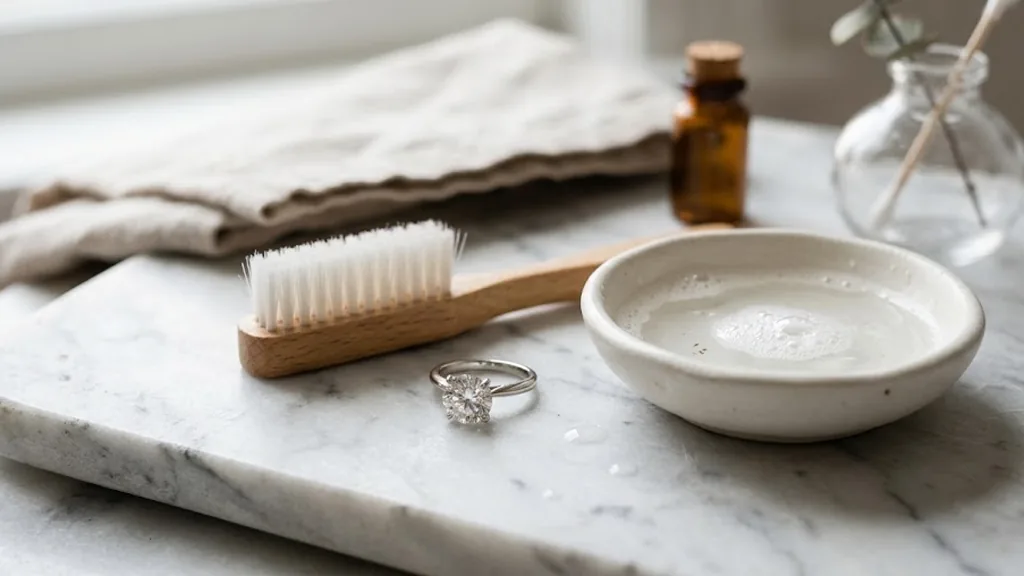
- Fill a small bowl with warm — not hot — water and add a drop of ordinary washing-up liquid.
- Soak the ring for ten to fifteen minutes.
- Brush it gently with a soft baby toothbrush, paying most attention to the underside of the stone. That is where the film sits and where the light gets in.
- Rinse in a bowl of clean water rather than under a running tap, so there is no chance of losing it down the plughole.
- Pat dry with a soft lint-free cloth. Do not use kitchen roll, which is abrasive.
Do this every week or two if you wear the ring daily. It is the difference between a ring that looks alive and one that looks tired.
What not to use
- Toothpaste. It is mildly abrasive and will scratch gold and platinum.
- Bicarbonate of soda. Same problem.
- Bleach or chlorine. Damages the alloys mixed with gold and can cause the metal to become brittle.
- Ammonia-based window cleaner. Fine on a plain diamond, but harmful to any coloured gemstones and to pearls if you have them in the same ring.
- Ultrasonic cleaners at home. Excellent on a sound diamond ring, but they will shake a loose stone out of its setting and can worsen an existing fracture. Have the ring checked before you ever put it in one.
How often should an engagement ring be checked by a jeweller?
Once a year, have the ring inspected by a jeweller. It takes minutes and it is the cheapest insurance there is. They will look under magnification for:
- Loose claws. The most common problem by far. A claw that has worn thin or lifted will eventually release the stone.
- Worn shank. The underside of the band thins over years of wear and can eventually crack.
- Chips on the girdle. The edge of the stone. Small chips are repairable if caught early.
- Wear on the setting. Especially on rings worn alongside another ring, where metal rubs metal.
If you can lift the stone slightly with a fingernail, or if the ring rattles when you hold it to your ear and tap it, stop wearing it and get it seen immediately.
How should you store a diamond ring?
Diamond is the hardest material there is, which means a diamond will scratch every other gemstone and every metal in your jewellery box — including other diamonds. Store rings separately, in individual soft pouches or in a box with divided compartments.
Keep the box somewhere with stable temperature and away from direct sunlight, which can fade the lining and, over many years, affect some coloured stones.
Does home insurance cover an engagement ring?
Check whether your home contents policy covers jewellery away from the home — many do not, or only up to a low single-item limit. If the ring is worth more than that limit, it needs to be listed specifically. Keep the receipt, the IGI certificate and a clear photograph together in one place, ideally scanned as well as on paper.
Every centre stone we sell comes with a free IGI certificate, which is exactly the document an insurer will ask for.
How does ring care differ by metal?
White gold is yellow gold mixed with white metals and then plated with rhodium to make it bright white. That plating wears off over time, usually starting on the underside of the band, and the ring begins to look faintly yellow. Replating is a routine job and typically wanted every one to three years depending on how hard you are on the ring.
Platinum does not need plating. It develops a soft matte surface with wear, called a patina, which many people like. If you prefer it bright, a jeweller can polish it. Platinum is denser and holds stones very securely, which is why we use it for settings that need to take a knock — the Bezel Cushion Cut Engagement Ring in Platinum is about as robust as an engagement ring gets.
Yellow and rose gold need no plating and simply want cleaning and the occasional polish. Rose gold contains copper, which is what gives it the colour; it is a slightly harder alloy and wears well.
What if you work with your hands?
Nurses, chefs, hairdressers, mechanics, gardeners, climbers, new parents — a high-set claw ring is a difficult daily companion. Two solutions work well.
The first is a bezel or low-profile setting, where the stone sits close to the finger and is protected by metal all the way round. The second is to wear a plain band for work and the engagement ring the rest of the time. There is nothing sentimental lost in doing that, and it will keep the ring in far better condition. A Minimalist Round Cut Wedding Band at £687 at the time of writing is a practical option for exactly this.
Frequently asked questions
Can I wear my engagement ring in the shower?
You can, and it will not damage the ring, but soap builds a film that dulls the diamond. If you shower with it on, clean it more often.
Will hand sanitiser damage my ring?
Alcohol-based sanitiser will not harm gold, platinum or a diamond. It does leave a residue that dries dull, particularly around the claws. Rinse the ring occasionally if you use sanitiser frequently.
How often should the ring be professionally cleaned?
Once a year is plenty for most people, at the same visit as the setting check. Home cleaning between visits does most of the work.
My diamond looks cloudy. Is it damaged?
Almost certainly not. In the overwhelming majority of cases it is a film of oil and soap. Clean it properly with the method above and see. If it still looks cloudy after a thorough clean, have it looked at.
Does a lab-grown diamond need different care?
No. A lab-grown diamond is the same material with the same hardness as a mined one, so the care is identical.
Where can you buy a ring or have one looked after?
If you are still choosing, our engagement ring collection and wedding ring collection are hand-made in North Harrow in solid gold and platinum, with free insured UK delivery and 30-day returns. If you already own a ring that needs resetting or repairing, we take that work on too.
Ready to find your perfect ring?
Explore our lab-grown diamond collection or book a virtual appointment with our team.











