How to Wear a Pear Shaped Ring With a Wedding Band
Which way the point faces, which ring goes first, how to stop spinning and close the gap when wearing a pear ring with a band.
You have the pear shaped engagement ring. Now you need to live with it alongside a wedding band, every day, for decades. Which way up does it go? Which ring sits underneath? Why does it keep turning round your finger, and what do you do about the gap under the point?
These are the questions people ask us after the proposal rather than before it, and they are rarely covered anywhere. Here are straight answers.
Which way should the point face?
There is no rule, but there is a convention and there is a reason behind it.
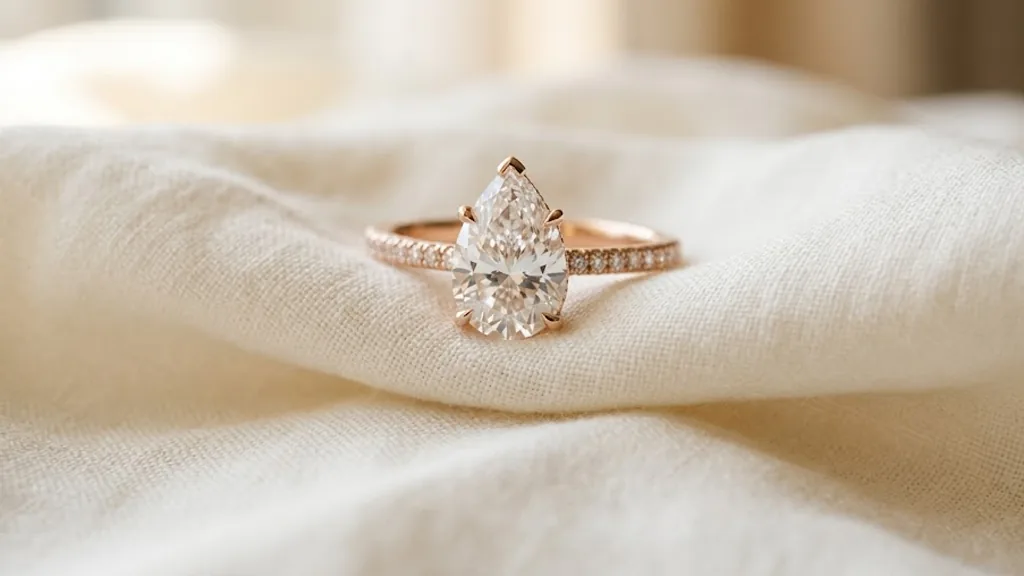
Most people wear a pear with the point facing towards the fingernail. This draws the eye up the finger and makes the hand look longer and slimmer. It also keeps the tip of the stone away from the knuckle, where it would be knocked most often.
Wearing the point towards the knuckle is a deliberate, slightly more modern look. It puts the widest part of the stone nearest your nail, which reads bolder.
Whichever you choose, decide before you buy the wedding band, because it changes which end of the stone the band has to sit against.
Which ring goes on first?
Tradition says the wedding band goes on the finger first, closest to the heart, with the engagement ring stacked above it. That is where the custom comes from, and most people follow it.
Practically, it also works well with a pear. If the point faces your nail, the wedding band meets the rounded base of the stone, which is easier to fit against than a tip.
If you prefer the wedding band on top, nothing terrible happens. Some people do it so the engagement ring is less exposed to knocks. It is entirely your choice.
Dealing with the gap
The gap is the single most common complaint about wearing a pear with a band. A flat band cannot follow the curve of the stone, so a small wedge of daylight shows between the two rings.
You have four options.
- Accept it. A small gap is normal and most people stop noticing within a week.
- Use a curved or chevron band. A shaped band nests against the stone and closes the gap. The Chevron Pear Cut Wedding Band in Rose Gold does this with a V that mirrors the point of the diamond.
- Buy them as a set. A bridal set is designed as a pair, so the fit is settled in the workshop. The Curved Pear Cut Bridal Set and the Teardrop Pear Cut Bridal Set in Rose Gold are both made to sit flush.
- Have the two rings soldered together. A jeweller joins them permanently. No gap, no rocking, no spinning. The trade-off is that you can never wear them separately, and resizing becomes a bigger job.
Why your pear ring spins, and how to stop it
A pear engagement ring is top-heavy. The stone and setting weigh more than the thin band underneath, so gravity slowly turns the ring until the diamond sits under your finger. It is not a fault, and it happens to nearly everyone.
Things that help, roughly in order of how easy they are:
- Wear a wedding band beneath it. The second ring acts as a brace and stops the rotation. This alone fixes most cases.
- Wear a band either side. Two slim bands hold the engagement ring upright completely.
- Check the size. Fingers change size with heat, salt, exercise and time. A ring that fits in December can be loose in July. Have it checked rather than assuming.
- Ask for sizing beads. A jeweller adds two small beads of metal inside the bottom of the shank. They grip below the knuckle and stop the ring turning, without changing how easily it goes on.
- Solder the rings together. The permanent solution.
Stacking a pear ring well
Pears stack beautifully because the curved outline leaves room for other rings to tuck in. A few combinations that work:
| Look | What to wear | Effect |
|---|---|---|
| Classic | Pear solitaire plus one curved band below | Neat, balanced, the stone stays the focus |
| Framed | Two slim bands, one either side | Symmetrical, and the ring cannot spin |
| Layered | Pear ring, curved band, plus a thin plain band | More presence without a wider ring |
| Mixed metal | White gold ring with a rose gold band | Deliberate contrast, warm against cool |
| Sideways | Pear worn east-west, with a straight band | Unusual, and a straight band suddenly fits |
If you like the stacked look but do not want a large centre stone, a slimmer ring such as the Stackable Pear Cut Engagement Ring is designed to sit in a group rather than dominate it.
Protecting the point
The tip of a pear is the thinnest part of the stone, so it is where damage happens if damage happens at all. Diamond is the hardest material used in jewellery, but hardness resists scratching, not impact.
Three habits that make a real difference:
- Take the rings off before the gym, gardening, and heavy lifting. A sharp knock on a door frame is the usual culprit, not daily wear.
- Check the claw over the tip once a year. Most settings use a V-shaped claw that wraps the point. If it lifts or loosens, the stone is exposed.
- Do not let the wedding band press against the point. If your band touches the tip, change the band rather than living with it.
Everyday care for two rings on one finger
Rings worn together rub against each other constantly. That contact, plus grit and hand cream, is what wears metal down over years.
Clean them once a fortnight in warm water with a drop of washing-up liquid and a soft toothbrush, paying attention to the underside of the stone where oils collect. A pear shows dullness faster than a round diamond because the point catches light so directly.
Remove both rings before applying hand cream, sun cream or fake tan. Cream collects underneath the setting and dulls the stone within days.
Have the claws checked every twelve months. It takes a jeweller two minutes and it is the cheapest insurance there is.
If you want both rings to match perfectly
The tidiest way to wear a pear with a band is to have the band made for the ring you already own. We design bespoke pieces at no extra design cost from our workshop in North Harrow, London, so you pay for metal and diamonds rather than the design work.
All our diamonds are lab-grown, every centre stone comes with a free IGI certificate, and each ring is hand-made in solid gold or platinum. UK delivery is free and insured, and you have 30 days to return anything that does not sit the way you hoped.
Frequently asked questions
Can I wear my pear ring on my right hand?
Yes. Plenty of people move the engagement ring to the right hand after the wedding and wear the band alone on the left. It also solves any fitting problem instantly, because the two rings never meet.
Does the wedding band have to be the same metal?
No, but matching metals wear evenly and keep the same colour over time. If you mix, mix on purpose and repeat the second metal somewhere else in the pairing so it looks intentional.
Should I resize my engagement ring once I add a band?
Not usually. Two rings do not make your finger bigger. If the pair feels tight, it is more likely the total width, so a narrower band is the first thing to try.
How do I stop the two rings scratching each other?
A spacer band, which is a very thin plain ring worn between them, keeps the metal apart. Soldering them together also works. Some wear is inevitable and is simply the record of a ring being worn.
Can I wear an eternity band with a pear engagement ring?
Yes, though a straight eternity band will leave a gap under the point unless the setting is high. A half eternity worn on the other side of the engagement ring avoids the problem completely.
More from this series
- What Wedding Band Goes With a Pear Shaped Engagement Ring? — choosing the band itself
- What Wedding Band Goes With an Emerald Cut Engagement Ring?
- What Wedding Band Goes With an Oval Engagement Ring?
- What Wedding Band Goes With a Marquise Engagement Ring?
Browse our pear shaped rings, the matched bridal sets, or the full wedding ring collection. If you would like advice on your own ring, send us a photograph and we will help.
More guides on this topic
Ready to find your perfect ring?
Explore our lab-grown diamond collection or book a virtual appointment with our team.