Should Promise Rings Match?
Whether matching promise rings are necessary, four levels of matching, and why engraving does more than shape.
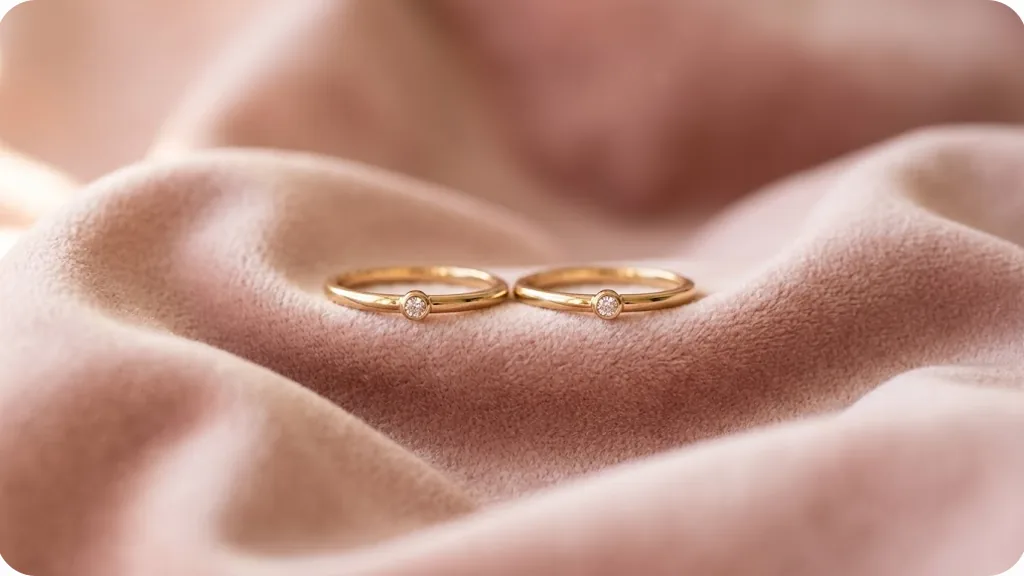
They do not have to. Matching promise rings are a lovely idea and plenty of couples choose them, but there is no tradition or etiquette requiring it — and forcing a match is the most reliable way to end up with one person wearing a ring they do not like.
The better question is not “should they match?” but “how closely?” There is a whole range between identical and unrelated, and the middle of that range is usually where the good answers live.
Four levels of matching
| Level | What it looks like | Best for |
|---|---|---|
| Identical | The same design, same metal, same width — just different sizes. | Couples who want the rings read as a pair instantly. Works best with plain or simple bands. |
| Same design, different scale | Same style, but wider or heavier on one hand and slimmer on the other. | Most couples. Keeps the connection while suiting two different hands. |
| Same metal only | Two completely different designs, both in the same gold or platinum. | Couples with genuinely different taste. Surprisingly effective — metal colour does most of the visual work. |
| Linked by a detail | Different rings, joined by a shared engraving, date, stone or finish. | People who want the meaning shared but the ring personal. Our favourite of the four. |
Why identical often disappoints
Two hands are rarely alike. A ring that looks elegant at 2 mm on a slim finger can look lost at the same width on a broad one. A 5 mm band that sits well on a large hand can swamp a small one.
There is also the practical side. Whoever has the more physical job will scratch, knock and remove their ring more often. Identical polished bands will not stay identical for long — one will hold its shine and the other will not.
If you want identical rings, plain bands with a brushed or matte finish age together far better than high-polish ones.
The detail that actually makes two rings a pair
If you take one thing from this article: engraving matters more than shape.
Two entirely different rings with the same date, the same initials, or the same short phrase inside are unmistakably a pair to the only two people who need to know. This is an old idea — sixteenth and seventeenth century posy rings carried a line of verse hidden inside the band, against the skin.
Keep engravings short. On a slim band you have room for roughly fifteen to twenty characters comfortably. A date is almost always the safest choice, because it never stops being true.
Metal: the one thing worth agreeing on
If you want the rings to feel connected without matching the designs, match the metal colour. Two yellow gold rings read as a set even when the designs are nothing alike. A yellow gold ring beside a white gold one does not.
A few practical notes:
- Yellow gold is warm and forgiving, and shows scratches least.
- White gold is plated with rhodium to give it its bright white finish. That plating wears and needs redoing every few years — budget for it on both rings, not just one.
- Rose gold is copper-rich, which makes it slightly harder and gives it a warm pink tone. It does not tarnish.
- Platinum is denser and heavier, and does not need replating. It scratches into a soft grey sheen rather than wearing away.
- Sterling silver is the most affordable, but it is soft and will need occasional polishing.
Mixing metals across two rings is not a mistake, but it is a choice — make it deliberately rather than by accident.
What to look at if you want a matched pair
Simple bands match most easily, because there is less to reconcile between two hands. Prices below are correct at the time of writing.
- The Minimalist Round Cut Wedding Band (£687) — clean and low profile, and the easiest of ours to wear in two different sizes without looking odd on either hand.
- The Stackable Rose Cut Wedding Band in Sterling Silver (£489) — our most affordable band, which matters when you are buying two rather than one.
- The Twisted Round Cut Half Eternity Band (£657) — a bit more detail, and the twist gives a pair a shared visual signature.
Browse the full band collection to compare, or the ring collection if one of you wants a stone.
And because matching pairs are one of the most common bespoke requests we get, it is worth saying plainly: we design bespoke at no extra design cost. Two bands in the same metal, cut to different widths, with the same engraving inside, is a straightforward thing for us to make and often costs no more than buying two ready-made rings.
What if one of you already has a ring?
This happens often — one person gives a ring, the other decides months later that they want one too. Matching after the fact is harder, but it is not a problem.
Take a clear photograph of the existing ring in daylight, and if you can, find out the metal and carat. Then bring both pieces of information to whoever is making the second ring. Matching 18ct yellow gold to 18ct yellow gold is straightforward. Matching an unmarked ring of unknown origin is guesswork, and honest jewellers will tell you so rather than promise a perfect match.
If an exact match proves impossible, do not chase it. Two rings that nearly match look like a failed attempt; two rings that are clearly different look deliberate. Shift to matching the engraving instead, which nobody can see and nobody can get wrong.
If only one of you wants a ring
That is fine, and more common than you would think. Some people cannot wear rings at work; some simply do not like jewellery. A ring on a chain, or no ring at all on one side, does not weaken anything. The promise is between two people, not between two pieces of metal.
Where matched rings go on the hand
If you are wearing them as a pair, the tidiest approach is to agree on the same hand and finger as each other — most commonly the right ring finger in the UK, which keeps the left hand free for an engagement ring later. Our guide to which hand and finger a promise ring goes on covers the alternatives.
Frequently asked questions
Should promise rings match?
Only if you both want them to. There is no tradition requiring it. Matching the metal, or matching the engraving inside, achieves most of the effect without forcing either of you into a design you would not choose.
Do couples usually buy both rings at the same time?
Usually, yes, because it is easier to match metals and finishes in one go. But there is nothing wrong with one person giving a ring first and the other reciprocating later.
Can matching rings be different widths?
Yes, and they generally should be. A wider band on a larger hand and a slimmer one on a smaller hand look far more like a considered pair than two identical widths do.
Can we match a plain band to a ring with stones?
Yes. Match the metal and, if you can, the finish. A plain band beside a small stone-set band in the same gold reads as a set very naturally.
What should we engrave?
A shared date, both sets of initials, or a short phrase that means something specific to you. Avoid anything that would need explaining in five years’ time.
What if we split up — is a matching pair harder?
A little, emotionally. Practically, a plain band in solid gold or platinum can be reset, re-engraved or traded against something else, which is another argument for choosing real metal over plated fashion jewellery.
If you are weighing up a pair, have a browse and then tell us what you are picturing. We are a small lab-grown diamond jeweller in North Harrow, and matching rings are one of the nicest things we get asked to make.
Ready to find your perfect ring?
Explore our lab-grown diamond collection or book a virtual appointment with our team.